|
Blix
Calls for Council Unity, Says Iraq Must Be Aware of Consequences
 |
|
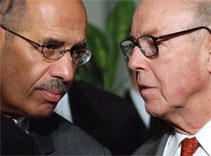
Blix, right, and El-Baradei
|
UNITED
NATIONS, October 28 (IslamOnline & News Agencies) - The chief UN
arms inspector, Hans Blix, urged a divided UN Security Council Monday,
October 28, to adopt a unified resolution to give full support to the
team he intends to send to Iraq.
While
Blix avoided taking sides in the debate between the United States and
its opponents in the Council, he said it would be helpful to warn Iraq
that there would be consequences if it failed to cooperate, reported
Agence France-Presse (AFP).
France
and Russia have opposed wording in a U.S. draft which would declare
Iraq "in material breach" of previous resolutions and warn
that it already faced "serious consequences" for failing to
comply.
"We
stressed the importance of having agreement and broad unity in the
Council," Blix told reporters as he emerged from a briefing with
the council which lasted almost three hours.
The
discussions, which also involved Mohammed El-Baradei, director general
of the International Atomic Energy Agency (IAEA), centered on U.S.
proposals to give the inspectors wider powers.
Blix
said the intention in the U.S. draft was to give "very clear
signals" to Iraq and to avoid the kind of "cat-and-mouse
play" that plagued inspectors between 1991 and 1998, when they
were withdrawn from Iraq.
"It
helps us if Iraq is conscious that non-cooperation will entail
reactions by the Council," he added.
However,
he rejected the suggestion that he and El-Baradei should have the last
word on whether to authorize the use of military force against Iraq.
"We
have seen it suggested that we hold peace and war in our hands,"
Blix said.
"We
decline that statement. Our job is to report, and the decision whether
there is war or peace or reaction, is for the Council and its
members," he said. "They are the highest organ in the UN
system."
France
distributed a heavily edited version of the U.S. draft Thursday,
October 24, in which the serious consequences would flow from a
decision by the Council, based on a report from the inspectors of
fresh violations by Iraq.
Pressed
by reporters to say whether Iraq was already in material breach of its
obligations, Blix said that was for the Council to decide.
"We
will report objectively. It will be for the council to determine
whether something is in material breach and it wants to give it
consequences," he said.
UN
Secretary General Kofi Annan, who was present for the first two hours
of the briefing, said Council members were engaged in "very
serious deliberations" and he hoped they would manage to bridge
their differences.
"It's
a grave matter, a question of war and peace, and I think it is
appropriate that the Council goes about it in a deliberate
manner," he said.
Ahead
of the meeting in New York, officials in the capitals of some key
Council members ratcheted up the pressure at the start of what is
expected to be make-or-break week in the council.
The
White House, meanwhile, said the United Nations must now vote on a
resolution.
"The
United Nations has debated this now long enough. The time has come for
people to raise their hand and cast their vote," President George
W. Bush's spokesman, Ari Fleischer, told reporters.
In
London, a spokesman for British Prime Minister Tony Blair also said
the time was close when a vote would have to be taken on the U.S.
draft, which would strengthen the inspectors' powers.
Britain
is alone among the four other permanent Council members in giving
wholehearted support to the U.S. draft resolution.
Blair's
spokesman noted that the permanent members had been discussing the
proposals since mid-September, and said that after addressing people's
concerns, "you come to a point where decisions have to be
made."
He
added, "I think we are at or near that point."
But
in Paris, French Foreign Minister Dominique de Villepin challenged the
bid by the United States to push through a resolution that would give
it a green light for military action in Iraq.
"There
can't be collective action and unilateral action at the same time. A
choice has to be made," he told reporters.
De
Villepin warned Saturday, October 26, that France, which already
distributed a text last week with extensive rewording of the U.S.
draft, would put forward its own proposal if no accord is reached.
The
two other permanent members, Russia and China, have sided with France.
While
the Big Five have been negotiating for several weeks, the 10
non-permanent members were not given the U.S. draft until last
Wednesday.
Few
diplomats in New York believe France, Russia or China would veto the
U.S.-British proposals, but the draft still needs nine 'yes' votes to
be adopted.
Diplomats
said the briefing by Blix and El-Baradei might sway two or three
member states and thus determine the success or failure of the draft.
Iraq,
meanwhile, urged the Security Council not to make any concessions to
the United States.
"The
United Nations faces a tough test," the ruling Baath Party daily Ath-Thawra
said.
"Either
it respects the charter and defends its authority by refusing to
submit to the will of one of it member states, or it turns into a
purely American body."
A
resolution "obtained by blackmail, pressure and threat ... will
have no legitimacy or credibility," Ath-Thawra added.
Iraq's
Deputy Prime Minister Tareq Aziz said his country was "ready to
thwart any aggression."
The
United States is "seeking to control oil and threaten the unity
and independence of this country to extend its hegemony over the
region and steal its resources," he charged, quoted by the state
news agency INA.
Meanwhile,
Arab League chief Amr Mussa said he was having urgent talks with
member states with the aim of convening a meeting of their Foreign
Ministers on the Iraq crisis and Israeli-Palestinian conflict within
the next two weeks.
Arab
countries have lined up in opposition to military action against
Baghdad.
They
include Saudi Arabia, which Monday hosted the chairman of the U.S.
joint chiefs of staff, General Richard B. Myers, for talks on the
regional situation.
|