|
Arabs
Urge Iraq to Accept UN Resolution That Averts War "for
Now"
 |
|
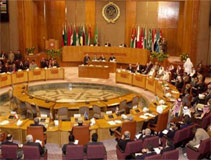
Arab
Leaque Foreign Ministers are seen during their meeting in
Cairo
|
CAIRO,
November 10 (IslamOnline & News Agencies) - Arab foreign ministers
resumed talks in Cairo Sunday, November 10, aimed at urging Iraq to
accept a stringent new UN disarmament resolution which the Syrian
minister said averted war only "for now."
Egyptian
Foreign Minister Ahmed Maher and Saudi Foreign Minister Saud al-Faisal
suggested, after a first round of talks ended overnight Saturday,
November 9, that Iraq was ready to accept the resolution, Agence
France-Presse (AFP) said.
Iraqi
Foreign Minister Naji Sabri and his counterparts from the 22-member Arab
League began a second day of talks after Sabri met separately with
Egyptian President Hosni Mubarak and Maher.
Maher
said the two sides discussed the resolution which offers a "chance
for a peaceful settlement" if Iraq agrees to its terms.
Such
a move would lead to a return later this month of the UN weapons
inspectors who left four years ago ahead of a four-day, U.S.-British
bombing attack.
In
defending Syria's decision to vote for the resolution in the Security
Council, Syrian Foreign Minister Faruq Shara said the measure averted
what would have been an immediate and inevitable strike.
Shara
said Syria, the only Arab country with a seat on the council, voted in
favor when it received assurances from France, Russia and the United
States that the resolution contained no hair trigger for military action
against Iraq.
"For
now, it is impossible to strike Iraq," Shara told reporters before
resuming talks with his Arab counterparts.
However,
Shara conceded, there are "points which are not very clear, some
details contain traps and ambiguities which can be negative."
"We
hope that our Iraqi brothers do not yield to American provocations from
now on, because the provocations are means which the United States is
counting on a lot to say Iraq has not respected UN resolutions," he
added.
The
resolution, adopted unanimously Friday, November 8, by the 15-member UN
Security Council, including Syria, warns Iraq of "serious
consequences" if Iraq fails to comply with its disarmament terms.
Iraq
has seven days to reply, and its state television said Sunday that
President Saddam Hussein had summoned an emergency session of parliament
to discuss the resolution.
Shara
also met with Sabri separately on Saturday, AFP said.
Sabri
emerged after midnight Saturday (2200 GMT) from the first round of full
Arab talks saying Iraq was still "studying the resolution and has
not announced its position."
However,
Sabri had earlier put a positive spin on the resolution when he said it
showed "the international community has aborted a decision by the
United States to use force against Iraq."
gypt
and Saudi Arabia sent out positive signals overnight Saturday.
"There
are statements at the highest level in Baghdad on the readiness to
cooperate with any resolution which carries assurances that it does not
foresee a military strike," Maher told reporters.
Saudi
Foreign Minister Saud al-Faisal said "the Arab ministers welcomed
Iraq's acceptance" of the resolution "following assurances
from Syria that this resolution does not provide for automatic military
action."
U.S.
Secretary of State Colin Powell had asked Arab states to use their clout
with Iraq to press it to comply with the UN resolution, and the
ministers began their meeting in Cairo Saturday saying they were working
toward that end.
Despite
Arab hopes the new resolution did not contain an automatic recourse to
use military force if Iraq failed to comply with the inspectors,
Australia echoed U.S. statements that the measure gave the United States
a free hand.
In
Canberra, Australian Defense Minister Robert Hill on Sunday said the
United States was entitled to attack Iraq without specific United
Nations approval if the UN's disarmament resolution was ignored.
Hill
said the resolution did not set out what would happen if Iraqi President
Saddam Hussein ignored a 30-day deadline to reveal details of any
program to produce weapons of mass destruction.
On
Friday, U.S. President George W. Bush stressed Washington was not
constrained by language in the resolution calling for the Security
Council to convene to discuss Iraqi non-compliance before deciding on a
course of action.
|