|
Iraqi Children Ask: Isn’t America Fed Up With Killing Yet?
 |
|
“What do the Americans want from us?”
|
By
Aws Al-Sharqi, IOL Iraq correspondent
BAGHDAD,
December 19 (IslamOnline) – The long drawn-out sanctions the United
States has imposed on Iraq have already wiped away the children’s
smiles, and now with a proposed U.S. war looming on the horizons, fear
lurks in every family home, and can especially be seen on the
children’s faces.
Instead
of sitting on school chairs at their desks in kindergartens or
schools, the children of Iraq have been pushed into the world of work,
polishing up their talents to look for all and any type of employment,
heedless of the summer heat and winter cold.
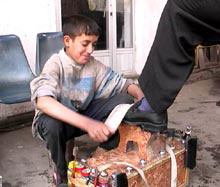
Laith
Abdel Qader, a 15 year old boy, works in the shoeshine business told
IslamOnline, “I left school to support my father who is ill, as well
as my younger siblings.”
“My
mother died of poverty,” he says matter-of-factly, “My father
couldn’t afford to get her medicine… That’s why I have to go to
work.”
“I
work from dawn to dusk to get my daily wages,” Laith says.
Laith
wishes he could go back to school so he could, along with his peers,
learn to read and write.
|
|
My sister tells our father: “Allah will make you triumphant over Bush and his gang” |
“I
want to be an officer in the Iraqi army so I can take revenge on the
Americans and British who destroyed our country these past years.”
“I
will never forget the shelling that destroyed my aunt’s house,”
Laith remembers.
“I
will never forget my cousin, Jaafar, getting killed by their bombs.
And his three sisters, all of my aunt’s children, were killed in the
war that Bush the father waged against us.”
With
the innocence that only children can possess, he asked, “What do the
Americans want from us?”
“Aren’t
they fed up with killing and destroying?”
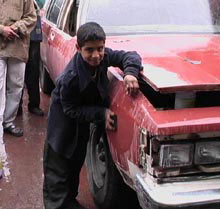
Hammam
Hussein Khoga, 13 years old, is working in a garage that repairs car
engines. His father is still serving in the Iraqi army in the Basra
province, and Hammam believes that his duty is to help his family get
by.
“I
told my father: don’t worry about us while you are protecting the
country. Even my little sister encourages him, saying: Allah will make
you triumphant over Bush and his gang.”
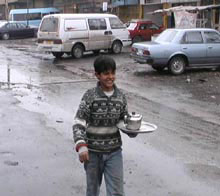
Ibrahim
Jaber, 14 years old, is a waiter in a coffee shop. “I work both the
morning and night shift to help my mother.”
“My
father was martyred in the 1991 war, and my mother has no one else to
support her.”
“Every
day,” Ibrahim adds, “my mother prays that Allah will keep all evil
away from Iraq and its people.”
“I
hope I will become a soldier so I can protect my country against the
American aggressors. I want to kill the people who killed my
father.”
Eleven-year-old
Jawad Saeed Hady goes to school everyday – but not to study.
Instead, he spreads out his goods near a school, trying to cater to
the luckier students’ needs.
Jawad’s
mother makes sweets at home which he sells in front of the school, in
an attempt to do his share supporting his family. His father suffers
from chronic asthma and can not work.
|
|
“I want to kill the people who killed my father.” |
On
the streets and at the petrol stations, Abd El-Salam sells incense
sticks. “I have been working in this trade with my brothers since
four years ago. We had to leave school after our father was paralyzed
from taking medicine that was expired because of the sanctions that
have been around for more than twelve years.
Magda
Kazem flits around the streets, selling lottery tickets. “My
mother,” she says, “has been coming along with me ever since my
father died of cancer.”
“My
father got cancer from being exposed to depleted uranium during the
war,” she says.
Magda’s
mother bemoans her daughter’s situation which forced her to leave
school for financial needs, and prays, “May Allah expel the
Americans and Israelis and make Iraq triumphant over its greedy
enemies.”
Maged
Amin Qassem is just nine years old. However, he helps his father
collect recyclable material like glass, plastic, and old household
pottery from the garbage.
Maged
talks bitterly about his father’s suffering when one of his hands
was amputated after a shell explosion near the Kuwaiti border, when he
was working as a border guard.
Maged
was obliged to leave school to help his handicapped father.
“I
still dream of going back to school. I want to continue my education,
and this will not happen until the sanctions are lifted, so that life
can return to normal.”
“My
family talks to me about how it beautiful it all was before the
sanctions,” Maged says.
“That’s
because ever since I was born until now, I have been living under
sanctions.”
|