|
Bush ‘Promise’ Not Enough to End Nuke Crisis: North Korea
 |
|
In
international relations, disliking the other party and not talking
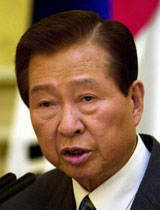
to them are two different things, Kim says to Bush
|
SEOUL,
January 24 (IslamOnline & News Agencies) - A written ‘promise’
from U.S. President George W. Bush not to invade North Korea would not
satisfy Pyongyang which wants a non-aggression treaty, a foreign
ministry official was quoted as saying Friday, January 24, as Russia's
Deputy Foreign Minister said on Friday that it is too soon to refer
North to the UN Security Council.
Nothing
less that a formal treaty binding in law would work, a North Korean
foreign ministry director general, Oh Song-Chol, was quoted as saying
in a pro-North Korean newspaper in Japan.
"Such
a document as a presidential letter for security assurance cannot
resolve the issue given the essence of the current situation," he
was quoted as saying Friday on the Choson Sinbo website.
"Two
countries feel the danger of aggression ... How can we remove such
concerns? It is not complicated at all. It is possible to confirm, by
law and in a treaty, that each other has no will to invade."
The
United States has ruled out a formal non-aggression treaty. But Deputy
Secretary of State Richard Armitage said last week Washington could
provide a security guarantee by letter or official statement if
Pyongyang dismantled its nuclear programs.
Washington
is refusing talks with North Korea until it dismantles the programs
while Pyongyang is demanding a non-aggression treaty before it will
address "US security concerns."
Pyongyang
ratcheted up pressure in the nuclear crisis earlier this month by
pulling out of the nuclear Non-Proliferation Treaty and threatening to
start up a nuclear reactor capable of producing weapons-grade
plutonium as response to U.S. cut of oil.
‘Too
Soon’ to Refer NKorea to UN Security Council
In
Moscow, Russia's Deputy Foreign Minister Alexander Losyukov said
on Friday that it is too soon to refer North Korea's violation of its
international nuclear obligations to the UN Security Council.
"To
refer the North Korean problem to the Security Council would be seen
by North Korea as an attempt to put pressure on it," said the
Russian diplomat, who held high-level talks in Pyongyang earlier this
week.
"If
sanctions are introduced by the Security Council it will be considered
by North Korea as a declaration of war," he told a news
conference in Moscow.
"Such
discussions at the Security Council would be premature," Losyukov
added.
Losyukov
held a surprise six-hour meeting with North Korean leader Kim Jong-Il
in Pyongyang on Monday, January 20, during which he presented Russia's
plan to defuse the four-month-old nuclear crisis.
U.S.
undersecretary of state for arms control, John Bolton, said during an
Asian tour Wednesday, January 22, that broad international agreement
was emerging to bring North Korea's nuclear violations before the
world body within days.
Bolton
said that he did not expect any opposition to the idea from the five
permanent members of the Security Council, which include Pyongyang's
allies Russia and China.
However,
the UN's nuclear watchdog, the International Atomic Energy Agency,
remains divided on whether to refer the crisis to the council.
Some
observers believe involving the council could cause the crisis,
currently in a lull, to erupt again and prompt Pyongyang to go full
speed ahead to reactivate a mothballed plutonium-based nuclear
program.
Pyongyang
has already said that it would consider any sanctions imposed by the
Security Council as a "declaration of war," though
Washington said on Wednesday that it would not immediately press for
sanctions.
The
IAEA had been supposed to hold a meeting of the executive board
Friday, but it was put off, officials in Seoul said.
Tensions
have mounted over the North's decision to reactivate a mothballed
nuclear plant capable of producing weapons-grade plutonium and to
withdraw from a key nuclear arms safeguard accord.
SKorea
launches new diplomatic drive
Meanwhile,
South Korean leaders launched a new diplomatic drive with North Korea
on Friday that raised hopes of a breakthrough in the nuclear crisis.
South
Korean President Kim Dae-Jung's office said a special envoy, who is
considered the architect of the government's policy of engagement with
the North, would travel to Pyongyang on Monday, January 27, for three
days of talks.
Pyongyang
agreed to allow envoy Lim Dong-Won to visit while discussing the
nuclear crisis in cabinet-level talks in Seoul that ended on Friday
with both sides pledging to work together to resolve the issue
"peacefully".
Lim
will try to meet North Korean leader Kim Jong-Il during the talks but
this had not yet been confirmed, a presidential office spokesman told
AFP.
Bush
should move beyond personal animosity
South
Korean President also said Friday the United States holds the key to
resolving the nuclear crisis with North Korea and should put aside
aversion to the Stalinist regime and open talks, AFP said.
Despite
condemning the Soviet Union as an "evil empire" in the
1980s, former president Ronald Reagan triumphed over the Soviet bloc
by engaging Moscow in dialogue and detente, Kim said.
A
decade earlier, former president Richard Nixon embarked on talks with
Maoist China that laid the groundwork for the establishment of
diplomatic relations.
Now
President George W. Bush should move beyond the personal animosity he
has expressed for North Korean leader and engage with a regime he has
branded part of an "axis of evil," he said.
"We
don't have any illusions about North Korea," Kim told
correspondents at a luncheon in the presidential Blue House. "We
are strongly opposed to communism and we are wary of North
Korea."
"But
... in international relations disliking the other party and not
talking to them are two different things. For the peace of the world
you need to talk to the other party even if you dislike it."
He
said that a resolution to the crisis over North Korea's nuclear
weapons drive lay in Washington's hands.
"This
crisis can be resolved peacefully and it will be, but it needs
Washington to bring that about," he said.
"We
now have to have positive things happening between the U.S. and North
Korea."
|