|
Powell
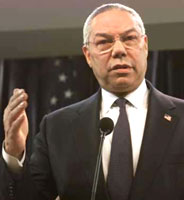
to Give “Pointers Not Proof” on Iraqi Weapons
 |
|
Powell
will be under the spotlight Wednesday, will he pull the trigger?
|
CAIRO,
February 3 (IslamOnline & News Agencies) – U.S. Secretary of State
Colin Powell will tell the United Nations Wednesday, February 5, of
“pointers, rather than proof” of Iraq’s weapons of mass
destruction, a senior aide was quoted as saying Monday, February 3,
while Iraq mocked alleged proof Washington says it will put before the
world.
“I
don’t want to raise false hopes,” Richard Haasss, the State
Department’s director of policy planning, told the Egyptian daily Al-Ahram, comparing Powell’s information to a pointillist painting by
impressionist Georges Seurat, who created pictures out of thousands of
tiny colored dots.
“We
are going to provide more ‘points’' on the activities of the Iraqis,
from which any intelligent person can deduce that they are hiding
something and have gone a very long way to make the work of the
inspectors fail,” he said, according to the official Arabic-language
daily.
“What
we are going to obtain is a more complete image of all that, and all I
ask is for us to be realistic in our expectations,” Haass added.
“We
are not going to provide pictures of stocks of 30,000 warheads, each one
capable of carrying chemical weapons, if that is the sort of proof you
are talking about.”
Haass
said it was rare for intelligence services, whether American, Russian or
Egyptian, to supply proof as concrete as that.
“What
we will do in the Security Council on Wednesday is share with the
international community more information showing that (Iraqi President
Saddam Hussein) does not want to respect international resolutions.”
Powell
would also “explain how the Iraqis are reducing the scope of
inspections and preventing scientists from meeting the inspectors and
hiding what they possess” in the way of banned weapons, Haass said.
Fabricated
Space Photos
 |
|
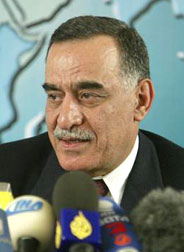
“We
have no weapons of mass destruction, we have no proscribed
activities,” Amin
|
Iraq,
for its part, rules out that the United States can provide any proof to
back allegations of mass-destruction weapons hidden by Baghdad,
insisting it has long since got rid of such weapons and halted all
programs to produce them, according to Agence France-Presse (AFP).
Hossam
Mohammad Amin, head of the National Monitoring Directorate which liaises
with the U.N. inspectors in Baghdad, told reporters Sunday night,
February 2, that Powell would put forward “fabricated space photos,
aerial photos to some vehicles, to some things that could be interpreted
in different ways.”
The
U.S. intent was “just to create suspicions around the Iraqi
declarations and the Iraqi positions in regard to the implementation of
Security Council resolutions.
“They
will not be real evidence, because we have nothing, we have no weapons
of mass destruction, we have no proscribed activities”.
“I
believe 100 percent that those so-called evidences are fabricated,” he
stressed.
The
ruling Baath party also mocked the alleged evidence. “The speech by
Powell to the Security Council will be just media noise made up of lies
and fabrications by the intelligence services,” the party mouthpiece
Ath-Thawra said.
“The
Bush administration is trying to confuse and blackmail other members of
the Security Council ... to win new concessions from them and have a
free hand to carry out an attack on Iraq,” the daily said.
Powell
will not furnish “the slightest material proof to back the untruthful
accusations made by his president against Iraq,” it said.
“We
hope these countries will not give in again to American blackmail as
they did over resolution 1441,” passed unanimously in November after
weeks of delay and which offered Iraq a last chance to disarm.
Crucial
Week of Diplomacy
|
|
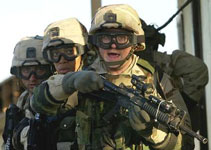
U.S.
forces are massing up for the invasion of Iraq
|
This
came as the U.S.-Iraq crisis entered a crucial week, with U.S. allies
coming under intense pressure to support a looming war, while Baghdad
showed fresh willingness to remove obstacles to U.N. weapons inspectors.
France,
a veto-wielding member of the U.N. Security Council, is expected to bear
the brunt of a U.S.-British diplomatic offensive to rally the world’s
powers behind a new United Nations resolution to underpin a U.S.-led
military assault on Iraq.
Bush’s
closest ally, British Prime Minister Tony Blair - himself under huge
pressure at home to hold his horses over war rhetoric - is confident he
will convince President Jacques Chirac to back a UN resolution
authorizing war on Iraq when the two meet for a summit in Le Touquet,
northern France, Tuesday, British newspapers reported.
However,
French Prime Minister Jean-Pierre Raffarin told the Indian newspaper The
Hindu in an interview Monday: “We have every intention of retaining
our autonomy.”
Raffarin
acknowledged, with a “certain sadness”, that not all European
countries shared France and Germany’s anti-war position - a reference
to a letter of support for Washington’s hard line stance signed last
week by Britain, Spain, Poland and five other countries.
Bush
has warned that Iraq has “weeks, not months” to give up its alleged
weapons programs in line with U.N. resolutions or face war.
Faced
with the growing threat, Iraq has said it is prepared to meet the
demands of U.N. weapons inspectors, who have been trying to secure
Baghdad’s agreement on over flights by U.S. spy planes and private
interviews with Iraqi scientists.
Chief
U.N. weapons inspector Hans Blix is due to go to Baghdad at the weekend
for talks after Iraq’s ambassador to the United Nations, Mohamed
Al-Douri, said Iraq now had “no objection” to the use of U2
surveillance aircraft.
Amin
said: “We shall do our best to make his visit successful.”
Turkey,
NATO’s only Muslim member and one of Iraq’s northern neighbors, is
also feeling the heat. Although Ankara is reluctant to take part in
an unpopular war, Washington has insisted it accommodate thousands of
U.S. troops for a two-pronged invasion of Iraq. A rancorous
parliamentary vote is expected within days.
In
the meantime, Turkish military reinforcements have been sent to the
Iraqi border and an appeal has gone out to other NATO members to protect
the country in case of a counter-attack by Baghdad.
The
United States, Britain and Australia are assembling a massive force in
the Gulf south of Iraq. By mid-February, there will be more than 150,000
service personnel, at least four aircraft carriers and hundreds of
aircraft in the region.
Bush
has repeated that he is willing to order a U.S.-led war on Iraq with or
without an explicit U.N. mandate.
According
to reports quoting U.S. and British officials, war plans call for the
United States to blitz Iraq with 3,000 guided bombs and missiles in the
first two days in a bid to demoralize Saddam’s forces.
An
invasion from the north and the south would then put the squeeze on
Baghdad, while airborne soldiers grab key installations such as oil
wells and airfields.
War
Could Be Too Close to Avert
In
a sign of how close war may be, the Polish diplomat who acts as the
United States’ representative in Baghdad, was to leave the Iraqi
capital Wednesday for “long consultations” in Poland, a Western
diplomatic source said.
Australian
Prime Minister John Howard said Monday he would go to the United States
at the weekend to show his loyalty to Bush, despite overwhelming
opposition at home that is threatening his political future.
Blair,
who faces a similar backlash, was to make a special statement to the
British parliament later Monday.
Last-minute
efforts to give U.N. inspectors more time to seek for weapons in Iraq
and possibly avert war are underway but suffered setbacks Monday.
Greek
Foreign Minister George Papandreou, whose country currently presides the
European Union, called off planned visits to Egypt and Saudi Arabia
after talks in Syria and Jordan.
Saudi
Foreign Minister Saud Al-Faisal cancelled a visit Monday to Moscow to
discuss the crisis. Russia is another permanent U.N. Security Council
member opposed to war. There were no explanations given for either
minister’s sudden change of mind.
Papandreou
said in Amman that he saw only “slim” hopes of a peaceful end to the
crisis and urged Saddam to “fully cooperate with the United
Nations”.
Iraq
has been mixing its promises of increased cooperation with defiant
warnings that a U.S. invasion would be crushed.
|