|
Sharon
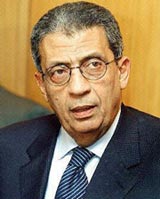
Bigger Regional Threat Than Saddam: Mussa
 |
|
"Everyone
knows Israel possesses many weapons (of mass destruction),"
Mussa
|
MADRID,
February 21 (IslamOnline.net & News Agencies) - Right-wing Israeli
Prime Minister Ariel Sharon poses a far greater regional threat than
Iraqi leader Saddam Hussein, Arab League Secretary General Amr Mussa
warned in an interview published Friday, February 21.
In
an interview with the Spanish newspaper El Pais , Mussa pointed out
that UN Security Council Resolution 687 called for the elimination of
weapons of mass destruction in the entire Middle East region - not
just Iraq.
"Everyone
knows Israel possesses many weapons (of mass destruction)," he
said.
"It's
a scandalous example of double standards. There's a lot of attention
to the possibility that Saddam could possess weapons of mass
destruction, yet it's accepted that another country in the region
should have them.
"Israel
is allowed to carry out violent acts with complete impunity that no
other country in the world could get away with. Israel can ignore
Security Council resolutions," the Arab leader said.
"All
Arabs are outraged by what's happening in the occupied Palestinian
territories. War against Iraq would add insult to injury, or injury to
insult," he added.
Mussa
told El Pais that more than a decade of UN sanctions and arms
inspections in Iraq meant Saddam was "much weaker than he was in
1990 and doesn't constitute a threat" to the Middle East.
"The
serious and chronic danger for this region comes from the Israeli
occupation of Palestine and the irresponsible, aggressive policies of
the Sharon government," he said, in comments translated into
Spanish.
Arabs
Dismayed By Double Standards
Mussa's
comments reflect the frustration and dismay prevalent in the Muslim
and Arab worlds, due to the provocative blindness, on the part of
world powers – notably Washington – in dealing with Israel's
arsenal of mass destruction weapons, according to observers in the
region and world-wide.
In
an article posted by IslamOnline.net, September, 2002, an American
attorney and activist, Thomas J. Haidon emphasized the same meaning.
"While
calling for enforcement of Security Council resolutions and action
against Iraq, a prong of the “Axis of Evil,” the United States has
proffered minimal empirical evidence of Iraqi capabilities and/or
intentions.
And
at the same time, to the utter dismay of Arab and Muslim states, the
United States has strategically ignored the case of Israel, a nation
that has been engaged in an illegal and belligerent occupation since
1967, and has served as one of the world’s most brutally oppressive
regimes.
"Since
1948, the United Nations has rendered countless Security Council and
General Assembly resolutions, aimed at Israel and its treatment and
occupation of Palestine and the Palestinian peoples.
To
this moment, these resolutions have been ignored, and the mechanisms
to enforce these resolutions have been stifled, in most cases by the
United States and its power on the Security Council," Haidon
wrote.
"Furthermore,
it is widely known that Israel has nuclear technologies and an arsenal
of nuclear weapons. The United States has not insisted upon weapons
inspectors, or monitors, despite the fact that Israel is a significant
threat to bordering Arab populations (i.e. the victims of Sabra and
Shatila)," added the American researcher and international law
expert.
"In
his speech, President Bush trivialized the plight of Palestinians when
he noted: “Palestinians deserve a government that serves their
interests and listens to their voices.” He did not address the
massive number of civilian casualties, destruction of homes, property
and the daily humiliation faced by Palestinians.
"What
President Bush failed to mention during his speech was that the United
States has exercised Security Council veto power on numerous
occasions, specifically on resolutions dealing with the protection of
Palestinian people.
"On
March 16, 2001, the United States vetoed a Security Council resolution
that proposed an international observer force in the Palestinian
territories. The resolution also called for a cessation of all
violence, including what it named “terrorist” attacks on
civilians.
"The
United States representative to the UN, considered the draft
resolution flawed because the resolution was “unbalanced” and
because there was not any agreement from either of the parties.
The
United States vetoed another important Security Council resolution on
December 15, 2001, that called for a cessation of violence and
demanded that Israel abide by its obligations under the Fourth Geneva
Convention.
"The
United Nations has lost significant credibility from Arab and Muslim
nations who believe that there is not an equal application of United
Nations mandates. President Bush’s speech only exacerbated the gap
between the United Nations and the Arab and Muslim world," Haidon
explained.
|