|
Iraq Agrees to Scrap Missiles, Russia to Veto War
 |
|
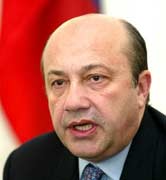
"Again, the Russian position is to resolve this issue through political means,” Ivanov
|
UNITED
NATIONS, February 28 (IslamOnline.net & News Agencies) - In
conformity with the demands of UN weapons’ inspectors, Iraq
wrote to chief UN arms inspector Hans Blix Thursday, February 27,
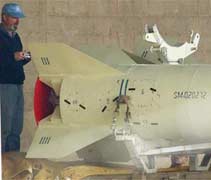
agreeing in principle to destroy its banned al-Samoud 2 missiles.
Blix's
office said it received a letter after the Security Council ended more
than three hours of inconclusive talks on a draft resolution from the
United States and Britain seeking authority to use military force
against Iraq.
A
counter-proposal by France, Russia and Germany called for expanding
the inspections which began three months ago to verify Iraq's
claim that it no longer has any nuclear, chemical and biological
weapons or banned missiles.
Before
the meeting, undecided council members hinted that they might be
swayed by a report from Blix which they are due to receive this
weekend. However, the Iraqi approval to destroy al-Samoud 2 is a move
likely to deepen divisions in the Council.
The
chief UN weapons inspector is expected to tell the Council that Iraq's
disarmament efforts have been "very limited" so far, a
diplomat said, according to Agence France-Presse (AFP).
The
diplomat who saw the draft quoted it as saying that "Iraq
could have made greater efforts to find proscribed items or credible
evidence showing the absence of such items."
In
a typical U.S. negative reaction to any Iraqi sign of compliance, U.S.
Secretary of Defense Donald Rumsfeld said the Iraqi letter did not
prove a change of heart. "I don't see a change in the pattern at
all," he told a news conference. "This is exactly what's
been going to for years," he said.
"They
refuse to cooperate, don't cooperate, drag it out, wait until someone
finally nails them with one little piece of the whole puzzle and
refuse to do anything about it and then finally when they see the
pressure building, they say well, maybe we'll do some of that."
The
Iraqi letter arrived too late to be mentioned in the draft report
which Blix sent to UN Secretary General Kofi Annan's office for
approval and then for translation.
 |
|
Iraq wrote to Blix agreeing in principle to destroy its al-Samoud 2 missiles
|
However,
Blix is expected to brief the Council next week, at a date to be
decided after Guinea takes over the Council presidency Saturday, March
1.
The
letter, signed by General Amir al-Saadi, chief scientific adviser to
President Saddam Hussein, stated that Iraq
was ready in principle to destroy the missiles.
The
UN Monitoring, Verification and Inspection Commission (UNMOVIC) was in
touch with the Iraqi authorities "to clarify this acceptance and
to start destruction measures," Blix's office said in a
statement.
On
Friday, Blix wrote to al-Saadi that the missiles were prohibited under
Security Council resolutions and that Iraq
should make arrangements to begin their demolition under UNMOVIC
supervision March 1.
He
noted that in test firings, the missiles had exceeded 150 kilometers
(93 miles), the limit imposed by the Council in Resolution 687, which
defined the terms of the Gulf War ceasefire in April 1991.
Iraqi
officials countered that the rockets used in test firings did not
carry guidance systems or warheads, and said the range of a fully
operational al-Samoud 2 would not breach the limit.
Russia
to Veto War
The
Iraqi letter of compliance came as Russian Foreign Minister Igor
Ivanov said Friday, February 28, without specifically mentioning Iraq,
that Moscow will use its veto power in the United
Nations to maintain world stability if needed.
"Russia
has veto power. If needed, and under the conditions of maintaining
international stability, Russia will use its veto," Ivanov said
through a translator at a press conference in the Chinese capital.
Russia
is a permanent member of the Security Council along with France,
China, Britain and the United States.
"As
everyone knows, the permanent members of the UN Security Council all
have veto power, but to use this we must use it with great
responsibility where world peace and stability is at stake.
"The
Russian position is that the UN Security Council must be united,
especially the permanent members."
Kremlin
sources were quoted by the TASS news agency as saying Thursday that
Russia may use its right of veto when a new resolution authorizing
possible military action in Baghdad is placed before the 15-member UN
Security Council, possibly in mid-March, adding that "such a
development is undesirable."
Ivanov
warned that if war was used to disarm Baghdad and effect regime
change, the consequences would be far reaching.
"If
it is a question of using force to resolve the Iraqi issue, under
these circumstances, there would be serious effects not only
regionally but globally," he said.
His
comments followed a joint Russian-Chinese communique Thursday
stressing that a war in Iraq
"can and should be avoided."
While
reiterating his opposition to war Friday, the Russian Foreign Minister
also repeatedly called for unity in the UN Security Council.
"On
the Iraq issue,
we will seek to maintain unity on the UN Security Council," he
said.
He
also poured cold water on the new resolution on Iraqi weapons
inspections, jointly tabled by the United States, Britain and Spain
Monday, saying it was not needed as UN inspectors were continuing to
seek out Iraq's
alleged weapons of mass destruction.
 |
|
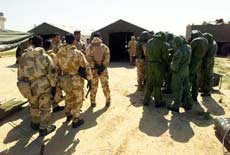
The U.S. continues to mass forces in the Gulf region
|
"Again,
the Russian position is to resolve this issue through political means.
I believe that the new resolution is not needed," Ivanov said.
"If
a new resolution was needed to support their (UN weapons' inspectors)
work, then we would think about it."
UN
inspectors reached the three-month mark in their work in Iraq
Thursday, having made some 800 unimpeded visits to more than 600
sites. They have not yet produced any evidence Iraq still possesses
banned weapons.
New
U.S. Deployments
Washington,
on the other hand, continued its military build-up and showering
threats on Baghdad.
A
sixth aircraft carrier, the USS Nimitz, is ordered to deploy to the
Gulf and will leave the U.S. west coast next week, the U.S. Navy says,
according to the BBC online news service.
Also,
several B-2 stealth bombers are to leave for the Gulf in the coming
days, U.S. air force officials said, BBC reported Friday.
Meanwhile,
U.S. President George W. Bush said in an interview published Friday
that Iraqi President Saddam Hussein has no intention of disarming and
the United States must now force him to do so.
"My
attitude about Saddam Hussein is that if he had any intention of
disarming, he would have disarmed," Bush said. "We will
disarm him now."
"Putting
off a decision will mean there will be greater sacrifices in the
future," the President told USA Today.
Bush
called war his "last option" but said he believed Americans
"fully understand" there may be a military onslaught soon,
the paper reported.
"I've
thought long and hard about the consequences and the price that could
be paid," the President said.
USA
Today said Bush expressed little concern about debate at the
United Nations, the prospect of a veto of a resolution that would
clear the way for war or the opposition of some traditional U.S.
allies.
Seeking
a second UN resolution that could authorize war was first and foremost
"a commitment to our allies and friends," he said.
However,
he added: "The most important part about whatever happens is that
(Saddam) be disarmed."
|