|
North Korea Test-Fires Missile Into Sea
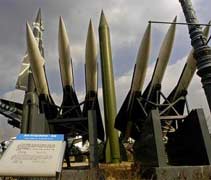 |
A South Korean policeman looks at North Korea's Scud-B missile, center green, at the Korea War Memorial Museum in Seoul
|
PYONGYANG,
March 10 (IslamOnline.net & News Agencies) – At a time the U.S.
is gearing up all its military and diplomatic forces to attack Iraq
for alleged weapons of mass destruction, North Korea test-fired a
missile Monday, March 10, that fell harmlessly into international
waters, according to officials in Seoul and in Tokyo.
A
South Korean defense ministry official said the test apparently
involved a short-range anti-ship missile similar to the one Pyongyang
test-fired on February 24 and was launched from Sinsang-ri on North
Korea's east coast in South Hamgyong province, Agence France-Presse
(AFP) said.
"The
missile is believed to have landed into the sea some 110 kilometers
off the east coast and has a range of 160 kilometers," a ministry
official said.
The
missile launch was widely anticipated after the February missile test
was pronounced a failure and North Korea last week issued a warning to
mariners off its east coast.
Markets
in Japan and South Korea dipped marginally on the news of the missile
launch that came just one week after North Korean jet fighters
intercepted a U.S. spy plane, further escalating the stand-off over
the North's nuclear weapons ambitions.
Analysts
said the missile test was part of Pyongyang's game of brinkmanship
aimed at breaking U.S. resolve five months into the crisis.
North
Korea has called for direct talks with Washington to end the
stand-off, demanding a non-aggression pact as a precondition.
Washington rules out one-one-one talks until North Korea dismantles
its nuclear programs.
Professor
Yu Suk-Ryul of the Institute of Foreign Affairs and National Security
here said Pyongyang was closely watching Washington's plans for war
against Iraq, and believed it had limited time to get Washington's
attention.
"I
think North Korea understands that Washington does not want war on two
fronts," he said.
"However,
after the Iraq war, North Koreans certainly believe that they will be
the next target. They are doing this (missile tests) and other
provocations because they believe that now is the time to induce the
United States to come to the negotiating table, not later."
South
Koreans, engrossed in the twists and turns of domestic politics under
new President Roh Moo-Hyun, are focusing less on North Korea.
"People
here interpret the test-firing and other North Korean actions as
signals from North Korea to the United States, not to us," said
Kookmin University politics professor Yoon Young-O.
Washington
and Pyongyang have been locked in a tense stand-off since the crisis
erupted in October when North Korea allegedly admitted to U.S.
officials that it had kept up a secret nuclear program in breach of a
1994 bilateral accord.
Since
then Pyongyang has kicked out international weapons inspectors, pulled
out of the nuclear Non-Proliferation Treaty, and fired up a reactor at
its Yongbyon nuclear plant that is capable of producing weapons grade
plutonium as a response to U.S. fuel cut.
All-Out
War
This
month the stakes rose higher when on March 2 four North Korean
fighters armed with heat-seeking missiles surprised a U.S. RC-135S spy
plane over international waters, flying within 50 feet of it and
chasing it for 22 minutes.
Reacting
to the rising tension, Washington earlier this month deployed
long-range bombers to the island of Guam in the western Pacific as a
deterrent to any aggression by North Korea.
A
U.S. aircraft carrier is also on its way to waters around the Korean
peninsula as part of joint war games that began last week involving
hundreds of thousands of U.S. and South Korean troops.
North
Korea has condemned the military exercises as a pretext for an
invasion of the communist state.
On
Sunday the North's official newspaper Rodongt Sinmum warned
that Pyongyang would respond to "all-out war with an all-out
war."
Self-Defense
Meanwhile,
North Korea
on Monday said that its
interception of an American spyplane by four fighter jets in
international airspace was a defensive act.
"We
can not stand by and watch the aggressive attempts by the U.S.
army," said a commentary in Rodong Sinmun newspaper,
China's Xinhua news agency reported from the North Korean capital
Pyongyang.
"If
the U.S. aggressors had not reinforced the military build-up against
us and committed such aggressive acts as that of the reconnaissance
aircraft, the interception would not have happened."
|