|
Iraqis
Alone Must Decide Fate: Arab Officials
 |
|
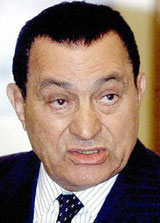
"The
fact of Iraq being governed by its sons, and as soon as possible,
is the quickest way to ensure stability for the Iraqi
people," Mubarak
|
AMMAN,
April 9 (IslamOnline.net & News Agencies) - Jordan, Egypt and Saudi
Arabia -- three of Washington's closet Arab allies -- on Wednesday,
April 9, called for Iraq's future government to be chosen by the Iraqis
as U.S. forces captured Baghdad.
In
almost identical words, Egyptian President Hosni Mubarak, Jordan's
Foreign Minister Marwan Moasher and his Saudi counterpart, Prince Saud
al-Faisal, said they wanted to deal with a leadership chosen by the
Iraqi people alone.
"The
Iraqi people must decide the future of Iraq and choose their own
leadership at this time. No one else can do that. This is Jordan's firm
position," Moasher told Agence France-Presse (AFP).
Mubarak,
the first Arab head of state to react to the collapse of Baghdad, said a
new Iraqi leadership chosen by the people should see the day quickly.
"The
fact of Iraq being governed by its sons, and as soon as possible, is the
quickest way to ensure stability for the Iraqi people," the
official MENA news agency quoted Mubarak as saying.
In
Riyadh Prince Saud called a news conference to outline Saudi Arabia's
position.
"The
government in Baghdad we will deal with is the one chosen by the Iraqi
people," he said, adding that U.S.-British occupation must end as
soon as possible.
"The
kingdom will wait for the Iraqi people to set up their government and
then we will deal with it," Prince Saud said, adding that the
United Nations should recognize the new leadership emerging from Baghdad
and be involved in Iraq.
The
Arab comments came as U.S. tanks positioned themselves in central
Baghdad, where they were greeted by jubilant crowds who cheered
uncontrollably when marines brought down a giant statue of Iraqi
President Saddam Hussein.
Iraqi
euphoria and scenes of looting in Baghdad and the southern city of Basra
triggered concern however in Arab capitals, where officials warned that
security must be brought under control.
Lawlessness,
looting and lack of security in Iraq, could lead to disaster, Prince
Saud said in Riyadh.
His
warning was echoed in Amman by the Jordanian foreign minister, who said
"internal security must be preserved in Iraq" and warned that
"a breakdown of security would have serious repercussions".
A
senior Kuwaiti official meanwhile described the turn of events in
Baghdad as "a natural development" since the war started on
March 20. "It's what we expected in fact, from day one," he
said on condition of anonymity.
I
Want Them To Catch Saddam Alive: Kuwaiti Civil Servant
Using
less diplomatic language, Kuwaiti civil servant Talib Abbas said:
"I want them to catch Saddam alive, and his two sons... then hand
them to the Kurds and to the Iraqis in the south. This is my
dream".
Kuwait,
which is serving as the main launch pad for the war, was invaded by Iraq
in 1990 and occupied for seven months before it was liberated in the
1991 Gulf War by a U.S.-led coalition.
"Today
is a clear lesson for dictatorships in the Arab world. I think they
should start looking for ways to change their people's lives," said
Mohammed al-Jassim, editor of the mass-circulating Kuwaiti newspaper
al-Watan.
And
while Kuwaitis rejoiced at the unfolding events in Iraq the mood was
more somber in Cairo where many Egyptians were persuaded that the fall
of Baghdad was the first step to U.S. colonization of all Arab
countries.
"We
must get ready because soon they will be in Cairo," a building
caretaker said bitterly. A colleague shook his head and dismay and asked
repeatedly: "Where is Saddam?".
Many
Egyptians had believed promises made by Iraqi officials that Baghdad
will fight the invading troops with all its might, and its fall with
little resistance left many Cairenes dumbfounded.
"We
thought that Baghdad would be the impregnable fortress of Iraq,"
Samir Ragab, the chief editor of the government daily Al-Gumhurriya
wrote Wednesday.
Bahrain's
king says time for Iraqis to choose own future, end embargo
Meanwhile,
the king of Bahrain, which hosts the U.S. Fifth Fleet, said it was time
for Iraqis to choose their own future and be free of economic sanctions
after Saddam Hussein's regime crumbled in Baghdad Wednesday.
"We
must give the Iraqi people a chance to have their own say, to express
themselves and decide their future and we must support them," said
King Hamad.
He
called for an end to international sanctions in place against Iraq since
its 1990 invasion of Kuwait.
"The
time has come to end the embargo," he said. "The people of
Iraq have been the victims of the current war, which they did not
choose, along with the Gulf War and the Iran-Iraq War."
"The
Iraqi people's suffering must come to an end ... and the international
community is called upon to listen to the Iraqi people so that they can
succeed in installing their political system .. and maintaining their
sovereignty and unity," said the king, in remarks carried by the
official BNA news agency.
On
the eve of the U.S.-British attack on Iraq March 20, King Hamad offered
Saddam exile as a way to avoid the war.
|