|
Bodies
Scattered On Baghdad Streets
 |
|
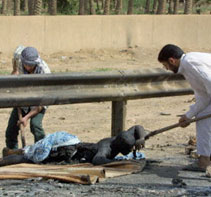
Iraqis
remove a charred body of an Iraqi civilian
|
BAGHDAD,
April 10 (IslamOnline.net & News Agencies) - Around 20 bodies and
burnt-out cars littered the streets of the southwestern Baghdad
neighborhood of Al-Dora on Thursday, April 10.
Bodies,
including those of children, were still strewn over the road between
Al-Dora and the international airport, which is under the control of
U.S. forces, reported Agence France-Presse (AFP).
The
putrid, fly-covered corpses were being buried in a mass grave along
the side of the road by volunteers whose noses were covered with
scarves against the stench, according to an AFP photographer.
Some
of the corpses were in or under the charred vehicles. Dead children
lay on the side of the road, covered in sheets.
One
family, two of whose members were completely incinerated, died in the
back of a pick-up truck.
"If
the price of freedom is this, we don't want it," said one Iraqi
helping at the scene cried.
A
gutted white Mercedes car sat at the roadside, a white flag still
fluttering from its antenna.
A
U.S. officer at the scene claimed Saddam Fedayeen fighters attacked an
American convoy which retaliated, causing the deaths on Monday, April
7.
Witnesses,
however, confirmed U.S. soldiers opened fire on cars carrying
civilians they thought posed a threat on Wednesday, April 9.
"Leadership
Meeting" Attacked
A
fierce firefight near a Baghdad mosque Thursday came amid attempts by
officials of the Iraqi regime to hold a meeting, a U.S. military
official claimed at the war command headquarters in Qatar.
"This
morning, members of the First Marine Expeditionary Force were involved
in a fierce firefight in the north-central area of Baghdad near the
Iman palace," said Captain Frank Thorp, adding that several of
the soldiers were wounded.
The
firefight came as "an Iraqi leadership group was trying to get
together for a meeting," he told journalists at the U.S. Central
Command (Centcom) base.
"It's
a very large mosque with a large wall around the mosque," he
said, adding that there was a palace and the house of a Baath leader
in the immediate area.
Asked
about reports Iraqi leader Saddam Hussein may have been at the
compound, he said: "There is no reason to speculate."
Brigadier
General Vincent Brooks, claimed "the mosque was used as a
fighting post."
Another
spokesman, Major General Victor Renuart, said the firefight lasted
several hours and that enemy forces clad in the distinctive black garb
of paramilitary forces were killed or captured.
"There
were intelligence reports the mosque was a Saddam stronghold,"
Major Pete Farnum said in Baghdad.
An
AFP correspondent with the marines said the troops came under fire
from fighters hiding in civilian areas, in buildings, cars, behind
lines of laundry on rooftops and beneath bridges.
"There
were at least 13 casualties and one soldier killed in action,"
said First Sergeant Jeff Treiber.
The
1st Marine Division, 5th Regiment captured one of Saddam's main palace
complexes on the northern side of the Tigris, Treiber said.
A
total of 22 prisoners were taken from the mosque to the palace,
according to Private Matthew Sienkiewicz, who was among those who
captured them. He said some were Egyptians.
When
the Marines arrived at the mosque, where they waited for an hour
before moving in, they came under heavy fire with at least one assault
vehicle being hit three times by rocket-propelled grenades while two
others fell short of the vehicle, the AFP correspondent said.
Corporal
Luke Mondoux said the inside of the mosque compound "looked like
a military barracks, there were lockers and mattresses."
Thorp
said there was also fighting in other parts of the Iraqi capital.
"In
Baghdad we found enemy forces, confronted them and defeated
them," he said.
"We're
continuing to see fierce, brief firefights," he said, adding,
however, that "there continues be no organized resistance."
U.S.
combat helicopters came to the aid of soldiers on the ground battling
Iraqi and Arab fighters in a district of central Baghdad, an AFP
reporter said.
Five
Apache helicopters hovered for over an hour over Al-Kadhimia and
Al-Otayfia neighborhoods, on the west bank of the Tigris as well as
Al-Aadhamia on the opposite side of the river.
The
firefights pitted U.S. troops against Fedayeen units and Arab
volunteer fighters hiding behind sandbag reinforcements on street
corners in Al-Otayfia.
On
the main Aden Square in Al-Kadhimia, two Iraqi tanks and three other
military vehicles were destroyed.
There
was no information on casualties from the clashes but they paralyzed
the entire district, blocking roads and forcing civilians to flee the
area on foot.
The
combats also forced the closure of Al-Aadhamia, Bab al-Muazzam and
Al-Ahrar bridges to cars.
No
cars were driving across Al-Aqimma bridge, but a long line of
pedestrians were seen crossing the bridge to the other side.
|