|
U.S. Forces Release Iraqi Shiite Mullah After Protests
 |
|
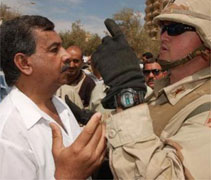
Protestors outside the Palestine Hotel contributed to Fartusi's "liberation"
|
Additional
Reporting By Imam Elliethi, IOL Baghdad Correspondent
BAGHDAD,
April 22 (IslamOnline.net & News Agencies) - A prominent Iraqi
Shiite cleric was released Tuesday, April 22, by U.S. forces after his
detention and reported torture sparked angry demonstrations for two
days, his followers said.
Sheikh
Mohammed al-Fartusi appeared aboard a mini-bus on Baghdad's central
Fardus Square to the cheers of hundreds of Shiites who had staged
protests against his reported arrest on Sunday.
One
of his followers said he was relieved Fartusi had been freed, although
U.S. army officials did not confirm he had ever been arrested, Agence
France-Presse (AFP) reported.
Quoting
his followers, al-Jazzera correspondent said that Fartusi was tortured
during his two-day detention.
Nihad
Rizkan said two days of protests in front the Palestine Hotel, which
hosts both U.S. forces and foreign journalists covering the war,
"contributed to his liberation."
He
said Fartusi would later lead prayers at the Hikma mosque, in the
impoverished Shiite suburb of Baghdad where he lives. Shiites account
for more than 60 percent of Iraq's population.
More
Arrests
However,
followers of Fartusi said U.S. forces arrested two other mullahs and
their three bodyguards at Al-Dura checkpoint, 25 kilometers (10 miles)
south of Baghdad. They said they were returning from Karbala, where
hundreds of thousands of Shiites gathered Tuesday for the climax of a
massive pilgrimage.
Also
Tuesday, , the head of the National Front for Iraqi Intellectuals was
arrested by the U.S. forces seeming on the grounds of his alleged
connection with the deposed regime.
"Some
12 U.S. armored vehicles drove to the Front's headquarters. Soldiers
showed up and took Suddam al-Qaud," said his brother who denied
that Suddam had any relations to the former regime.
The
captured is a tribal heavyweight in the western Iraqi areas and a rich
businessman.
"No
To Colonialism"
 |
|
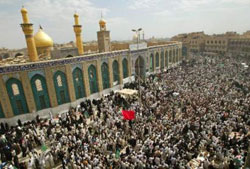
Throngs of Iraqi Shiite pilgrims celebrate as they circle the Imam Hussein holy shrine in Karbala
|
Hammering
their chests and whipping their own backs until they bled, tens of
thousands of Shiite Muslims swarmed through Kerbala, 70 miles south of
Baghdad, on a pilgrimage long suppressed by Saddam.
Shiite
leaders say a million or more people may flock to Kerbala for the
climax of the pilgrimage – Arbaiin - which honors Imam Hussein, a
grandson of Islam's Prophet Mohammad, who was killed in the city in
680 AD.
U.S.
helicopters flew overhead but troops kept their distance on the
outskirts, hoping to avoid any friction.
But
in the religious ceremony, anti-American slogans were heard as some
3,000 to protest the U.S. occupation of Iraq.
"Yes,
yes to Islam, no to America, no to Israel, no to colonialism and no to
occupation," some pilgrims chanted, in another indication of
stormy weather ahead for the postwar administration headed by retired
U.S. general Jay Garner.
Garner
was warmly embraced by Jalal Talabani, veteran leader of the Patriotic
Union of Kurdistan, when he landed by helicopter at Sulaimaniya.
"If
America stays, it will suffer," the crowd shouted, hoisting black
mourning flags for Imam Hussein. "No to colonialism, no to
occupation."
But
many slogans also denounced Saddam, who had banned their pilgrimage
during his 24-year rule.
In
Baghdad, about 1,000 Iraqi Shiites staged a second day of angry
demonstrations, complaining that Farusi had been arrested by U.S.
forces and threatening to take action if he was not released.
No
violence was reported in the demonstration, which followed a protest
by 5,000 people on Monday, April 21.
The
pilgrimage this week came at a particularly volatile time with
rivalries erupting among the Shiites and anger mounting over the
failure of invading U.S. troops to restore order to Iraq.
Some
Shiites had expressed the fear that violence could erupt. A Kuwaiti
cleric said leading clergymen in Iraq would not take part for fear of
"terrorist attacks" by Saddam loyalists.
"We
cannot hide our worries and fears of recurrent terrorist operations
and clashes between these millions of crowds gathering at Karbala on
Wednesday," Mohammed Baqer Musawi al-Muhri said in a statement.
For
many, this year's commemoration is the first time they will be able to
mark the religious anniversary with full fervor - and a chance to show
their political muscle in the post-Saddam era.
An
endless flood of pilgrims, carrying little luggage but laden with
religious ardor, filled the wide four-lane highway southwest from
Baghdad to Karbala, some 80 kilometers (50 miles) to the southwest, to
visit the domed tomb of Hussein.
|