|
Armitage
Greeted By Mysterious Blast In Kabul
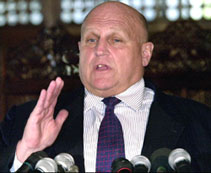 |
|
"The
U.S. will withdraw forces once we're sure that the government of
Afghanistan feels perfectly secure," said Armitage
|
KABUL,
May 9 (IslamOnline.net & News Agencies) - U.S. Deputy Secretary of
State Richard Armitage was greeted by a bomb blast Friday, May 9,
shortly after his arrival in the Afghan capital Kabul on the second
leg of an Asian tour.
"President
(George) Bush has asked me to come to Afghanistan ... to dramatically
make the point that the United States, although we may at present be
occupied by Iraq, is not going to forget our responsibilities in
Afghanistan and that we are able to do two things at the same
time," Armitage told reporters at a press conference.
As
he spoke, a mysterious explosion shook the capital and rattled houses
in the upmarket Wazir Akbar Khan district near the U.S. embassy where
he was staying.
The
cause and location of the blast were not immediately known, Agence
France-Presse (AFP) reported.
An
embassy spokesman was unfazed and said Armitage's visit was not
affected.
Armitage
said U.S. forces would remain in Afghanistan until the country was
secure, the same statement echoed by U.S. officials as to the U.S.
military presence in Iraq.
"The
United States will withdraw forces once we're sure that the government
of Afghanistan feels perfectly secure and the people of Afghanistan
have found necessary stability," he said after a meeting with
President Hamid Karzai and Foreign Minister Abdullah Abdullah.
But
Afghans are infuriated at the long presence of the U.S. forces in
their country with scenes of insecurity and a slow pace of
construction in the war-dashed country.
Scores
of Afghans took to
the streets of Kabul this week to show their opposition to the U.S.
military presence and Karzai's policies.
They
shouted such slogans as "Death to America" and denounced
"the phantom government of President Hamid Karzai which had been
sold to foreigners."
In
a report to the U.N. Security Council on Tuesday, May 6, special U.N.
envoy for Afghanistan Lakhdar Brahimi said attacks by the Taliban,
al-Qaeda and former prime minister Gulbuddin Hekmatyar loyalists had
increased to an almost daily occurrence.
Brahimi
also repeated his call for the extension of the peacekeeping
International Security Assistance Force (ISAF) beyond its present
confines of Kabul.
Hekmatyar
sent a message to U.N. Secretary General Kofi Annan in March 2003 in which
he detailed the “heinous crimes” perpetrated by U.S. forces
against Afghan civilians.
U.S.
forces have faced rising anti-American sentiments among Afghani
people, especially after a U.S. aircraft claimed
the lives of 11 Afghan civilians in April.
U.S.-led
forces of more than 10,000 are currently in Afghanistan allegedly to
hunt down Taliban and al-Qaeda remnants, but is not involved in
providing security in the provinces.
"Different
Views"
Armitage
said the U.S. "took careful note" of Brahimi's statement,
but had different views.
"We
ourselves have slightly different views about the most effective way
to bring security, reconstruction, stability to Afghanistan," he
said, pointing to a U.S.-led civil-military program to establish
provincial reconstruction teams.
"We
think this is a very effective way of providing security and extending
the reach of the central government," said the American diplomat.
Security
in the provinces is a major headache for Karzai.
The
killing of an Afghan deminer on Saturday, May 3, prompted the U.N. to
suspend missions in southern Afghanistan.
Four
U.S. soldiers, a foreign International Red Cross worker and an Italian
tourist have been killed since the end of March.
Karzai’s
government has attempted to disarm some 100,000 militiamen and
reintegrate them into the nascent national army but warlords and local
militias retain control of much of the country.
"Porous
Border"
Armitage
said he had also discussed the situation on the Pakistani border with
Karzai and Abdullah.
Afghan
and U.S. military officials claim Taliban and al-Qaeda fighters cross
the border to launch attacks in Afghanistan.
"It
is a very porous border, the tribal areas are well known for their own
independence. I think we all have to do more to make sure that the
remnants of the Taliban are got rid of for good," Armitage said.
This
week suspected Taliban fighters seized control of part of a district
in southern Zabul province before hundreds of Afghan troops were sent
to the area to back local forces.
Also
a delegation of Taliban, led by former Health Minister Mullah Abbas,
secretly arrived in the Afghan capital this week for expected talks
with Karzai.
On
his visit last week, U.S. Secretary of Defense Donald Rumsfeld
announced an end to "major combat operations" in Afghanistan
and said the country had moved into the reconstruction and
redevelopment stage.
"My
own view is that in things large and small, the United States and
other nations are trying to be a part of the reconstruction and
redevelopment of this nation," Armitage said after visiting a
USAID- funded water pumping station in Kabul.
He
said Washington was going to be a "worthy partner" in the
economic and social development of Afghanistan.
|