|
The Scene Gets Bloodier Again, Is There A way Out?
 |
|
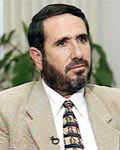
Abu Shaban was seen as Hamas most moderate figure
|
By
Khaled Mamdouh, IOL Staff
CAIRO,
August 21 (IslamOnline.net) – A top Hamas political leader was assassinated
by Israel Thursday, August 21, in an air strike in Gaza City as Israel
exacted revenge for a massive suicide bomb, hammering the final nail
into the coffin of a floundering truce declared by major Palestinian
groups.
The
bloodbath in the occupied Palestinian territories and Israeli cities
is again the most likely scenario, with each party blaming the other
for the bloodshed.
Ismail
Abu Shanab, often described as Hamas third-in-command, died when an
Israeli F-16 plane targeted his car in an attack which claimed the
lives of at least two other people.
Hamas
promptly announced that it was calling off its three-month ceasefire
announced June 29.
"The
assassination of Abu Shanab is also the assassination of the
ceasefire," senior Hamas official Ismail Haniyeh told Agence
France-Presse (AFP).
Palestinian
Culture Minister Ziad Abu Amr, who had been liaising with the
Palestinian resistance groups about the truce, said: "The
official position is that the truce is over and Israel is responsible
for that, not only because of this assassination in Gaza but also
because of many actions which had been continuing before."
On
the other hand, a senior Israeli foreign ministry official argued the
announcement by Hamas that it was calling off its truce after the
killing of one of its top political leader was "ridiculous".
"This
announcement is ridiculous, coming from a movement which claimed
responsibility for this horrific attack and attempted a whole string
of attacks over the last two weeks," Gideon Meir, deputy director
general of the foreign ministry, told AFP in reference to the bus
blast.
This
often repeated chain of events bring to mind a similar incident on
June 10 when Israel carried out a failed assassination attempt on the
life of another Hamas political figure, Abdul
Aziz al-Rantissi.
The
situation, however, was then brought under control quickly – may be
due to some facts; failure of the attempt, world verbal pressure on
Israel and willingness – on both sides – to observe a period of
relative calm, to rearrange the then-shattered cards.
However,
the situation now seems categorically different.
The
assassination came two days after an occupied Jerusalem
bus bombing that killed 20 and injured over 110 Israelis and was
claimed by the two main resistance groups – Hamas and Islamic Jihad.
The
bombing was a response to a series of Israeli killings and
demolitions, in violation of the shaky Hudna (truce).
Another
important factor that adds to the gloominess and gravity of the
current situation is Egypt’s reluctance to interfere again and
practice pressure on the Palestinians to refrain from carrying out
anti-Israeli attacks.
A
couple of weeks ago, Egypt declared it would not interfere unless
Israel respected its commitments defined by the roadmap.
Also,
the U.S. officials’ statements, following the bomb blast in occupied
Jerusalem, were seen as a go-ahead for the Israelis to launch an
all-out war against what they termed "terrorist Palestinian
organizations".
At
the same time, there was a clear incitation to the Palestinian
Authority to track down and destroy all Palestinian organizations; in
a nutshell, a call for inter-Palestinian fighting.
However,
the Israeli "heavy-handed" assassination of Abu Shanab may
have saved the Palestinians from falling out against each other.
It
was surprising to watch a Palestinian man – on Al-Jazeera TV channel
– saying that "the assassination – tragic and terrible as it
is - actually had a positive side to it".
He
elaborated by saying that it "awakened the Palestinian Authority
to the fact that armed resistance was the only option left to the
Palestinians so as to win back their freedom and occupied lands".
The
same meaning was expressed by a PLO official in exile in Tunisia, in
an open letter to U.S. President George W. Bush, the European Union,
United Nation Secretary-General Kofi Annan and U.N. Security Council
members, reported AFP Thursday.
Faruq
Qaddumi said resistance was the "only option" left open to
the Palestinian people, adding "the Palestinians had the right to
defend their land, their freedom and their sovereignty."
He
called on the international community to send a force to Palestinian
territory immediately "to end the bloodbath and preserve security
and stability."
"How
can a government or a Palestinian Authority in the current
circumstances prevent a Palestinian from seeking revenge for himself
and also for his people and wanting to put an end to the siege, the
misery being suffered?" Qaddumi wrote.
"Before
linking noble (Palestinian) resistance with terrorism, order the
Israeli colonialists instead to withdraw their forces from our
land," he said, adding: "Colonization itself is a form of
terrorism".
I
do not know why it is so difficult to see this fact. There are dozens
of Security Council resolutions, peace initiatives by the world
community, in addition to agreements signed by consecutive Israeli
governments, stating the right of the Palestinians to establish their
own independent state.
When
will this chain of violence (by the Israeli occupiers) and
counter-violence (by the Palestinians in the form of resistance –
controversial as it may be seen by some in the west) continue?
Why
is it so difficult for the international community to step in and give
some weight behind its own resolutions to see them implemented? Or may
be the whole point is for the world to live with the non-stop bloody
scenes coming from the Middle East as a bitter reality of life, with
the blame put on the "Arab and Islamic terrorists"?
|