|
Islamic Jihad, Hamas Formally End Ceasefire
 |
|
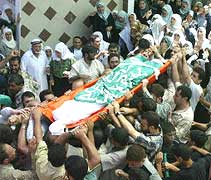
Palestinians bid farewell as men carry away the body of Shanab for burial in Gaza City
|
GAZA
CITY, August 22 (IslamOnline.net & News Agencies) - The
Palestinian resistance groups Islamic Jihad and Hamas issued a joint
statement Friday, August 22, formally ending their seven-week-old
truce because of an Israeli air strike that killed a top political
leader.
The
statement blamed Israeli Prime Minister Ariel Sharon for wrecking the
truce that the Palestinian factions declared unilaterally on June 29.
Hamas
effectively called
off the truce Thursday, August 21, after Ismail Abu Shanab,
one of its top officials, was assassinated with two bodyguards in a
hail of rocket fire on his car in central Gaza. But Islamic Jihad
waited until Friday.
"We
announce together today that Sharon assassinated the truce and
delivered the final blow in killing political leader Ismail Abu
Shanab," the joint Hamas-Islamic Jihad statement said.
"The
Zionist enemy bears full responsibility for the ceasefire's end and
the consequences of the escalation of violence that will flow from it.
"We
also blame the U.S. administration, for not only has it remained
silent about the Zionists' crimes, it has also provided them with
political cover."
The
statement also urged the "Palestinian Authority and cabinet to
put an end to its policy of threats against the resistance forces,
reject U.S. and Zionist pressures and rejoin the Palestinian people in
its resistance" to Israeli occupation.
The
latter call was a reference to a clampdown on Hamas and Islamic Jihad
ordered by the Palestinian leadership in the immediate aftermath of
Tuesday's bombing
but left in disarray by Thursday's killing.
At
least twenty people were killed and more than 105 wounded in a huge
bus bomb blast late Tuesday, August 19, in occupied Jerusalem.
Hamas
claimed responsibility for the blast in response to Israeli escalation
of attacks against Palestinian-ruled areas and continued assassination
and detention campaigns against Palestinian activists.
Israeli
troops had earlier launched a rocket
attack on a house in the southern West Bank city of Al-Khalil,
killing Mohamed Al-Sedr, a local leader of the Islamic Jihad,
triggering vows of revenge from the resistance group.
Grief
And Anger
Meanwhile,
tens of thousands of Palestinians were expected to jam the streets of
Gaza for Abu Shanab's funeral Friday as anger mounted over Abu Shanab
assassination.
Nearly
20,000 Palestinians held demonstrations in various parts of Gaza
Thursday crying for vengeance, and more were expected for a funeral
likely to turn into an outpouring of grief and anger.
"This
crime demands a painful punishment," top Hamas leader Abdul Aziz
al-Rantissi, who narrowly escaped a missile attack himself on June 10,
told reporters Thursday.
"The
streets of Tel Aviv, Haifa and Jerusalem will be filled with blood and
Sharon will be responsible for it," he said.
The
body of Abu Shanab was expected to be carried out of the Shifa
hospital around noon (0900 GMT) and taken in a procession to the
Al-Amera mosque in the center of Gaza City.
After
Friday prayers, the mourners will march about five kilometers (three
miles) to bury Abu Shanab in the Martyrs' Cemetery in the community of
Eshaikh Radhwan, north of Gaza City, where he lived.
Israeli
troops closed the main highway through the Gaza Strip ahead of the
funeral, effectively cutting the territory in two and undoing one of
the confidence-building measures adopted by Israel before the renewed
spiral of violence.
Israel
had only lifted the roadblock near the Qatif block of Jewish
settlements south of Gaza City in late July, when the faction's truce
remained in force and the two sides were moving forward with the
implementation of a U.S.-backed peace “roadmap”.
Mubarak
adviser in talks with Arafat
Trying
to save what is left of a shattered peace, Egyptian President Hosni
Mubarak's top adviser went into talks with Palestinian leader Yasser
Arafat in Ramallah Friday.
Osama
al-Baz arrived for an unexpected visit to Arafat's battered West Bank
headquarters, a Palestinian official said.
No
details were immediately available on the nature of the talks, but
while intelligence chief Omar Suleiman has visited the Palestinian
territories frequently in recent months, Mubarak rarely dispatches his
top aide.
"Tragic
Cycle"
Meanwhile,
French Foreign Minister Dominique de Villepin said on Friday that
Israel and the Palestinians must try to break out of their
"tragic cycle" of violence in the Middle East.
Speaking
on the privately-owned RTL radio station, De Villepin said both sides
needed to make concessions to stop the cycle of violence, and he
called for a new effort by the European Union to get involved.
The
Israelis had to promise to pull out of the Palestinian territories to
give their inhabitants "the feeling that their life is going to
change," while the Palestinians had to "very clearly give up
carrying out attacks," he said.
The
French official also called for the international community to broaden
its efforts for peace, and said the United States could not act on its
own.
"Europe
must get involved again," he added.
Explosion
Of The Situation
The
speaker of the Jordanian parliament, Saad Hayel Srur, Friday condemned
Israel's killing of Abu Shanab.
"This
terrorist act will lead to an explosion of the situation in the
occupied Palestinian territories ... and destroy all the efforts made
for the sake of peace," Srur said in comments carried by the Al-Dustur
newspaper.
"This
crime, which we condemn, indicates the lack of seriousness on the part
of the Israeli government in working for peace," he added.
Jordan's
Muslim Brotherhood announced it would organize meetings "to
receive congratulations for the martyrdom of the heroic mujahed
(freedom fighter) Ismail Abu Shanab" over the next three days.
The
Brotherhood and its political wing, the Islamic Action Front, which
has 17 MPs in parliament, also condemned the killing of Abu Shanab in
separate statements saying the Israeli government bore responsibility
for his death.
Both
urged the Palestinian Authority and all resistance factions to close
ranks and specifically asked the Palestinian Authority "to reject
the enemy's pressure and provocation".
They
also demanded that Arab countries "assume their duties and
protect the Palestinian people" and help them recover their
legitimate rights, adding that this was also the duty of the world
community.
|