|
Hakim Assassinated In Najav Blast, 82 Others Killed
 |
|
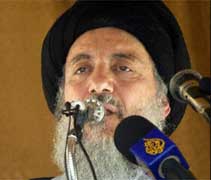
Hakim was killed
|
NAJAV,
Iraq, August 29 (IslamOnline.net & News Agencies) – A car bomb
explosion killed at least 82 people and wounded 229 others outside one
of Shiite Islam's holiest shrines in the central Iraqi city of Najaf
Friday, August 29, medical sources said.
The
explosion killed Iraqi Shiite leader Ayatollah Mohammad Baqer al-Hakim,
one of Iraq's best-known Shiite Muslim politician and head of the
Iran-backed Supreme Assembly of the Islamic Revolution in Iraq (SAIRI).
Hakim,
who spent some 20 years in exile in Iran before returning in triumph to
Iraq earlier this year, "met a martyr's fate along with his
bodyguards," Mohsen Hakim, political adviser to the ayatollah's
brother Abdel Aziz, told Agence France-Presse (AFP) in tears.
In
one of the most violent days in the occupied country, a car bomb
explosion killed at least 82 people and wounded scores more outside one
of Shiite Islam's holiest shrines in the central Iraqi city of Najaf
Friday, an AFP correspondent witnessed.
Scores
of corpses were picked off the ground outside the Tomb of Ali as
blood-spattered casualties wandered around the square in panic moments
after the blast in the holy city, 180 kilometers (110 miles) south of
Baghdad.
Several
shops were gutted by the blast which struck as the faithful left after
afternoon prayers on the main Muslim day of worship.
Smoke
filled the area as five charred cars burned. One was thrown at least 100
meters (yards).
People
were buried beneath the rubble of a gate to the compound and two nearby
restaurants and shops, which were flattened by the explosion.
Iraqi
police supervised rescue efforts as a few U.S. soldiers watched on.
Onlookers
shouted: "Allahu Akbar" (God is Greater) every time a body was
lifted from the heap of metal and brick.
Outdoor
vendors and worshippers had gashes on their faces from flying glass.
An
announcement over the mosque's loudspeakers urged residents to go to the
local children's hospital to donate blood.
The
offices of firebrand anti-American cleric, Moqtada Sadr, were also
damaged in the blast.
The
gates of the mosque were shuttered and guarded by dozens of Iraqi
police, while three fire trucks were positioned around the compound.
Police
hauled away cars left in the area for fear that more bombs might be
hidden.
Minutes
before the blast, worshippers were listening to the weekly prayer sermon
delivered by Baqer al-Hakim, head of the SAIRI, the country's main
Shiite political party.
Earlier,
an announcement over the mosque's loudspeakers said Hakim had survived
the blast.
The
car exploded outside the shrine compound's southern gate where Hakim
normally enters and exits on Fridays.
An
angry crowd outside shouted slogans against fallen dictator Saddam
Hussein and the Baath party in the moments after the blast.
Hakim
had denounced Saddam and the Baath party during his sermon.
Kurdish
Deputy Security Chief Killed
|
|
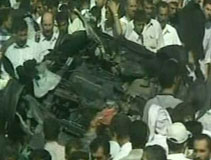
A burned car, possibly the one used in the explosion
|
In
another violent incident, the deputy security chief for the Kurds in the
northeastern Iraqi province of Sulaimaniya has been shot dead by Ansar
al-Islam group, an official from the Patriotic Union of Kurdistan (PUK)
told AFP Friday.
Sulaimaniya's
deputy security chief, Hama Hussein, was shot dead Wednesday afternoon
by four Ansar members, as he approached the house where his forces had
them surrounded in the middle of the city, the official said.
The
militants had agreed to negotiate with Hussein and, as he walked towards
the agreed meeting point, he was hit by bullets, the official said.
In
the ensuing battle, three Ansar members were killed and one arrested,
the official said.
Along
the porous border with Iran, Ansar, espousing a puritanical vision of
Islamic law, ruled a handful of villages for nearly two years and
allegedly struck up ties with the al-Qaeda network before being crushed
by U.S. special forces at the end of March.
Now
five months later, Ansar fighters are believed to have slipped back
inside Iraq from Iran, across the mountainous border, posing a threat in
the minds of the Americans and the PUK, the party of Jalal Talabani
which dominates life in the eastern part of Iraqi Kurdistan.
The
country's U.S. civilian administrator, Paul Bremer, warned repeatedly
that hundreds of the group's followers have returned to plot
"terror attacks" around the country.
Kurdish
officials have also blamed Iran for allowing the Ansar fighters to
return.
|