|
Russian Leader Dismisses Chechen Elections As 'Farce'
 |
|
"What
is the point of this election, seeing that Kadyrov, hated by 70
percent of Chechens, is incapable of restoring peace in the
republic?" Nemtsov said
|
MOSCOW,
October 1 (IslamOnline.net & News Agencies) – While human
rights activists accused the Kremlin of intimidation after a Moscow
cinema cancelled a festival of documentaries on the horrors of the war
in Chechnya, a leading Russian opposition politician Wednesday,
October 1, denounced as "a farce" the Moscow-sponsored
presidential election in the troubled southern republic of Chechnya,
saying electors had been given no choice.
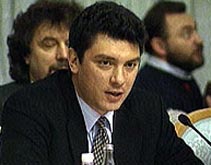
Boris
Nemtsov, leader of the centre-right Union of Rightist Forces (SPS),
said his party will not send observers to Sunday's poll in which the
pro-Russian head of the Chechen administration, Akhmad Kadyrov, is a
near-certain winner, reported Agence France-Presse (AFP).
The
poll is a "farce" marked by "a lack of choice,"
Nemtsov told a press conference.
"What
is the point of this election, seeing that Kadyrov, hated by 70
percent of Chechens, is incapable of restoring peace in the
republic?" Nemtsov said.
"This
election will not end either the atrocities or the sweep operations
(by the Russian military) nor the attacks," he said.
Media
reports said last month that the Kremlin had rigged the race
for the sake of Kadyrov after four front-runners had mysteriously
withdrawn or been ejected from Chechnya's troubled election, leaving
Kadyrov as the almost certain winner.
Moscow's
key objective was to sideline Aslan Maskhadov, who was elected in
Chechnya's only free presidential polls, in 1997.
Chechen
lawmakers have repudiated
claims by pro-Moscow parliament deputy speaker Issa Temirov
that they have signed a petition to overthrow Aslan Maskhadov from his
post as president of Chechnya.
Maskhadov,
who is not taking part in presidential election, was elected to a
five-year term in 1997 after the republic won de facto independence
from Russia following a brutal 1994-96 war.
The
presidential election campaign started
officially Friday, September 5, amid controversy and cries of
foul play.
International
organizations including the Organization for Security and Cooperation
in Europe (OSCE) have also declined to send observers to the troubled
poll.
Kremlin
Intimidation
Meanwhile,
Russian human rights activists Wednesday accused the Kremlin of
intimidation after a Moscow cinema abruptly cancelled a festival of
hard-hitting documentary films providing graphic and sometimes
harrowing accounts of the war in Chechnya as seen through the eyes of
local people, Russian soldiers sent to the republic to enforce the
Kremlin's rule and their parents.
Some
recount the difficulties and dangers faced by journalists attempting
to report on the war.
Festival
organizer Yury Samodurov said he was informed late Tuesday, September
30, by the cinema, the popular Kinocentre in central Moscow, that it
would not host the free festival, already presented in Washington, New
York and London, as previously agreed.
"My
feeling is that the Kinocentre has come under pressure from the FSB
(the Russian intelligence services," AFP quoted Samodurov as
telling a press conference.
Cinema
manager Vladimir Medvedev told Moscow Echo radio that the non-Russian
films "showed anti-Russian tendencies."
Moreover
the films were "pure politics, and we are apolitical. There was
no pressure on us, we simply don't show political films," he
said.
But
members of the festival organizing committee were in no doubt where
the responsibility for the cancellation lay.
"This
is absolutely a political decision," said Anna Politkovskaya, the
campaigning journalist who earlier this month presented the films in
Britain and the U.S.
"I
thought this would be impossible. I'm shocked," she said.
"For me the whole point of organizing the festival was that it
should reach a wider public."
The
cancelled program included "Assassination of Russia", a
documentary funded by the self-exiled billionaire Boris Berezovsky,
one of the Kremlin's strongest critics, that accuses the FSB of
staging the 1999 apartment bombings that served as a pretext for the
current Chechen war.
Other
films were from Britain's Channel Four television: "Terror in
Moscow", about last year's hostage crisis in a Moscow theatre in
which 129 people died after special forces used gas to stun the
hostage-takers, and "Babitsky's War", about a Russian
reporter in Chechnya who was kidnapped by the secret services.
Politkovskaya
dismissed on Monday, September 29, as "a
political scandal" the decision taken by the Frankfurt
International Book Fair to retract an invitation to the
much-celebrated event set for October 8.
She
said the pressures exercised by the Russian authorities have paid off,
particularly in light of the forthcoming visit of Russian President
Vladimir Putin to the Fair.
|