|
Three U.S. Soldiers Killed, Wolfowitz In Iraq
 |
|
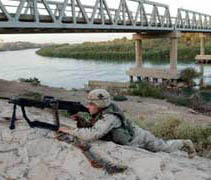
108 U.S. soldiers have been killed in Iraq since May 1
|
BAGHDAD,
October 24 (IslamOnline.net & News Agencies) - As U.S. Deputy
Defense Secretary Paul Wolfowitz flew into Iraq to meet with U.S.
commanders and top officials, two U.S. soldiers were killed and four
wounded in a mortar attack north of Baghdad Friday, October 24,
raising the U.S. death toll to three in one day.
The
Pentagon provided no other details on the trip by Wolfowitz, a driving
force behind America's invasion of Iraq, which comes amid debate over
the progress of the U.S.-led occupation and a battle on the ground
against Iraqi resistance elements opposed to the U.S. presence.
The
hawkish Wolfowitz arrived in Baghdad on a four-day tour of the
country, where U.S. commanders warn they are facing a tougher fight on
the ground and the U.S.-sponsored interim Governing Council is
demanding greater power from the coalition, reported Agence France-Presse
(AFP).
A
U.S. base in Samarra, 125 kilometers (78 miles) from Baghdad, took two
mortar shells at 1:00 pm (1000 GMT), leaving two soldiers dead and
four wounded, said Major Josslyn Aberle of the Fourth Infantry
Division, according to AFP.
The
wounded were evacuated to a combat hospital.
Earlier
Friday, another soldier was killed as he guarded a grain silo in the
northern Iraqi city of Mosul, the U.S.-led occupation forces said in
Baghdad. The killings raise to 108 the number of U.S. soldiers killed
since major hostilities were declared over on May 1.
Another
attack Thursday night on a Baghdad market left one Iraqi dead and six
wounded, just ahead of the Muslim holy month of Ramadan. The market
was only 30 meters (yards) from where a bomb was discovered hours
earlier hidden next to a school, the sources told AFP.
Since
August 2003, there have been several attacks, mainly car bombings,
claiming the lives of U.N. officials, Iraqi religious leaders,
policemen and scores of innocent bystanders across Iraq.
While
civilians were being struck down, the four-month-old battle between
resistance fighters and U.S. forces raged on north and west of the
capital, home to what Washington claims to be "the bedrock of
Saddam Hussein supporters".
Two
U.S. soldiers were wounded in a bomb blast Friday that damaged one of
the vehicles in the convoy in which they were traveling in Fallujah,
west of Baghdad, witnesses said.
Anti-American
Protests
Meanwhile,
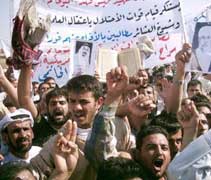
more than 100 Iraqis clashed with police in Fallujah after a giant
outdoor prayer service was held Friday in protest against U.S. forces.
People
threw stones at a wall of policemen who stopped them from ransacking
the office of the U.S.-backed mayor in this flashpoint town, an AFP
correspondent witnessed.
Rebuffed,
the demonstrators marched down the street, shouting: "Americans
be patient. Fallujah will dig your grave."
The
brief skirmishes in the town, considered ground zero of the resistance
to .U.S forces, broke out after a prayer service attended by
thousands, which denounced U.S. soldiers' conduct in Fallujah.
Sunni
scholar Dr. Mekkhi Hussein told the faithful, "I say to the
Muslims, wounded Baghdad is calling and screaming to you, asking you
for help. And so is Prophet Mohammed and all who follow him," he
added, in what amounted to an implicit nod to the resistance.
"You
Americans must understand that communities cannot be ruled by the
whip. Friendship cannot be made by force," he preached. "You
must know the Muslims will not bow to anyone."
All
other mosques had been shut down ahead of the prayer service,
following a tense few weeks during which a Sunni imam was arrested by
the Americans and soldiers have come under constant attack.
 |
|
Iraqi protesters
|
Mekkhi
warned the Americans to release Sheikh Jamal Shaker Nazzal, 61,
arrested by U.S. forces along with tribal leader Barakat Saadun Aifan
and four religious students from the Al-Kabir mosque on October 13.
"So
you Americans should know that, Sheikh Jamal and his brothers who are
held by you, we can get them out either by asking or by force."
As
the demonstrators took to the street, many yelled slogans against
right-wing Israeli Prime Minister Ariel Sharon, considered an enemy of
the Arab world and an ally of the United States.
"There
is no God but Allah. Sharon is the enemy of God. The army of Mohammed
is coming back," the crowd shouted in a call-and-response to
Sheikh Abdul Monem Shaqer, who was carried on the people's shoulders,
as they swept past police.
A
huge divide has grown between U.S. forces and Fallujah residents since
soldiers first opened fire on a demonstration in April 2003, killing
at least 16.
Hitch
Over Turkish Troops For Iraq
In
a separately-related development, Turkish Prime Minister Recep Tayyip
Erdogan acknowledged Friday that the United States had suspended talks
with his country over the possible deployment of Turkish troops in
Iraq, the NTV news channel reported Friday.
The
remarks came amid intense speculation in Ankara that the United States
is about to give up on the idea of Turkey sending troops to Iraq
because it cannot convince that country's local leaders that it would
be a good idea.
"The
United States called our general staff some time ago and said 'give us
some time... and we will continue later,'" Erdogan told Turkish
reporters during a visit to Tajikistan, according to NTV, AFP said.
He
said, however, that "the fact that a pause has been called in the
talks does not mean that this job is over."
"The
government is always ready. We do not know what the United States will
do... We will look at the proposal they will bring us and make a
decision," he was quoted as saying.
Erdogan
said scrapping the troop plan would not be a problem for Turkey.
The
Ankara government is already under strong pressure from its public
opinion, strongly opposed to the troop plan.
U.S.
State Department spokesman Adam Ereli said Thursday that Washington
was still hoping to find a solution to the wrangle that would satisfy
both parties.
The
Iraqi Kurds, who have long had stormy relations with Ankara, are
particularly hostile to a Turkish deployment.
They
fear that Turkey, which borders the mainly Kurdish region of Iraq,
could attempt to thwart their political gains in the post-Saddam
Hussein era.
|