|
Iraqis Protest U.S. Raids On Mosques
 |
|
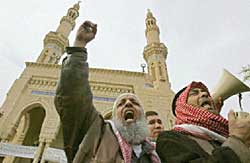
The protestors called for holy struggle against the American occupation forces
|
By
Aws Al-Sharqy, IOL Correspondent
BAGHDAD,
January 2 (IslamOnline.net & News Agencies) - Massive
demonstrations erupted in Baghdad Friday, January 2, in protest at a
U.S. military raid on a capital mosque and detention of a number of
prominent Sunni scholars a day earlier.
Sheikh
Mahdi Al-Someidah, a member of the Supreme Authority for Religious
Guidance and Awareness (A newly-founded Sunni Gathering), was detained
along with 20 of his followers and worshippers in a massive sweep that
lasted for six hours.
The
protestors called for holy struggle against the American occupation
forces during the Friday noon prayer at the Ibn Taimiya mosque in the
Yarmuk district of Baghdad.
U.S.
armored vehicles sealed off the mosque in southwestern Baghdad a day
earlier in an operation to detain Someidah, witnesses said.
“The
wave of detentions - carried out on false pretexts - reveal concealed
plots to drive a wedge between people of the same religion,” said
Adel-Samaray, a mosque imam in Baghdad.
He
was referring to U.S. targeting of Sunnis on claims that they are
mainly to blame for the rising attacks against occupation forces and
rewarding Shiites for stopping short of declaring struggle against
occupation.
Moving
west, more than 1,000 soldiers and 500 Iraqi policemen carried out a
large-scale sweep for an alleged fundamentalist cell responsible for
attacks against American forces. Nine people were detained.
In
the western town of Ar-Rutbah, soldiers from the Third Armored Cavalry
Regiment on Thursday caught a man they suspected of managing the
movement of what they call “foreign fighters inside Iraq from
Syria”.
They
billed him as a "high-value target" for the U.S. military
command, but did not rank where he stood on the U.S. military's most
wanted list, Agence France-Presse (AFP) reported.
Rutbah,
375 kilometers (233 miles) west of Baghdad, home to the flashpoint
towns of Ramadi and Fallujah, is rife with jeering anti-American
sentiments among embattled Sunni Muslim population.
 |
|
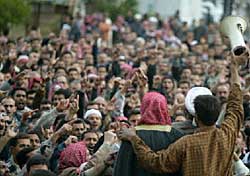
The raid was denounced by Imams as a violation of religious and human rights of Sunnis
|
Analysts
and observers said that the U.S. raids that single out Sunni areas
could flare up ethnic tensions in the already-turbulent country - a
key destabilizing element the occupation forces may use to justify
presence in the oil-rich country after the capture of former Iraqi
President Saddam Hussein and finding no weapons of mass destruction.
Sectarian
Army
In
another related development, a senior U.S. military official said that
the new Iraqi army is now being formed on sectarian basis, where
Shiites make up 40 per cent of its members and both Sunnis and Kurds
only 60 per cent.
Speaking
in an interview aired by Iraqi broadcasters, Jeffery Pektan, who is
responsible for coordination with the Iraqi army, gave no mention of
the percentage of Turkmen or Christians in the new army.
Shiites
were already given a higher representation in the new army than that
in the U.S.-sanctioned Governing
Council and cabinet, whose 25 members comprised 13
Shiites, 5 Sunnis, 5 Kurds, 1 Christian and 1 Turkman.
The
first recruits of the New Iraqi Army (NIA) graduated
on September 15 at a small northern borderline Iraqi town, with 60
percent Shiites, 25 percent Sunnis and 10 percent Kurds.
Iraqi
analysts say that the U.S. sectarian-based distribution of posts in
the council and in the army are based on a misleading census in 1970s
that found Shiites making up 60 per cent of the population.
Iraqi
Sunnis are bitterly
resentful at being marginalized under the new U.S.-led
order in post-war Iraq, charging that the Americans were rewarding the
Kurds and the Shiites with mapping out the country's political
landscape.
Earlier
this week, at least five people were killed when gunfire erupted as
Turkmens and Arabs faced off with the mainly Kurdish police during a
protest against a plan to include Kirkuk in a Kurdish administrative
unit.
Arabs
and Turkmen in Kirkuk are bitterly opposed to a plan by Kurds on
Iraq's U.S.-appointed Governing Council to grant significant autonomy
to a Kurdish area based in three provinces they wrested from Baghdad
after the 1991 Gulf War, and which would include Kirkuk.
More
U.S. Casualties
 |
|
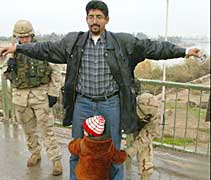
Frisking him before the eyes of his frightened kid
|
In
the meantime, a U.S. soldier was killed and another wounded in a
helicopter crash in central Iraq Friday.
A
policeman who witnessed the helicopter crash, which occurred about 32
miles west of Baghdad near the volatile town of Falluja, told Reuters
that the aircraft was shot down, although the U.S. military could not
immediately confirm that.
“We
were in a joint patrol with U.S. troops to remove land mines and I saw
a helicopter hovering in the sky which was hit by a missile,"
policeman Mohammad Abdul Aziz said.
A
U.S. military spokeswoman said the helicopter, an OH-58 observation
chopper, came down around 12:50 p.m. near Falluja but had no further
details. She said the cause of the crash was under investigation.
Also,
a roadside bomb killed an Iraqi civilian Thursday when he stepped from
his car to relieve himself near Kirkuk in northern Iraq, police said.
Abbas
Omar Mohammad had stopped at around 6:00 a.m. (0300 GMT) on the road
between Kirkuk and Sulaymaniya, Major Khodayer Ahmad Hassun, police
said.
The
road is used by U.S. troops, the frequent target of roadside bombs
laid by resistance fighters, to go on leave in Sulaymaniya, which is
controlled by the pro-U.S. Patriotic Union of Kurdistan.
|