|
Bush Planned Iraq Invasion Before 9/11: O'Neill
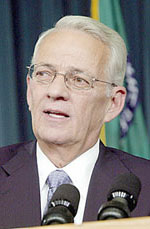 |
|
"From
the very beginning, there was a conviction that Saddam Hussein was
a bad person and that he needed to go," O'Neill (AFP)
|
WASHINGTON,
January 12 (IslamOnline.net & News Agencies) - President George W.
Bush was intent on ousting Iraqi leader Saddam Hussein long before the
September 11 attacks in the United States, former Treasury secretary
Paul O'Neill has told U.S. media.
"From
the very beginning, there was a conviction that Saddam Hussein was a
bad person and that he needed to go," O'Neill told the CBS
television program "60 Minutes," in an interview broadcast
Sunday, January 11.
"For
me, the notion of pre-emption, that the U.S. has the unilateral right
to do whatever we decide to do, is a really huge leap," Agence
France-Presse (AFP) quoted him as saying.
O'Neill,
a former CEO of aluminum giant Alcoa and known for his outspoken
talks, was forced to resign in December 2002 for publicly doubting the
need for the President's sweeping tax cut plans.
O’Neil’s
count will be the main source of former Wall Street Journal reporter
Ron Suskind’s 'The Price of Loyalty Book' - expected to be published
Tuesday, January 13.
It
paints an insider's picture of the White House under Bush according to
19,000 documents provided by O'Neill and dozens of former Bush
officials.
In
the book, O'Neill said in all cabinet meetings, Bush "was like
a blind man in a room full of deaf people. It was similar in
one-on-one meetings," said the former executive, who was sworn in
as the 72nd Secretary of the Treasury on January 20, 2001.
Bush
took office in January 2001 - and in his first three months in power,
officials were already looking at military options to remove Saddam
from power, according to documents that O'Neill and other White House
insiders gave author reporter Suskind.
One
of the memos, marked "secret," says "Plan for
Post-Saddam Iraq," Suskind told "60 Minutes."
No
Evidence
In
a separate interview with Time magazine, O'Neill further said
that he never say any evidence of Iraqi alleged weapons of mass
destruction, the central rationale for the U.S.-led war in his
capacity as a former member of Bush's national security team.
"In
the 23 months I was there, I never saw anything that I would
characterize as evidence of weapons of mass destruction," said
O'Neill, who was sworn in as the 72nd Secretary of the Treasury on
January 20, 2001.
"To
me there is a difference between real evidence and everything else.
And I never saw anything in the intelligence that I would characterize
as real evidence."
O'Neill
told Suskind he was surprised that no one on Bush's national security
council - which includes national security adviser Condoleezza Rice,
Secretary of State Colin Powell and Defense Secretary Donald Rumsfeld
- questioned why Iraq should be invaded.
"It
was all about finding a way to do it," O'Neill is quoted in the
book as saying. "That was the tone of it, the President saying,
'Go find me a way to do this.'"
One
Pentagon document titled "Foreign Suitors For Iraqi Oilfield
Contracts," talks about "contractors around the world from
... 30, 40 countries and which ones have what intentions on oil in
Iraq," according to Suskind.
White
House spokesman Scott McClellan Friday deflected repeated questions
about O'Neill's assertions.
"I
don't do book reviews," he said.
O'Neill's
"unflattering count" is seen as the strongest criticism of
the Bush administration from a former insider since the president came
to power.
He
was the first cabinet member to leave since Bush took office in
January 2001. Environmental Protection Agency head Christine Whitman
left in June 2003.
Housing
and Urban Development Secretary Mel Martinez quit in December 2003.
O'Neill's
diatribe against Bush is the latest in a series of anti-Bush remarks
and campaigns by scores of U.S. officials and celebrities.
Last
month, New York Senator Hillary Clinton criticized the
"extremist agenda" of Bush, charging his
administration of "making America less free, fair, strong, [and]
smart".
|