|
Kirkuk Blast Kills 10, Rumsfeld Assesses ‘Security’
 |
|
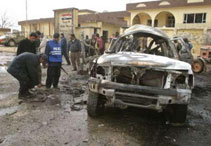
The explosion occurred at a time when 400 policemen were changing shifts
|
KIRKUK
,
Iraq
, February 23 (IslamOnline & News Agencies) - A car bomb ripped
through a police station in the northern Iraqi city of
Kirkuk
, killing at least seven policemen and the two bombers, shortly before
U.S. Defense Secretary Donald Rumsfeld flew in to
Baghdad
.
Police
Sergeant Mohammad Mortada said two people drove up to the station in a
white Oldsmobile and blew up the vehicle, packed with nails and 50
kilograms (110 pounds) of TNT, reported Agence France-Presse
(AFP).
Reuters
reported that the attack killed 13 people and wounded 51, while the AP
said that al least 10 were killed.
The
explosion occurred at
8:30 am
(0530 GMT) as 400 policemen changed shifts, said the station chief,
Colonel Adel Zain Al-Abadin Ibrahim.
Dr.
Hashem Mohammed of the city's Azadi hospital put the number of
policemen killed at seven, along with the two bombers who were
completely incinerated by the blast.
Another
45 people were wounded, all but 10 of them policemen, said the city's
police chief, Turhan Youssef.
As
in past such attacks, there was no immediate claim of responsibility,
but Ibrahim said two men had been arrested near the station and
brought in for questioning.
The
explosion in the Kurdish Rahimawa neighborhood was the latest in a
string of deadly attacks this month against U.S.-trained Iraqi
security forces.
Some
47 Iraqis perished
in a car-bomb attack at a
Baghdad
recruitment center for the New Iraqi Army on February 11 a day after a
bombing at a police station south of
Baghdad
killed
up to 50 people.
At
least 250 Iraqis have been killed so far in February 2004, making it
the bloodiest month in
Iraq
since the
U.S.
invasion and occupation of
Iraq
and the fall of Saddam Hussein in April 2003, the interior ministry
said Monday.
Meanwhile,
the brother of a high-ranking Iraqi security official in the town of
Samarra
, 125 kilometers (80 miles) north of
Baghdad
, was shot dead on Monday, medical sources said.
“Unknown
attackers opened fire at
9:00 am
(0600 GMT) on Othman Aziz Mohammad, hitting him in the head as he was
on duty in the town's truck station,” said the head of the local
hospital, Abdel Tufiq.
The
30-year-old victim was a member of the U.S.-trained Iraqi Civil
Defense Corps, which is headed in
Samarra
by his brother, Colonel Ahsan Aziz Mohammad.
Rumsfeld
Back
|
|
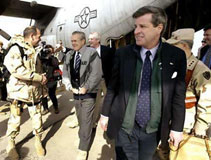
Rumsfeld (C) is escorted by Bremer (R), after his arrival in Baghdad |
Meanwhile,
U.S. Defense Secretary Donald Rumsfeld was met at
Baghdad
airport by
U.S.
civil administrator Paul Bremer after flying in from
Kuwait
on his fourth visit to the region since U.S.-led forces occupied
Iraq
last April.
Bremer
then flew by helicopter with the defense secretary to a forward
operating base of the 2nd Light Cavalry Regiment on the east side of
the capital, AFP said.
Rumsfeld
was briefed on plans to reduce the
U.S.
military presence in
Baghdad
, shrinking the number of troops inside the city from 36,000 to 24,000
by May 15, and the number of bases in the capital from 48 to eight.
Replacing
them will be 12,000 Iraqi police and seven battalions of the civil
defense corps, Brigadier General Martin Dempsey told Rumsfeld.
Rumsfeld
observed that the Iraqi security forces will soon reach the 226,000, a
force larger in number at least than any other contingent of the
U.S.-led occupation here.
U.S.
military officials, however, acknowledged that the Iraqis are still
far from being fully trained or equipped for their mission.
Bremer
told reporters traveling with Rumsfeld that attacks like the one in
Kirkuk
aimed at “disrupting
U.S.
plans to shift greater weight for security to Iraqi forces”.
“It
is certainly the same method of operation and it certainly suggests
the terrorists are targeting these security forces because as the
Zarqawi letter makes clear, that's one of his prime targets,” he
said.
Bremer
was referring to a captured letter attributed to Abu Musab Al-Zarqawi,
a Jordanian believed to have ties to Al-Qaeda.
Amid
the almost daily attacks on
U.S.
troops, Rumsfeld held talks with occupation and military officials
about the troubled transition to Iraqi sovereignty.
U.N.
Secretary General Kofi Annan said last week that it was not feasible
to hold elections before June 30, when the
U.S.
occupation forces should hand over power to a provisional Iraqi
government.
But
Annan told reporters that the June 30 date
Washington
had fixed for a transfer of sovereignty “must
be respected”.
Bremer,
however, said Saturday, February 21, that elections would
be impossible to be held for at least one year, setting the stage
for another clash with the Iraqis demanding a swift end to occupation
of the oil-rich country.
|