|
Sadr Ready To Face Trial Under Legitimate Iraqi Gov’t
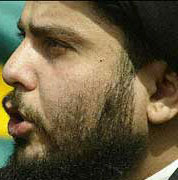 |
|
Sadr
"has agreed to appear before court after the formation of a
legitimate and democratic government"
|
BAGHDAD,
April 14 (IslamOnline.net & News Agencies) -
Shiite leader Moqtada Sadr is willing to stand trial on charges
of killing a rival scholar but only under a future "legitimate
and democratic" government in Iraq, an aide said on Wednesday,
April 14.
"Sayyed
Moqtada has agreed to appear before court after the formation of a
legitimate and democratic government," Haidar Aziz told Agence
France-Presse (AFP).
Aziz
said that Sadr is ready to transform his Mehdi Army militia into a
political and social organization with no military activities.
The
statements came after General Richard Myers, the chairman of the U.S.
joint chiefs of staff, said Sadr, who has "incited violence and
sparked unrest" in Iraq "must be brought to justice".
"The
Iraqi court system wants Sadr ... He has to be brought to justice ...
The coalition will help bring him to justice," Myers told a press
conference in Kuwait after talks with the emirate's leaders.
"This
individual has incited violence against the coalition. He is also
responsible for lack of progress in Iraq in terms of his opposition to
the transitional administrative law," Myers said.
But
the top U.S. military official declined to say if the threat to kill
Sadr was still an option for the U.S.-led forces, saying that a number
of Shiite leaders were negotiating with Sadr to bring a peaceful end
to the standoff.
General
Myers said the U.S. forces had reinforced their forces around the
Shiite holy city of Najaf, where Sadr is believed to be staying, but
refused to say if the U.S.-led forces would attack the city to capture
the Shiite leader.
Myers
said that detaining Sadr might trigger some ‘violent reactions’,
but only for a temporary period.
The
U.S. forces were Wednesday poised to detain or assassinate Sadr, as
the Shiite leader has told journalists he is ready for outside
mediation to end the standoff peacefully.
U.S.
President George W. Bush warned in a Washington press conference on
Tuesday, April 13, that Sadr must answer murder charges against him
and disband his banned Mehdi Army.
Conditions
Dropped
This
comes as another close aide of Sadr told reporters in Najaf that the
Shiite leader had agreed to drop all his conditions in negotiations
with the U.S. occupation forces and to follow the guidance of the
highest Shiite religious authority.
"Moqtada
Sadr is ready to accept what the Marjaiya (the top Shiite spiritual
leaders) ask for and to drop the conditions he had set for a
mediation," Qais Al-Khazaali told a press conference in Najaf.
He
said the Marjaiya had chosen a delegation to negotiate with the U.S.
side.
The
delegation is led by Abdel Karim Al-Aanazi, who heads the breakaway
faction of the Daawa party led by Ibrahim Jaafari.
A
Sadr spokesman however said Wednesday that Sadr loyalists were
prepared to resist "political pressure as well as a (military)
confrontation."
"The
reinforcements which the U.S. military talks about are aimed at either
putting pressure to secure political concessions or at invading
Najaf," said Sheikh Kais Khazaali.
"We
are ready to face both scenarios," he said.
U.S.
commanders said they were massing troops around Najaf a day after Bush
warned in a Washington press conference that Sadr must answer murder
charges against him and disband his banned Mehdi Army.
Iranian
Support
Meanwhile,
an official Iranian delegation arrived from Tehran to try to avert
violence and was expected to meet Sadr, according to his aide Aziz.
"The
Iranian foreign ministry delegation has arrived but we still do not
know the identities of the members of this delegation," he said.
"We
are going to meet with them, and they may meet with Sayyed Sadr,"
said the aide.
Tehran
earlier said it had received a U.S. request for assistance to mediate
in the conflict.
A
senior State Department official said Washington would welcome
"constructive" Iranian efforts to calm the volatile security
situation in southern Iraq.
"As
far as Iranian involvement in southern Iraq, it is our position that
to the extent that Iraq's neighbors can help calm the situation and
help achieve a stable transition, those efforts would be
welcome," the official said.
"We
have made it clear to the Iranians that they need to play a
constructive and not a destructive role in southern Iraq," the
official told AFP on condition of anonymity.
The
official said there has been "occasional" contact between
the United States and Iran through established diplomatic channels -
which normally refers to messages passed through the Swiss embassy in
Tehran.
Some
U.S. officials and lawmakers claimed that Iran may be "fomenting
unrest"
among the Shiite community in southern Iraq.
Iranian
Foreign Minister Kamal Kharazi said in Tehran that following the U.S.
request, Iran had sent the delegation to see what it could do to end
the standoff between the U.S. forces and Sadr.
|