|
Deal
Clinched, Families Returning To Fallujah
 |
|
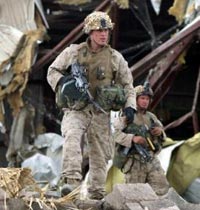
U.S.
Marines pass a building they destroyed in Fallujah
|
FALLUJAH,
April 20 (IslamOnline.net & News Agencies) - One day after a deal
was struck to defuse tensions following a two-week siege by U.S.
marines, Iraqi civilians started returning to their homes in the
resistance bastion of Fallujah Tuesday, April 20.
Hundreds
of Iraqis lined up at the edge of the city, 50 kilometers (30 miles)
west of Baghdad, and were allowed in after being searched by marines,
according to an Agence France-Presse (AFP) correspondent at the scene.
Some
100 cars and lorries carrying those returning formed a long queue at a
checkpoint by the main road linking Baghdad with the Jordanian and
Syrian borders.
The
U.S. occupation forces, helped by Iraqi police and members of the
paramilitary Iraqi Civil Defense Corps (ICDC), checked identity papers
and screened the returning civilians with metal detectors.
The
start of the return of thousands of civilians who fled fighting in the
city was included in a deal hammer out Monday, April 19, between the
occupation authority and leading figures from Fallujah after several
days of talks.
One
of the Iraqi mediators voiced optimism Tuesday about implementing the
ceasefire accord while occupation spokesman Dan Senor threatened if
the deal did not hold, "major hostilities" could resume at
short notice.
However,
there was no reaction from the resistance fighters in Fallujah who
have been battling U.S. occupation forces inside the western Iraqi
town.
"We
are optimistic about the willingness of the (Iraqi) fighters to
respect the ceasefire which was decided by the coalition and the
city's community leaders," Faud Rawi, of the Iraqi Islamic Party
told AFP.
"The
crisis has been contained to some degree, which averts the destruction
of the city, and things are beginning to return to normal," added
the mediator.
Rawi
stressed that the head of the Iraqi police and the commander of the
ICDC had returned to Fallujah and joint patrols with the U.S. marines
had begun.
"The
process of collecting arms has also begun and some were turned over to
police stations" as stipulated by Monday's accord, he added.
 |
|
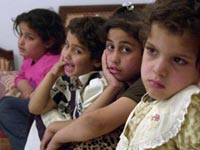
Girls
from Fallujah, now called refugees
|
In
another sign of easing tension, Rawi cited the withdrawal of marines
from the town of Amiriyat Al-Fallujah, 20 kilometers (12 miles) south
of Fallujah.
Under
the terms of the agreement, an arms amnesty has been called in an
"initial effort to restore security" covering weapons from
sniper rifles to surface-to-air missiles and ammunition.
"Those
who give up their weapons voluntarily will not be prosecuted for
weapons violations and unarmed individuals will not be attacked,"
the occupation authority spokesman told reporters.
"The
parties agreed that coalition forces do not intend to resume offensive
operations if all people in the city turn in their heavy weapons,
"Senor added.
A
previous arms amnesty organized by the occupation authority nationwide
ahead of the introduction of weapons controls in June last year
prompted only a meager response.
"The
parties reaffirmed the absolute need to restore law and order in the
city as quickly as possible, to rebuild the judicial system and to
initiate... investigations into criminal acts," Senor said.
He
said local security agencies including the police and civil defense
forces, with "coalition" support, "must move to
eliminate remaining foreign fighters, criminals and drug users in
order for stability and security to occur."
Terms
Of The Deal
 |
|
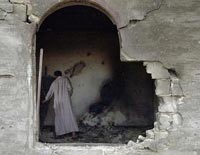
A
man searching through his shelled home in Fallujah
|
Following
are the key points of the Fallujah deal, according to AFP.
-
Regular joint patrols in the city by occupation troops and Iraqi
security forces.
-
Illegal weapons and ammunition to be handed in including mortars,
grenades, and surface-to-air missiles.
-
The occupation authority does not "intend" to resume
offensive operations if heavy weapons are handed over.
-
Police, Iraqi paramilitary forces and those in the city must drive out
foreign fighters, criminals and drug users.
-
The judicial system to be rebuilt with crimes including the killing of
four American contractors to be investigated by Iraqis.
-
The occupation to allow unfettered access to Fallujah General Hospital
for treatment of the sick and wounded.
-
Arrangements to be made to remove and bury the dead and provide food
and medicine to isolated areas of the city.
-
Curfew hours to be shortened by two hours to allow people to go to
mosques in the evening.
-
Ambulances to be allowed to travel more easily through the city,
particularly at checkpoints.
-
Security, medical and technical staff to be helped to gain access to
the city to work. - Consideration also to be given to families wanting
to get into the city.
|