|
U.S.
Military Presence In S.East Asia Rejected
|
|
|
File
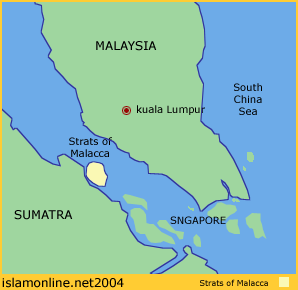
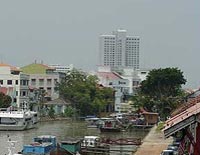
photo of straits of Malacca
|
By
Kazi Mahmood, IOL Correspondent
KUALA
LUMPUR, May 10 (IslamOnline.net) - The attempts of the United States
to have a military presence in South East Asia (SEA) were rejected by
most countries of the region.
Washington
has raised concerns over increasing piracy in the Straits of Malacca,
which rests between Malaysia and Indonesia, and has offered to build a
military base in southern Thailand allegedly to help crush mounting
Islamic militancy in the largely Muslim-dominated provinces there.
Malaysia
and Indonesia unanimously rejected on Friday, May 7, any foreign
presence in the Straits, saying that they are capable of handling
security in their waters themselves.
Both
countries expressed their stand at the end of the eighth
Malaysia-Indonesia Joint Commission meeting in Jakarta, according to
Antara the Indonesian news agency.
Domination
Sayed
Abdullah, an expert on regional Military affairs, said the attempts
are part of the U.S. effort to dominate the region.
"Malaysia
and Indonesia are Muslim nations and they have absolute control over
the Straits of Malacca, which is now the object of desire of the
U.S.," Abdullah told IslamOnline.net on Sunday, May 10.
"It
is obvious that the U.S. is desperate to establish a military base in
the SEA in order to have a direct control and rapid access in the
Muslim countries here," he averred.
Abdullah,
who operates an intelligence services firm in Indonesia, said it has
already achieved a status of deep "military cooperation"
with the Philippines and Thailand, and it is the protector of
Singapore in case of a conflict.
"It
has a foothold in Australia, which is one of its closest allies in its
wars of expansion in the Middle East and Asia", he said.
'Mouthpiece'
Abdullah
said the U.S. seems to be using Singapore "as mouthpiece to
pressure Indonesia and Malaysia over the Straits of Malacca, which it
claims is infested with pirates who are linked to terrorism in the
region".
Earlier
last month, Singapore, officially the third littoral state in the
Straits of Malacca, urged the U.S. to have a military role in the
straits, arguing that Malaysia and Indonesia did not have enough
military power to protect the international vessels using the straits.
The
Singaporean government had also approached the Indonesian government
to consider allowing the U.S. to have a role in the security of the
straits, raising the specter of increased terror acts on the seas as
the reason for their request.
It
said on Friday piracy activities in the straits were a growing menace
to the trade routes, quoting a report from the Kuala Lumpur-based
Piracy Reporting Centre of the International Maritime Bureau (IMB).
Informed
sources in Kuala Lumpur said that Indonesia decided to reject the U.S.
offer after Malaysia’s strong warning that it would not allow any
foreign forces to patrol the straits.
But
the appeal was also turned down, with Malaysia’s constant refusal to
accept such a military plan by the U.S.
Reinforcing
Security
However,
Malaysia recently revealed that it had plans to revitalize its defense
in the Straits to enhance safety in the waterway, as reports said
there are growing piracy there.
The
Malaysian Defense Ministry said last month that it had acquired seven
Automatic Identification System (AIS) which is supposed to have been
operational by the end of the month of April.
In
addition to the seven AIS bases, nine light beacons had also been
fitted with the AtoN AIS system to broadcast AtoN AIS messages to
ships.
The
system allows the authorities to actively poll vessels via the AIS
radio channels, which means that the marine police may conduct random
checks on vessels in the straits.
Thai
Rejection
In
the meantime, Thailand rejected a U.S. offer to help the government
"crush rising militancy" in the predominantly-Muslim areas
in the south.
The
Thai premier last week rejected the offer saying that his country
could handle the matter and that he did not need such a help.
Malaysia
said it was in the position to help the Thais, who accepted the offer.
In
the late 1990’s, the U.S. saw its only base in the region, at the
Subic Bay in the Philippines closed after pressure from Manila.
Since
then it has tried to have a stronger military presence in the region,
particularly at the frontiers of Muslim countries like Malaysia,
Indonesia or Brunei.
|