|
Arab Leaders Agree On Reform, Slam Attacks On Civilians
 |
|
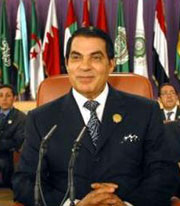
Ben Ali said "shared determination by all to realize comprehensive reforms… amounts to a new beginning."
|
TUNIS,
May 23 (IslamOnline.net & News Agencies) - Wrapping up their
two-day summit, the Arab leaders adopted Sunday, May 23, a joint
pledge to promote political reform and condemned attacks against
civilians "without distinction."
Egypt
and other Arab countries are expected to submit the 13-point reform
program to the G8 summit of leading industrial nations in the U.S.
state of Georgia on June 10, reported Agenece France-Presse (AFP).
Delegates
described the program as a genuine "Arab" document aimed at
undercutting U.S. efforts to impose an alien package of political and
economic reforms.
The
13-point program adopted here said Arab leaders were determined to
pursue and intensify the process of political, economic, social and
educational reform -- but according to their own national and cultural
requirements, their religious values and their own
"possibilities."
Other
points called for fighting terrorism and expanding the bases of
democracy and promoting human rights, as well as women's rights.
No
formal mandate was given to Egypt and other Arab countries to discuss
the reform plan with the international community, because of
opposition from Syria, delegates said.
However,
representatives of Arab countries invited to the G8 summit discuss the
plan with the international community.
Bahrain,
Yemen, Egypt, Jordan and Saudi Arabia, as well as Algeria, have been
invited to attend, delegates from those countries said.
U.S.
President George W. Bush plans to use the G8 talks to launch the
Greater Middle East Initiative for political and economic reform in
Arab and Muslim countries.
U.S.
Vice President Dick Cheney spoke of the reform initiative last January
in the World Economic Forum in the Swiss ski resort of Davos.
"Our
forward strategy for freedom commits us to support those who work and
sacrifice for reform across the greater
Middle East ,"
he said then.
Many
Arab states, including two heavyweights Saudi Arabia and Egypt, rebuffed
any reform plans "imposed on Arab and Islamic countries from
outside".
However,
diplomats in the region said the United States was happy with the
program presented to the summit, saying at least Arab leaders were
finally talking about democratic change.
The
summit had been set to open here on March 28 but was postponed
at the last minute by the Tunisian host on the ground that its reform
proposals were not being taken seriously.
Collective
In
his closing statement, Tunisian President Zine El Abidine Ben Ali told
the gathering that "the shared determination by all to realize
comprehensive reforms in our countries in order to bolster democracy,
human rights and promote women's rights amounts to a new
beginning."
"Now
we have the first collective government commitment to reform," an
Arab minister attending the summit told AFP.
"The
consensus that emerged was very good, given the political and social
scene in the Arab world."
The
rescheduled summit took place amid Arab outrage over the abuse of
detainees at U.S.-run prisons in Iraq and deadly Israeli military
raids in the Gaza Strip, killing some 57
people .
In
the final declaration, the leaders "strongly denounce the crimes
and immoral and inhuman behavior committed by occupation soldiers and
forces against Iraqi prisoners" and called for the perpetrators
to be prosecuted.
They
also called for international efforts to restore Iraq's sovereignty
and prevent its breakup.
In
its preamble, the program links reform in the Middle East to a just
settlement of regional conflicts, particularly the Israeli-Palestinian
conflict.
Ben
Ali pledged as chairman of the Arab summit for the next year to step
up efforts to end Israel's occupation of the Palestinian territories
and restore sovereignty to Iraq.
Arab
leaders also renewed their commitment to the Middle East peace process
on the basis of the longstanding formula of the exchange of land for
peace.
Bush
had sparked anger in the Arab world last month by endorsing unilateral
Israeli plans to pull back from nearly all the Gaza Strip while
retaining much of the West Bank, in what is dubbed as a "Bushfour
Promise".
"They
ask the American president to honor the commitments set out in his
vision for establishing a viable Palestinian state beside Israel and
ask him to respect the terms of reference of the peace process
enshrined in U.N. resolutions," the final declaration said.
The
leaders decided to "work at all levels to lift the siege on the
Palestinian people and President [Yasser] Arafat," the
declaration said.
In
a satellite link-up from his headquarters in the West Bank at
Saturday's opening session, Arafat urged his Arab counterparts to
lobby for international protection for his people.
Similar
calls in the past have fallen on deaf ears amid Israeli opposition.
Civilians
The
Arab leaders also adopted language condemning attacks on
"civilians without distinction," a reference to Israeli
civilians as well as Palestinians.
The
"the leaders condemn all Israeli military operations in the
Palestinian and Arab territories as well as operations that target
civilians without distinction."
The
text also condemns "operations which target Palestinian leaders
and which lead to violence and counter-violence, and (the leaders)
believe they will not lead to the peace the region needs."
Critics
say the Arab leaders are powerless to do much against the U.S.
occupation of Iraq and Israeli occupation of the Palestinian
territories.
The
summit was marred on its opening day when Libya's leader Colonel
Maummar Gaddafi walked out.
He
made unspecified protests about the agenda and alluded to his previous
complaints the Arab League was powerless to defend the Iraqis and
Palestinians.
However,
the Libyan delegation appeared to have approved the reform document.
|