The
deal resolved the sticking point of power-sharing, the legal status of
non-Muslims in Khartoum, the capital, which is currently governed by
Islamic Shari’ah law, and the future of three disputed regions in
the centre of the country.
After
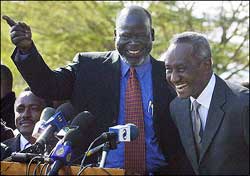
agonizing last-minute haggling, Ali Osman Taha, vice-President in the
central government in Khartoum, and John Garang, leader of the SPLM,
settled the remaining issues standing in the way of a comprehensive
deal between the two sides.
"They
agreed to offer the ruling National Congress Party 52 per cent of
powers in the government and Parliament, after it had earlier asked
for 60 per cent," the sources said.
"The
SPLM was granted 30 per cent of powers, against 16 per cent to other
forces and two per cent for the citizens of Nuba and Blue Nile
areas."
The
sources said the government will get only 15 per cent of
administrative powers in the south against 70 per cent to the rebel
group and 15 per cent to other forces.
For
power-sharing in the two of the three disputed areas, the Nuba
Mountains and Blue Nile, 55 per cent of the powers will be run by the
government and 45 per cent by the rebels, with the government presided
over by rotation every one and a half years.
"The
SPLM had called for a 50 per cent power in these marginalized areas,
but it accepted 45 per cent after the government relinquished the
right to appoint a Northern deputy to the President of the
South."
In
Abyei, the third marginalized area, the two sides agreed the region
belongs to the North, given historical facts dating back to 1905, but
"there will be a joint administration equally run by the two
parties."
Two
Vice Presidents
The
deal calls for President Omar Bashir to remain in power with the
appointment of two vice Presidents, one form the SPLM (Garang) and
other from the ruling National Congress Party (Taha).
"General
elections will be held after three years of signing the final
comprehensive peace accord, on that the members of the Presidency will
be in office during the six transitional years."
"A
joint commission will be set up to be run by the Presidential office,
in an effort to put guarantees to non-Muslims in Khartoum."
The
Kenyan talks followed previous agreements allowing the southern rebels
to maintain a separate army, the south to share revenues from local
oil production, and southerners to vote after a six-year transition
period on whether to become independent from the north.
Good
Faith
The
concessions made by the government in the negotiations were meant to
"boost chances for unity with the southerners, and show the good
faith to maintain the territorial integrity" of the African
country, the sources.
"Still,
the government reaped gains out of the deal, including keeping
Shari’ah applied in the three marginalized areas in return for
limited guarantees to the non-Muslims that they will be exonerated
from the move."
"This
was considered a victory to the government, which had earlier deemed
the question of Shari’ah a red line not to be overstepped."
The
sources said the agreement was hailed by the Sufi and Salafist
Sudanese leaders during the signing ceremony.
Pure
Sudanese
In
the meantime, the political consultant for the Sudanese Embassy in
Cairo, Al-Tayyib Mohamed Ahmed expressed conviction that the deal will
push forward a settlement to the crisis in the western region of
Darfur.
"The
agreement sets stage for general rules that govern the use of riches
in Sudanese regions, with local inhabitants of every area to be
allowed to get a two per cent share of the revenues and the remainder
to the central government."
Waxing
optimistic, the Sudanese diplomat said the Wednesday deal witnessed a
settlement to all disputable questions, and "what remains is a
series of technical details, such as observing ceasefire".
A
spokesman for the southern rebels said after the signing ceremony in
Kenya that the latest protocol had dealt with "all the burning
issues that led us into war".
But
Kenyan mediators said the two sides still needed to work out detailed
arrangements for a permanent ceasefire, including provisions for
international peacekeepers, before a final and comprehensive peace
accord could be signed.
Grueling
Talks
The
Wednesday deal capped two years of intense political negotiations in
Kenya and left only technical and military aspects of a ceasefire
standing in the way of a comprehensive peace accord.
Once
the main war is definitively over - a final deal is expected by
mid-July - a six-year transition period will kick in, when the south
will not only have its own autonomous administration, but also sit on
a government of national unity, with Garang becoming first vice
President.
Encouraged
partly by powerful Christian lobby groups which have long supported
the southern rebel cause, the U.S. government has played a leading
role in pushing Khartoum into a negotiated solution to the conflict,
which has claimed an estimated 2 million lives since 1983.
The
conflict dates back to before independence from Britain in 1956 and
was halted with a 1972 accord, which broke down in 1983.