|
Oil-Rich Iraq Hit By Another Fuel Crisis
 |
|
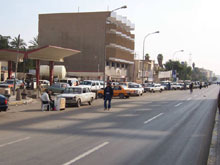
Iraqis are waiting in lines of cars waiting to get fuel
|
By
Nagem Salam, IOL correspondent
BAGHDAD,
June 2 (IslamOnline.net) - Another gasoline shortage has struck
occupied Iraq, as lines of cars up to 7 km long are visible waiting
for fuel along the streets of the country’s capital city, giving
Iraqis yet more reasons, beside the absence of adequate functional
infrastructure and rising summer temperatures, to have flaring
tempers.
"We
never had gas crises before, even under Saddam,” said Abdullah Hamin
Hammed while pushing his car towards a gasoline station over three
kilometers away.
Angry
that he was losing wages from time away from work, he added; “We had
no fuel problems before the Americans came to our country, and now we
have this. Why? They are stealing our fuel!”
Hamad
Aziz, a 43 year-old unemployed electrical engineer, felt that the
shortage was also due to the currently high price of petrol in the
United States. “I think the Americans are taking our oil for
themselves to try to bring their own prices down,” he said while
sitting in the gas line.
Crude
oil futures in New York surged to a record closing price of 42.33
dollars a barrel on Wednesday, June 2.
Black
Market Flourishing
Fuel
prices in Iraq at the pump usually run 20 U.S. cents per liter.
However, during a crisis such as this, on the black market Iraqis can
expect to pay five to fifteen times that amount.
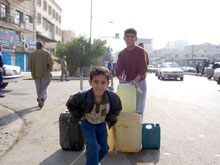
Men
and young boys line the street near the crowded gas stations with
jerry-cans of the expensive fuel, in hopes that Iraqis without enough
time to wait in the long lines will pay their premium prices.
Mohammed
Talil Aziz, while siphoning fuel from the tank of his own car to sell
at higher prices to passers by said, "Since I don’t have a
regular job, I am pleased that the crisis has given me a way to make
money."
A
young boy of 11 years-old, standing near several jugs of gasoline,
waited impatiently for someone to sell his fuel to. “My father is
over there,” he says while pointing down the street towards a man
selling black market petrol, "We are here all day doing this
because he makes more money from this than driving his taxi."
Empty
Generators
Another
effect of the fuel shortage Iraq is experiencing is that people who
are unwilling to wait what oftentimes requires between four to six
hours in petrol lines are unable to run their generators at home.
With
electricity still far below pre-invasion levels, Iraqis who rely on
small generators to run their fans and air conditioners are left
without them while temperatures are already over 35 degrees each day.
“My
father is very old, and without a fan he is suffering a great deal
during the day,” stated Ahmed Abdul Rubai. Waiting in a petrol line
without choice if he is to have fuel for his home generator, he also
said, “My friends grandmother died last summer from the heat because
they had no generator, so I cannot allow that to happen to my
father.”
Another
man, sweating in his car in a petrol line in the busy Karrada district
of Baghdad yelled; “This is the freedom. We are free to waste our
days waiting for fuel since we have no electricity.”
Mohammed
Abrahim, who works as a taxi driver, believes the fuel shortage is due
to electricity problems. “Since we have less electricity now during
the occupation, people are buying so much fuel for their
generators.”
After
pausing, he added; “Our problems will never be solved by the
Americans. Saddam repaired our electricity in four months, and here we
are after one year and nothing is working!”
'Why'
 |
|
Everybody is selling oil
|
“Baghdad
has 103 fuel stations, 43 of which belong to the government, while the
remaining 60 are privately owned,” said Asim Jihad, a spokesman for
the Iraq Ministry of Oil.
He
claimed that there is not a fuel problem because there is enough fuel
for all of Iraq and thus, there is no action required by the
government to control the prices.
According
to Jihad, seeming to contradict himself, the primary cause for the
current fuel crisis at the pumps is that fuel tanker truck drivers are
afraid to deliver the petrol into Iraq from neighboring countries. His
secondary reason for the fuel crisis is because people are,
"buying too much fuel."
The
Al-Dora refinery produces one third of Iraq’s gasoline, and due to
recent explosions along the pipeline leading to it, no fuel has been
produced by the refinery since May 12.
While
Iraq’s Oil Ministry is rushing to repair the sabotaged pipelines
that were put out of order due to resistance attacks resulting in a
decrease in oil production from 2.5 million to 1.95 million barrels
per day [bpd] in mid-May, Iraqis are paying higher prices and waiting
angrily for hours to fill their cars.
In
the past, the causes of oil crisis have primarily been due to either
pipeline sabotage or strikes against fuel tanker trucks traveling the
dangerous roads.
The
current crisis, an Iraqi expert said, has been brought about by
sabotage of the oil pipeline which feeds the refinery located in
Al-Dora, on the outskirts of Baghdad, in addition to lack of tanker
trucks delivering their fuel due to the horrendous security situation.
While
record fuel prices have struck western countries, several oil
pipelines throughout Iraq have fallen to attacks and sabotage from
members of the resistance to the occupation.
There
were 86 attacks on Iraq’s 4,350 mile oil pipeline system and 11,000
mile long power grid between April 2003 and December 2003 alone. Thus
far in 2004, the number of attacks has not let up, which has cast much
doubt on the country’s ability to maintain crude oil supplies for
exportation, as well as its own citizens.
The
U.S. military has set up a force called Task Force Shield, comprised
of 9,700 people in order to guard Iraq's oil infrastructure, however,
the number of successful attacks on the vast stretches of pipelines in
the deserts have not declined.
Iraq
has rarely faced gasoline shortages prior to the U.S.-led invasion of
March, 2003, but since then, the country has suffered several fuel
crises.
Oil-rich
Iraq has the world's second largest reserves after Saudi Arabia, with
an estimated 115 billion barrels of proven oil reserves and vast
reserves remaining untapped. With only 17 of 80 discovered fields
having been developed, only about 2,300 wells have been drilled in
Iraq. Of these, only 1,600 are currently producing oil. Comparatively,
the state of Texas has around one million wells.
Iraq
had a sustained production of about 2.6 million/bpd before the
U.S.-led invasion. Currently, due to sabotage and the lack of
rebuilding of the oil infrastructure by foreign contractors, the
production is 1.8 million/bpd at most.
|