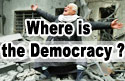
|
Rafah
Students Bear Brunt Of Israeli Offensive
 |
|
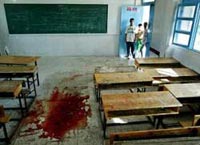
Schools
have borne the brunt of the Israeli massive incursion into
Rafah
|
By
Adel Zaarab & Yasser Al Banna, IOL Correspondents
RAFAH,
June 7 (IslamOnline.net) – Hassan Khedr missed his high school final
exams that began Monday, June 7, as he had been killed by Israeli
forces a few weeks ago.
Khedr
was killed by Israeli apache gunships that launched a massive
offensive on the southern Gaza Strip town of Rafah last month.
"The
Apaches did not give him the chance to sit for the exams, killed off
his dream for joining university," his father told
IslamOnline.net.
"I
did not recognize my son's body. The missiles cut through him beyond
recognition," said grieving Khedr, pointing to a surrounding
residential area devastated by the Israeli army incursion,
the bloodiest of its kind in years.
At
least 61 others were killed in the raid and 2,066 individuals
displaced when a total of 167 buildings were destroyed in the
operation, which Amnesty International described as a part of "war
crimes".
Not
Conducive
The
atmosphere dominating the area after the Israeli operation, which came
with exams around the corner, drew a grim picture on other high school
students going through the same ordeal.
Students
living close to the borderline and near the Jewish settlements bear
mist of the brunt, as they face almost daily army incursions and
random shooting of civilians by the invading occupation soldiers.
"This
triggers a bad 'psychological atmosphere' not conducive for us to
study," said Ahmed Abu Darb.
Living
in Western Rafah, close to Atsmona settlement in the Gush Qatif, Abu
Darb said his residence is situated "rather on the fire
line". The area has seen daily shelling by Israeli soldiers
manning a nearby army post.
"I
have no time for studying. It's all-time shooting," the student
said, recalling the killing of his friend during the Israeli military
incursion.
Abu
Darb said he anticipated the shelling to begin, "abruptly at any
time".
Mohamed
Abu Gazar was forced to study in the open after the Israeli forces
destroyed his house in the raid.
"My
main concern now is to find a shelter for my homeless family. Is this
helping me to study with concentration?"
Palestinian
students are forced to take bumpy roads, which may take hours to avoid
the Israeli checkpoints where they may be shot. But these roads are
not less dangerous than the checkpoints since they are near Israeli
settlements out of which settlers could come out and attack the
students.
Zahida
Abu Eisha, a psychologist, has said that the Palestinian students are
living under great emotional pressure which leads them feeling
headaches and pains in the joints as well as the inability to sleep
and being easily provoked.
She
said in a study that the current situation with the Israeli aggression
has a negative effect on the students, especially on their
concentration levels.
The
students are more concerned about other things such as fearing for
their lives and the lives of their family and the fact that their
homes are prone to be destroyed any minute, read the report.
Hard
Times
Palestinian
Minister of Education Naim Abu Al-Hamas said that 60,000 Palestinian
students are to sit in for the exams this year, conceding the hard
situation triggered by Israeli road blocks and separation wall
blocking access to schools.
Abu
Hamas told IOL that makeshift exam halls were set up behind
checkpoints and in Israeli prisons where more than 8,000 people are
detained with no charges.
"We
have made all preparations for overcoming these conditions. We
actually take into account the cruel situation under occupation,"
he said.
"Four
years no, we are acting under special conditions due to Israeli
aggressions."
The
minister referred to the Israeli
offensive on the West Bank in 2002, which notched up the
number of high students killed since the beginning of Intifadah since
September 2001 to 211, along with 150 teachers.
Also
the separation wall adds to the restrictions facing the Palestinian
students. the students are forced to deftly climb the nine-meter-high
concrete parts of the 700km-long wall, which snakes through the West
Bank, in order to "pass".
According
to a
report by the U.N. Office for the Coordination of Humanitarian
Affairs (OCHA), 30 percent of the West Bank population, or some
680,000 people, will be "directly
harmed" by the completion of the wall.
More
than 200,000 Palestinians are already suffering the humanitarian
consequences of the separation wall, according to the United Nations.
|