|
Britain Mulls Military Intervention In Sudan: Paper
 |
|
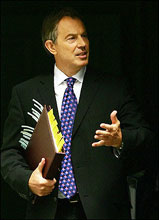
Blair has had discussions with advisers for on-the-ground involvement of troops in Sudan
|
LONDON,
July 22 (IslamOnline.net & News Agencies) – British Prime
Minister Tony Blair is mulling a military intervention in Sudan
allegedly to ameliorate humanitarian crisis in the western Darfur
region, as the United States mounted pressures for UN sanctions on the
African country.
Blair
has asked officials to draw up plans for possible military
intervention in Darfur to help end a growing humanitarian crisis
there, The Guardian reported on Thursday, July 22.
"The
prime minister has asked to look at all options that will save lives
and not to rule out the military services," an unnamed British
government official involved in the plans was quoted by the paper as
saying.
The
British daily said that despite a heavy commitment of British armed
forces in Iraq and other trouble spots, Blair has had discussions with
advisers for on-the-ground involvement of troops.
In
Downing Street, three options for military intervention were put
forward, including sending British troops to protect refugee camps
allegedly harassed by militias.
The
other two options call for deploying British servicemen to help with
the delivery of aid if the humanitarian agencies can no longer cope,
or giving British logistical support for an
African Union force of 60 monitors and 300-strong protection
force being deployed in the Sudan.
Interventionist
The
fact that Blair is prepared to consider military options, even limited
ones, so soon after the Iraq invasion may create controversy, not
least among critics who already regard him as too interventionist,
said The Guardian.
It
would be his sixth military venture since becoming prime minister in
1997.
Asked
about Sudan in the Commons on Wednesday, Blair did not mention the
military option but said he "ruled absolutely nothing out".
British
Foreign Secretary Jack Straw is to fly to Sudan soon allegedly to
assess the plight of the Darfur refugees at first-hand.
A
spokesman for Blair's office was quoted by Reuters as saying there was
"nothing recognizable" in the Guardian report.
For
its part, the Foreign Office said: "We are still very much in the
diplomatic phase."
Blair
had staunchly made the case for the invasion of Iraq – which has the
world’s second largest oil reserves – on claims Baghdad has
weapons of mass destruction.
But
none of these banned weapons have been found more than one year after
US-British occupation of Iraq, raising expectations the invasion was
based on false pretexts.
Oil
was discovered in Sudan in the 1970's, but it has only recently become
a significant part of the country's economy. In 2000 Sudan became an
oil exporter.
UN
Sanctions
Meanwhile,
the United States said it would present a revised draft resolution to
the UN Security Council on Thursday about the situation in Darfur amid
mounting international concern over what some UN officials call the
worst humanitarian catastrophe in the world.
"It's
the responsibility of the government of Sudan," John Danforth, US
ambassador to the UN and former envoy to Sudan, was quoted as saying
by Agence France-Presse (AFP).
US
Secretary of State Colin Powell will meet UN Secretary General Kofi
Annan later on Thursday to discuss Darfur, State Department spokesman
Richard Boucher said in Washington.
Powell
and Annan traveled to Sudan earlier this month and threatened
the country with an unspecified UN Security Council action.
"They
both think it's time to get together now to look very carefully at the
situation, as the Security Council is currently doing, and to see what
more they can do to try to get progress on the ground," Boucher
said.
A
first version of the US resolution, which would have slapped sanctions
on the Janjaweed militias but did not call for similar steps against
the government, did not garner much support from council members.
But
British ambassador Emyr Jones Parry said he thought the 15-nation
council could now "quite speedily" agree on an amended
resolution that would send a "very firm" message to
Khartoum.
"The
primary purpose of the Security Council now is to ensure effective
action on the ground," Jones Parry said.
Annan
said Wednesday, July 21, that Sudan had made little progress in
preventing Janjaweed militias from allegedly terrorizing African
villagers.
"Serious
crimes have been committed and there has been gross and systematic
abuse of human rights. We, the international community, must intensify
our efforts to protect the innocent in Darfur," he added.
He
UN chief said he did not want to set an "artificial
deadline" for further international action if it was determined
that Sudan had not kept its commitment to ease the crisis. He said any
such date was "a judgment call."
Sudan,
in an agreement with Annan two weeks ago, pledged
to protect displaced civilians, disarm the Janjaweed and other
armed groups, suspend visa and travel restrictions on relief workers,
allow African Union human rights monitors and punish those responsible
for the crisis.
|