|
UN Adopts Sudan Resolution, Arabs Suspicious
 |
|
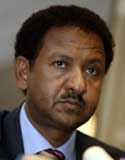
"We expect an attenuated resolution to be issued by the Security Council today," said Ismail
|
UNITED
NATIONS, July 30 (IslamOnline.net & News Agencies) - The UN
Security Council Friday, July 30, adopted a US-drafted resolution
threatening Sudan with 'measures' unless it reigned in militias
responsible for atrocities in Darfur, as Arabs expressed fear the move
could lead to American-led invasion of yet another country in their
region.
The
13-0 vote, with abstentions from China and Pakistan, came after the
United States, facing considerable opposition, deleted the word
"sanctions" and substituted a reference to a section of the
U.N. Charter permitting punitive measures.
This
provision, called Article 41, allows the "interruption" of
economic, transport, communications or diplomatic measures, which
amounts to sanctions, according to Reuters.
The
resolution, co-sponsored by Britain, France, Germany, Spain, Chile and
Romania, demands that Khartoum disarm and prosecute within 30 days
militia known as Janjaweed or the Security Council will consider
punitive measures under Article 41.
The
resolution also places an immediate weapons embargo on all armed
groups in Darfur, where government forces and Arab militia (Janjaweed)
have been battling a rebellion from some African tribes. But Sudan
security forces, accused of protecting the Janjaweed as they rape and
kill, are excluded.
The
United Nations has been planning a peacekeeping force after a final
peace pact in southern Sudan, where a decades-old civil war is ending.
The resolution says the planning should also include Darfur, although
troops are not expected soon.
The
United States and its European allies faced an uphill battle in the
Security Council, where developing nations as well as Russia
questioned the 15-member body's right to interfere in internal affairs
and argued that punishing Sudan would make matters worse.
 |
|
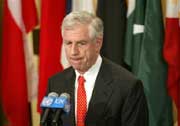
"If you read article 41, it speaks of 'measures,' and … this is a sanctions provision," said Danforth
|
US
Ambassador on the United Nations John Danforth said deleting the word
"sanctions" did not alter the threat of sanctions against
Sudan, an oil-producing country with promising potential levels.
"If
you read article 41, it speaks of 'measures,' and it says these may
include complete or partial interruptions of economic relations and of
rail, sea, air, postal, telegraphic, radio and other means of
communication and the severance of diplomatic relations - so this is a
sanctions provision," he said before the vote.
Different
Interpretation
But
Sudanese Foreign Minister Mustafa Ismail had apparently had another
interpretation in mind, as he hailed what he called a "weaker
text" of the draft resolution.
"We
expect an attenuated resolution to be issued by the Security Council
today," Ismail told the independent Khartoum daily Akhbar
Al-Youm Friday.
He
said his ministry had set out a two-pronged plan to counter the draft
resolution - "either to block its adoption altogether or to
strive, in cooperation with our friends, to remove from it such
references as genocide, ethnic cleansing and other extreme points and
apparently this is what we have so far succeeded in achieving just
hours before the vote."
AU
Role
This
came as the African Union (AU) keeps efforts to settle the crisis in
Darfur, where many people were uprooted from their houses into barren
areas. The UN says the conflict the world’s worst humanitarian
crisis.
Nigerian
President Olusegun Obasanjo, current head of the AU, said Friday that
more African troops than planned should go to the strife-torn Darfur.
"I
sent a fact-finding mission to Darfur and they came back just three
days ago... (having) found a formal deterioration from when we met in
Addis Ababa at the beginning of this month," Obasanjo said in the
Ghanaian capital.
After
delays, the AU plans next week to deploy some 300 troops to Darfur by
the end of July to protect its team of observers and monitors
overseeing the implementation of a shaky ceasefire between the
Khartoum government and two rebel groups in Darfur.
Asked
about the Khartoum government's likely response to the deployment of
further foreign forces to Darfur, Obasanjo replied: "Sudan is not
rejecting the deployment of African troops."
Sudan
had earlier dismissed US-led threats of military intervention into
Darfur, warning this could create an "Iraq-like situation".
Arab
Suspicions
As
Khartoum faces rising pressures, some in the Arab world see the UN
resolution as a US pretext for a fresh military intervention in the
region after the Iraq invasion.
"Many
would say that the US administration, as well as some European
countries, have found in the Darfur crisis a long lost pretext to put
the government under the sword of international sanctions," Arab
League spokesman Hossam Zaki said, adding an embargo would not help
resolve the crisis, but antagonize Khartoum.
The
Arab world is still boiling over the US invasion of Iraq, and
at what they see as an unswerving US bias towards Israel at the
Palestinians' expense. The arabs are now questioning
Washington's motives in taking the Darfur issue to the Security
Council, said Reuters.
"How
come the Security Council ... and those with a humanitarian agenda are
so active when it comes to such a situation, when they turn a blind
eye to the miserable situation in the Palestinian territories,"
Zaki said.
Mohamed
Mahdi Akef, head of Muslim Brotherhood, said Washington was using
Darfur as part of a plan "designed to fragment all states of the
region, the beginning of it (the plan) was in Iraq".
Under
US pressures, Khartoum has agreed to a southern vote on secession six
years after a final deal, a move which could divide Sudan into two
states.
Some
Arab writers and politicians are suspicious, however, that the US
diplomacy is aimed at splitting the Muslim Arab north of the
oil-producing country from the south.
Émigré
Sudanese opposition leader Mohammed Osman Al-Mirghani said the
situation in Darfur could pave the way for foreign intervention,
"jeopardizing the Sudan's sovereignty, independence, territorial
integrity and people."
The
United States in 1998 launched missiles at a Khartoum pharmaceuticals
plant, saying it was making ingredients for chemical weapons. Sudan
has been under US sanctions since 1997 for sponsoring terrorism.
The
United States and Britain had invaded Iraq in March 2003 allegedly for
the search for weapons of mass destruction, none of which have been
found so far in Iraq, raising fears the offensive of the country,
which has the world’s second oil reserves, was based on false
pretexts.
|