|
Sharon Approves Building 600 New Settlements
 |
|
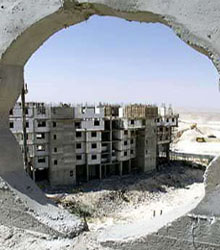
Construction in the Maale Adumim settlement is at full swing
|
OCCUPIED
JERUSALEM, August 3 (IslamOnline.net & News Agencies) – Israel gave a
"new push" to its settlement program in defiance of the
internationally-backed roadmap peace plan by approving the
construction of 600 new settlements in the West Bank.
Prime
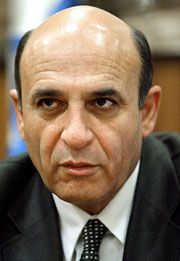
Minister Ariel Sharon and his Defense Minister Shaul Mofaz have both
given the green light to the building work in Maale Adumim, the
largest of the
West Bank
settlements, reported Agence France-Presse (AFP) Monday, August 2.
"Mr
Sharon and Mr Mofaz have given their go-ahead to the construction of
these buildings" in Maale Adumim, a ministry spokesman told AFP.
The
new units are expected to house some 2,000 Israelis which would
represent a seven percent rise in the Jewish settlement's population.
Under
the terms of the roadmap peace plan,
Israel
is obliged to freeze all settlement activity in the occupied
Palestinian territories where around 245,000 Israelis live.
According
to
Israel
’s Maariv newspaper, the housing ministry received instructions not
to publish public tenders to avoid embarrassing the Americans who are
one of the four sponsors of the roadmap.
US
President George W. Bush said back in April 2004 that it was "unrealistic"
to expect a complete Israeli withdrawal from the
West Bank
as he endorsed Sharon's controversial disengagement plan.
The
plan calls for evacuating all Israeli settlers from the Gaza Strip and
four small Jewish enclaves in the northern
West Bank
next year.
Bush,
who describes himself as a wartime president, further backtracked
in an interview published May 8 on the 2005 date he set two years ago
for the establishment of a Palestinian state.
Wall’s
Route
 |
|
"We will not return to lines of 1967," Mofaz stressed (AFP)
|
More
and more, Mofaz confirmed Monday that that major Jewish settlement of
Maale Adumim and the Gush Etzion settlement bloc would be included
inside the illegal
West Bank
separation wall.
"In
any event, Maale Adumim and Gush Etzion will be included inside the
security fence," Mofaz told reporters.
"We
will not return to lines of 1967," he added in reference to the
internationally-recognized borders of the
West Bank
which has been occupied by
Israel
since the end of the 1967 Six-Day War.
Maale
Adumim, which lies close to Al-Quds (occupied East Jerusalem), is the
largest of the West Bank settlements with some 28,000 residents, while
around 12,000 live in the 15 settlements which make up Gush Etzion in
the Bethlehem region of the southern West Bank.
Both
were widely
expected to be included in the route of the barrier that is
being rerouted following a recent Israeli high
court decision which said its path infringed the fundamental
rights of tens of thousands of Palestinians living near Al-Quds.
Israel
says the barrier is essential for security reasons but Palestinians
argue that the route, by jutting into the
West Bank
, is proof of an intent to prejudge the borders of their promised
future state.
The
UN General Assembly demanded
Israel
on July 20 to abide by the International Court of Justice's ruling and
tear down the separation wall.
The
ICJ ruled
on July 9 that the barrier was illegal because it cuts deep into the
occupied
West Bank
to shield settlements built by
Israel
on Palestinian territory it occupied in the 1967 Middle East War.
Israel
has vowed to ignore the judges' non-binding verdict.
More
than 200,000 Palestinians are already suffering the humanitarian
consequences of the wall, according to the United Nations.
The
wall has resulted in the confiscation of 11,4000 dunums (2,850 acres -
1,140 hectares) of privately-owned Palestinian land and in the
destruction of 102,320 trees, according to a report by the UN Office
for the Coordination of Humanitarian Affairs (OCHA).
It
estimated that with the competition of the wall, 30 percent of the
West Bank
population, or some 680,000 people, will be "directly
harmed."
|