|
Germany
Loses Big By US Troop Realignment: Report
 |
|
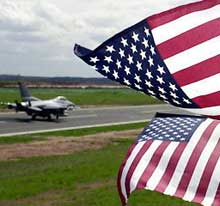
An F-16 lands at the US Airbase in the western German town of Spangdahlem (AFP)
|
BERLIN,
August 17 (IslamOnline.net ) - Germany could be hit hardest by
American plans for a major overhaul of the US military presence
worldwide in a move seen as a punishment for the anti Iraq-war
country.
President
George W. Bush announced Monday, August 16, the eventual withdrawal of
up to 70,000 troops from Europe and Asia in a move aimed at increasing
the capability to fight the “war on terror” and meet other new
threats.
The
proposals have been
watched warily in Germany, which is home to the US European Command,
73 US military installations and 71,000 American troops -- around 70
percent of the number stationed in Europe, reported Agence
France-Presse (AFP).
“The
United States has informed Germany in several rounds of consultations
- the latest on May 28 - about the state of planning on adjustments
being made after the end of the Cold War and in light of new global
challenges,” a German foreign ministry spokeswoman said Monday.
Senior
defense officials said the 1st Armored Division and the 1st Infantry
Division, each numbering about 15,000 troops, will be brought back to
the United States from Germany as early as 2006.
They
will be replaced by a single Stryker brigade, a 3,600-strong unit
consisting of wheeled armored vehicles designed for rapid deployment
aboard C-130 aircraft.
The
Army's 5th Corps, which now oversees the two armored divisions, will
be kept in Germany but be made more deployable, they said.
The
United States also appears to have opted to maintain air bases and
training areas in Germany and take advantage of new ones elsewhere in
eastern Europe.
Ramstein
Air Base, a major logistics hub near Frankfurt that also serves as the
headquarters for the US air forces in Europe, will stay, officials
said.
About
half of the US soldiers in Germany could be sent home or through other
lightly manned “forward operating locations” in southern and
eastern Europe with the transformation.
Plans
are also to significantly reduce US ground forces in Europe, bringing
home two heavy army divisions from Germany and replacing them with a
single hi-tech combat brigade about a tenth the size.
Changes
are also expected to US deployments in South Korea and Japan.
One
of the most significant changes are plans to concentrate US ground
forces in the United States, rather than deployed overseas as they
have since the end of World War II.
In
addition, thousands of military support staff and family members are
expected to pack their bags.
Punishment
Although
US officials have assured Germany that the move is not intended as a
punishment for Berlin's outspoken opposition to the Iraq war, the
plans have left a bitter aftertaste in towns that have come to rely on
Uncle Sam.
Dollar
estimates are hard to come by but a vast network of caterers, cleaning
personnel, subcontractors and other firms serving the Americans will
be hard pressed to replace their business when the troops leave.
Wolfgang
Brunner of the Verdi service sector union told AFP that 15,272 Germans
work for the US military and half of them could lose their jobs with
the plans currently being debated.
He
estimated that each of those positions was linked to another 10
service and retail jobs that could be endangered in the long run.
But
he noted that the timeframe cited by US Defense Secretary Donald
Rumsfeld of up to six years would give communities time to cushion the
blow.
The
Iraq mobilization has already led to the departure of thousands of
German-based troops, most of them from the 1st Armored Division and
the 1st Infantry Division with a total of about 28,000 soldiers.
Neither is expected to return to Germany from the Gulf.
The
US military presence dates back to the end of World War II, when
troops entered a country morally and economically ruined after the
Nazis' unconditional capitulation on May 8, 1945 and threatening to
plunge into chaos.
The
Allies divided the country into four zones at the Yalta conference in
February 1945 even before war's end - American, British, French and
Soviet.
Some
17 million US soldiers have done tours of duty in Germany, with
250,000 still stationed in the country in 1988.
With
the fall of the Berlin Wall the following year and the disappearance
of the Soviet threat, cities such as Frankfurt and Berlin that once
had massive troop levels bid the soldiers farewell in the mid-1990s.
The
GIs left behind US schools, shops, restaurants, housing and cinemas -
a special taste of the American way of life that Germans became
accustomed to in the postwar years.
Australian
Welcome
On
the other extreme, Australia Tuesday, August 17, welcomed the US plans
to realign its oversees troop deployment.
Defense
Minister Robert Hill described the move as a significant global
security development.
“The
United States has consulted closely with Australia over its plans for
the global force posture review and we see this initiative as a
positive development for both regional and global security,” Senator
Hill said in a statement carried by AFP.
“It
will improve the US capability to contribute to international efforts
to defeat global threats such as terrorism and the proliferation of
weapons of mass destruction and enable the United States to engage
more effectively in regional contingencies.”
Australia
was a staunch supporter of the US-led war in Iraq, contributing about
2,000 personnel to the fight and around 850 troops remain in the
region.
|