|
Imam
Ali Mosque Hit by US, Najaf Battle Goes On
 |
|
Al-Jazeera
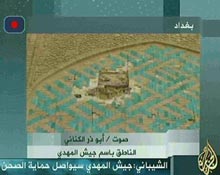
broadcasted footage of slight damage done to the outer wall of the
Imam Ali mosque
|
AN-NAJAF,
Iraq, August 23 (IslamOnline.net & News Agencies) - Fierce
fighting broke out once again in the holy Iraqi city of An-Najaf
Monday, August 23, a day after the wall of the Imam Ali mosque was hit
by US gunfire Sunday night.
Numerous
explosions and gunfire echoed around the sacred shrine of Imam Ali
held by followers of Shiite leader Moqtada Al-Sadr, Reuters news
agency reported.
"It's
quite intense. I've heard at least 10 explosions,” a Reuters
reporter said from inside the compound of the Imam Ali mosque.
Shiite
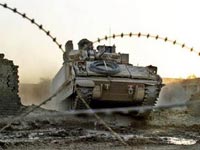
fighters remained in control of the mosque. US tanks were still in the
vicinity but were not as close as they were Sunday, when they advanced
to within 300 meters of the mosque.
Some
shrapnel landed inside the mosque's courtyard, and some of the blasts
sounded like artillery shells, Reuters added.
A
US AC-130 gunship also attacked fighter positions across An-Najaf, it
added.
Sadr’s
Mahdi Army launched Sunday, August 22, multiple attacks on US tanks,
parked away from the holy shrine.
Shrine
Hit
 |
|
Although
US troops outpower Sadr's men with tanks and aerial support, any
raid on the shrine could backfire and fuel anti-US sentiment
|
Al-Jazeera
satellite channel broadcast footage of slight damage done to the
outer wall of the Imam Ali mosque by the US bombardment on Sunday
night.
Sheikh
Aws Al-Khafaji, the director of Sadr Office, confirmed to the
Doha-based channel that the wall was struck by US tanks.
The
attack is expected to enrage millions of Shiites around the world and
give Sadr political ammunition in his rebellion against U.S. troops.
Although
US troops outpower Sadr's men with tanks and aerial support, any raid
on the shrine could backfire and fuel anti-American sentiment, which
is already running high in Iraq, where Shiites make up 60 percent of
the population.
On
Saturday, August 21, US tanks shelled a mosque in Kufa. The shelling
caused a huge hole in the outer wall of the mosque. Part of a the
opposite court building was blackened and gutted by fire, with blood
smeared on the windows.
Talks
to hand over control of the shrine to Grand Ayatollah Ali Al-Sistani,
the top Shiite authority in Iraq, was suspended
Sunday.
Sistani
has been reluctant to take back the shrine without ensuring that
nothing is missing and the Mahdi Army is unwilling to surrender
control amid any suggestion of impropriety.
Sistani's
office accepted an offer by Sadr Friday, August 20, to take control of
the shrine to bring an end to the face-off with US forces since August
5.
But
it has stipulated that before it takes control, an inventory must be
carried out to make sure the treasures remain in place and intact.
In
a letter circulated in Najaf late Thursday, August 19, and signed by
the firebrand Shiite leader, Sadr urged his followers to hand over the
shrine to the Shiite leadership (Al-Marjiyah or hawaza in Arabic).
The
move also came a few hours after interim Prime Minister Iyad Allawi
made a “final
call” for Sadr to disarm his militia, withdraw from
Imam Ali Shrine or face a massive onslaught.
40
Iraqis Killed
Near
Najaf, at least 40 Iraqis were killed on Saturday, August 21, in
fierce clashes with US occupation forces, the Iraqi interim Interior
Ministry announced Sunday.
A
ministry official told Reuters US troops had fought battles in the
nearby town of Kufa, one of a number of cities where Shiite fighters
have risen up this month.
The
official said the dead where Mahdi Army fighters and civilians.
The
US military also announced Sunday that four Marines assigned to the
1st Marine Expeditionary Force were killed in separate incidents in
Iraq’s volatile Anbar province.
Since
the start of the war last year to occupy oil-rich Iraq, 714 American
troops have been killed in resistance attacks, according to a Reuters
toll.
US
Journalist Released
 |
|
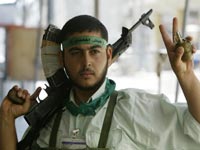
A
Shiite fighter flashes the victory sign while holding a grenade in
one hand and an AK-47 assault rifle in the other (AFP)
|
Meanwhile,
US journalist Micah Garen was on Sunday freed by an Iraqi group who
had held him hostage in the southern Iraqi city of Nassiriya.
"I
am very grateful to everyone who worked to protect me and guarantee my
release and I thank my friends in Nasiriyah and my family and fiancée
who spent three months with me in Nasiriyah," Garen told Al-Jazeera
by telephone.
He
was speaking from the Nasiriyah office of Moqtada Al-Sadr.
"Today
he was brought to the office of Sheikh Sadr in Nasiriyah and he is now
there. We have called the human rights body in Nasiriyah to come and
receive him," Aws Al-Khafaji told the all-news Arabic channel.
Garen,
of New York-based company Four Corners Media, said he was seized while
taking pictures with a small camera at a market in Nasiriyah.
"People
misunderstood what I was taking pictures of. There was a
misunderstanding," he said without elaborating.
The
36-year-old reporter was working on a documentary in Iraq about the
looting of archeological artifacts following last year’s US-led
invasion.
Mystery
shrouded the fate of Garen, who went missing on August 13,
whether he was kidnapped by an Iraqi group or killed after he filmed
an ambulance hit by Italian forces in Nasiriyah and sent the footage
to the Italian television.
|