|
Journalist Paints Human Experience In Najaf
 |
|
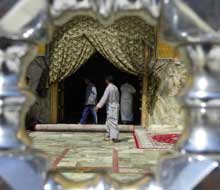
Robertson has spent three days inside the Imam Ali shrine
|
By
Ahmad Maher, IOL Staff
CAIRO,
August 23 (IslamOnline.net) – It takes a lion-hearted and objective
journalist along with a talented cameraman to go all the way to
perils-riddled Iraqi holy city of An-Najaf, to reveal facts and
unearth the truth that we may never know.
Beleaguered
by a torrent of western media reports that sometimes, if not all the
time, are politically motivated, many people worldwide are really
bewildered at what is really going on in the flashpoint city of
An-Najaf, especially after a stark warning by the interim Iraqi
government to journalists to leave or face arrest or even death.
Braving
the media
blackout, Phillip
Robertson, an independent
journalist, and his
friend cameraman Thorne Anderson, saw a much different scene than what
was painted in the news reports. Now it is their turn to paint their
human experience without reference to propaganda, ideology or hoary
old clichés.
"This
is natural because most Western reporters stayed away, thinking that
the Mahdi Army would take them hostage or kill them," Robertson
told IslamOnline.net’s audience through a
live dialogue on Sunday,
August 22.
Robertson
and Anderson were the only journalists inside the US-besieged Imam Ali
shrine for three days, August 17-19.
‘Heartbroken’
Robertson
feels "heartbroken" at the destruction done to the
time-honored city by the three-week US raids.
"I
think taking the war to the old city, to the Shrine was a terrible
mistake, and a travesty. Most Americans, if they could see the mosque,
and experience how beautiful it is, would agree. It is a sacred
place," he said.
The
awarded journalist said the conditions of civilians in An-Najaf are
deplorable.
"No
electricity, no good sources of food and warfare raging outside in the
streets. Snipers are a great danger, and they are invisible. Most
people are hiding, trapped in their houses.
"These
battles have caused a great number of casualties as well as widespread
destruction to the edge of the old city of Najaf, he went on.
"I
believe that some men have remained behind to protect their houses
from looters. This happened in [nearby] Karbala as well."
Pitched
battles between US occupation forces and the Mahdi Army of
anti-occupation firebrand Sheikh Moqtada Al-Sadr have gone almost
unabated.
Iraqi
Sunni and Shiite leaders slammed the “bloodbath”
in An-Najaf and called upon the international community to rein in the
Americans.
The
US raids have been described by law experts as amounting
to genocide.
Shrine
Hit
 |
|
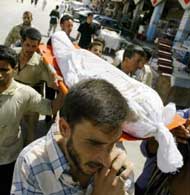
Robertson says the battles have killed many civilians
|
Giving
his first-hand experience of the situation there, Robertson said US
gunfire hit the outer walls of the Imam Ali shrine, the Shiites’
most revered site.
"The
building is not badly damaged. Bullets and mortar fragments hit the
structure and land in the marble courtyard. There are nicks and
scratches, but nothing major. Of course, continuing attacks place the
building and everyone inside it at risk," he said.
"The
tomb of Imam Ali was undamaged as of 4:30 pm Thursday, Baghdad time.
It is well protected by the walls of the mosque."
Al-Jazeera
satellite channel broadcast
Monday footage of slight damage done to the outer wall of the Imam Ali
mosque by the US bombardment on Sunday night, August 22.
Sheikh
Aws Al-Khafaji, the director of Sadr Office, confirmed to the
Doha-based channel that the wall was struck by US tanks.
The
attack is expected to enrage millions of Shiites around the world and
give Sadr political ammunition in his rebellion against US troops.
Misinformation
Robertson
further said there is a great deal of misinformation and distorted
facts about the exact situation in An-Najaf.
He
was keen on refuting claims that Imam Ali shrine was used as launching
pad for mortar attacks by Shiite fighters.
"There
are no weapons in the Shrine. It is a place of refuge, not a military
encampment," he said, extending a heartfelt thank-you to the
Shiite people there for their "kindness and hospitality".
"The
[Imam Ali] mosque is not used as a place where fighters are launching
mortar attacks. I would have been able to see and hear any activity
along those lines, and I was free to go where I liked. Mahdi Army
officials are in the Shrine, but they are unarmed, like everyone else
inside," he stressed.
"I
was there and never feared for my safety. It is vital that the war in
Najaf end immediately, and that US attacks on the area near the Shrine
cease."
Volunteers
Robertson
also said many Shiites from different cross-sections of Iraqi society
have volunteered to defend their sacred site.
"In
the press, they have often been portrayed as the poor, uneducated
class of Iraq. In fact, this is not the case. Sadr has many poor
supporters, like his father, Sayeed Mohammad Sadiq Al-Sadr, had.
"But
many of the Mahdi Army cell leaders have college education. The
militia attracts educated men as well as workers. The movement is
broad-based and cuts across many layers of society. Most Western
papers don’t describe it this way—much to their shame," he
explained.
The
journalist also said that the Mahdi Army is a disciplined force,
dismissing as untrue reports about fighters’ abuse and hooliganism.
"As
far as the US goes, the worst reports of abuse stem from Abu
Ghraib; those are
well-documented crimes, but I am not familiar directly with any
others," he said.
No
Iraqi Forces
Robertson
also held the interim Iraqi government of Iyad Allawi accountable for
the aggravating situation in An-Najaf.
"The
Iraqi government, through statements made by Prime Minister Allawi,
has not helped the situation," he said.
He
even did not see Iraqi government forces there.
"But
they could be hidden somewhere. As for the Iraqi police, I was hiding
from them most of the time because they have misguidedly banned
journalists from the zone that includes Najaf," he said.
Robertson
further said the United States can work out a deal with the Mahdi Army
if it wished to do so, hitting out at its military juggernaut used
disproportionately against lightly armed Shiite fighters.
"The
United States is spending a billion dollars a month to fight men who
make 300 dollars a year. Fighters kept asking me why America hated the
poor," he said.
|