|
Lebanon Rejects UN Resolution, Parliament Meets
 |
|
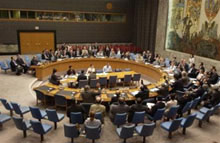
The UN Security Council during the vote
|
BEIRUT,
September 3 (IslamOnline.net & News Agencies) - Lebanon rejected
Friday, September 3, a UN Security Council resolution demanding the
withdrawal of foreign forces from the Arab country as the Lebanese
parliament was to convene to discuss introducing constitutional
amendments allowing Lebanese president Emile Lahoud to stay in office
for three more years.
"Lebanon
will not accept any plan which does not address the Israeli occupation
of its land and is replaced by interference in its internal
affairs," Agence France Presse (AFP) quoted Lebanese Foreign
Minister Jean Obeid as saying.
He
said the UN resolution forms an unprecedented interference in
Lebanon's internal affairs.
"This
resolution is misplaced since it goes against the principles of
non-interference in internal affairs, by UN member states," he
said.
Syria,
for its part, said the presidential election in Lebanon was an
internal affairs.
"The
Lebanese presidential election was an internal matter and there was no
justification for the council to discuss the issue," Syrian
ambassador to the UN Fayssal Mekdad, told reporters.
The
UN Security Council has adopted Friday a resolution, put forward by
the United States and France, demanding the withdrawal of foreign
forces from Lebanon and non-interference in the Lebanese presidential
elections.
The
resolution, adopted by 9 countries with six abstentions did not name
Syria though it is the only country that has forces in the Arab
country.
The
UN resolution came as the Lebanese parliament was to meet Friday at 6
p.m. local time to vote for constitutional amendments to allow the
pro-Syria president Lahoud to stay in office for other three years.
The
proposed constitutional
amendment is expected to gain the support of two-third
of the Lebanese members of parliament.
Welcome
Israel,
for its part, welcomed the UN resolution.
"Israel
welcomes this decision as Syria has been occupying Lebanon since 30
years and is killing its legitimate ambitions," a senior Israeli
official, who declined to be named, told AFP.
He
accused Syria of attempting to amend the Lebanese constitution to
control the country.
Playing
the same tone, Israeli ambassador to the United Nations Dan Gillerman
told Israeli Radio that the UN resolution put Syria back in its place
as a country supporting terrorism.
US
Ambassador to the UN John Danforth, for his part, said it was
necessary to act quickly before the Lebanese parliament allows the
Lebanese president to stay for other term in office.
"The
Lebanese parliament and the Lebanese cabinet should express the will
of the Lebanese people through a free and fair presidential electoral
process," Danforth told the council.
"What
the Lebanese people and we have witnessed over the past week in terms
of Syrian actions is a crude mockery of this principle," he said.
He
viewed the resolution as a sign to the Syrian government to not
interfere in the Lebanese presidential elections.
"The
government of Syria has put the hammer on Lebanon, basically
instructing Lebanon to amend the constitution -- not to change the
election process, but to abort the election process, and to extend the
term of the president by three years," the Associated Press
reported.
"So
if the Security Council is to speak about it, it has to speak about it
right now."
France,
for its part, said the new resolution came to preserve Lebanon's
sovereignty.
"France
believes that by acting firmly today, the Security Council is showing
its confidence in Lebanon's future. This future must be marked by the
restoration of its sovereignty and not by the intensification of
outside interference," said French Ambassador Jean-Marc de la
Sabliere.
"This
future must be marked by the restoration of its sovereignty and not by
the intensification of outside interference," Reuters quoted him
as saying.
Abstaining
countries, on the other hand, said the UN resolution formed an
unprecedented interference in the Lebanese internal affairs.
"This
cannot be justified as part of the role given to the Security
Council," Philippines Ambassador Lauro Baja said.
|