|
Aqsa Intifada… Significant Strategic Changes
 |
|
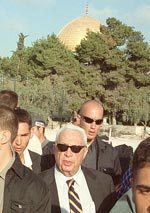
Sharon’s
provocative visit to Al-Aqsa Mosque four years ago erupted the
Intifada (AFP)
|
By
Mohammad Yassin & Ola Attallah, IOL Correspondents
GAZA
CITY, September 28 (IslamOnline.net) – Standing at the threshold of
its fifth running year, the second Palestinian Intifada has left its
indelible marks and has come along way compared to the 1987 Intifada
(first one) against the Israeli occupation.
Following
the killing of four Palestinian workers at the hands of Israeli
settlers, the Palestinians launched their first seven-year Intifada
(Stone Intifada) against the occupation forces to retaliate Israeli
practices against unarmed Palestinian civilians.
And
in September 2000, Al-Aqsa Intifada erupted in the wake of the visit of
the then Israeli opposition leader Ariel Sharon to Al-Aqsa mosque,
Islam’s third holiest site.
As
the first Palestinian Intifada was manifested with broad participation
of the Palestinian people, the second Intifada immediately turned into a
military confrontation between the resistance groups and the occupation
forces.
“The
militarization of Al-Aqsa Intifada caused a drop in level of popular
participation,” Palestinian writer Adli Sadek told IslamOnline.net.
Atef
Odwan, political sciences professor at the Islamic University in Gaza,
attributed the U-turn to the Israeli assassination policy against
resistance cadres.
“Both
Intifadas manifested themselves in broad popular participation. The big
difference between the two is that the second has turned into a military
action in response to the incessant Israeli assassinations.”
Sophisticated
Weapons
The
second Palestinian Intifada has seen the usage of more sophisticated
weapons, contrary to the first Intifada, whose main weapon against the
occupation forces was stones.
“There
was a drastic change in the resistance techniques during Al-Aqsa
Intifada as new weapons are now used such as missiles while the first
Intifada basically depended on stones,” Odwan added.
He
said the “martyr operations” were also one of the main
characteristics of the second Intifada.
“Contrary
to the first Intifada, Palestinian factions [as Fatah, the popular and
democratic fronts] resorted during Al-Aqsa Intifada to martyr operations
against the occupation forces and Israeli settlers, while such a
technique was scarcely used at the first.”
Unique
Coordination
 |
|
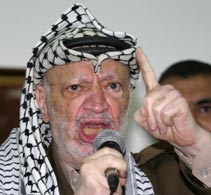
Arafat
opted for the now dying peace process (AFP)
|
Al-Aqsa
Intifada has also seen a remarkable coordination among all Palestinian
resistance groups, contrary to the first Intifada during which tensions
were running high.
“The
resistance groups now carry out joint operations against Israeli
targets. They also formed coordination committees in the West Bank and
Gaza,” Odwan said.
On
the other extreme, Palestinian President Yasser Arafat has opted for the
peace process and negotiating table clichés, deserting decades of
military struggle against the Israeli occupation.
“The
Palestinian Authority has abandoned the military struggle and rather
focused on negotiations, contrary to its stand during the first Intifada
as the liberation movement at that time adopted the military struggle in
principle though opposing martyr operations inside the 1948 lands.”
Under
the strikes of the Palestinian resistance, Israeli Prime Minister Ariel
Sharon proposed a plan to withdraw from the Gaza Strip as well as
starting the construction of the separation wall in the Palestinian
lands.
“Sharon's
plan to withdraw from Gaza and the construction of the separation wall
in the West Bank show that Al-Aqsa Intifada had dealt a psychological
blow to Israeli society,” Odwan said.
Women’s
Role
 |
|
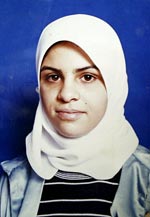
Zeinab
was the latest Palestinian bomber (AFP)
|
Another
key hallmark carried by Al-Aqsa Intifada is the pivotal role played by
Palestinian women in resisting the occupation.
Women
who sacrificed themselves in a string of bombings against Israeli
interests have hit headlines over the past four years.
The
latest of whom was Zeinab Abu Salem, who blew herself up earlier in the
month against Israeli soldiers in Al-Quds (occupied East Jerusalem).
Her
death brought to eight the number of Palestinian women who sacrificed
themselves for their cause.
Palestinian
mothers also showed unprecedented strength, watching sons pay with their
souls to resist the Israeli occupation.
Um
Mohammad Farahat has photographed her son as he was preparing to carry
out a bombing operation in 2002 against the Israeli occupation forces.
As
a result of the unabated Palestinian resistance against the occupation
forces, Israel adopted a policy of assassinations of Palestinian
resistance activists.
Not
only that, Israel went even further by assassinating political figures,
foremost of whom were the assassinations Hamas spiritual leader Sheikh
Ahmad Yassin and his successor Abdul Aziz Al-Rantissi.
Yassin
was assassinated on March 22 in an Israeli
missile attack that also killed at least eight of his
companions.
Rantissi
was
assassinated one month later in a similar attack on his car.
The
Israeli government also sent into exile a number of Palestinian
activists to weaken the uprising as was the case during the crippling
siege of the Church of Nativity in Bethlehem in 2002.
Media
Coverage
 |
|
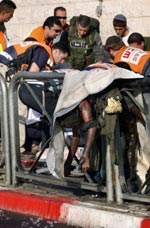
Bombing
operations were used to counter the Israeli military might (AFP)
|
Al-Aqsa
Intifada was much lucky to get heavy media coverage contrary to the
first one.
“There
is no comparison between the two when it comes to media,” said Nashaat
Al-Aktash, media professor at the Beer Zeit University.
“The
1987 Intifada was poorly covered despite growing international sympathy
at the time. Add to that, satellite channels were something of a
luxury.”
He
continued: “In the past, we used to listen only to the mouthpieces of
the Israeli policies, but now we have distinguished Arab satellite
channels and websites that forced the Palestinian cause center stage.”
“More
and more, many Palestinian private radio stations have seen the light,
enticing away the Palestinians from the Israeli radio, which often
broadcast malicious information.”
The
media expert further said Israel has lost its media struggle to gain the
support of the world public opinion.
Over
the past four years, Israel has also targeted Palestinian journalists to
kill the truth.
Israeli
forces have killed eight Palestinian reporters, injured 100 others and
arrested hundreds in addition to confiscating their cameras to impose a
media blackout on their horrific practices.
|