|
Bush, Kerry Seem to Agree on "Arab Oil"
|
 |
|
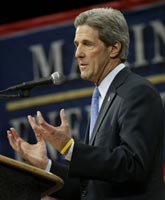
“…we must meet
that challenge and make America energy independent of Mideast
oil,” Kerry said
|
By
Adam walad Abah, IOL Correspondent
WASHINGTION,
October 12 (IslamOnline.net) - Gearing up for their third and final TV
face-off Wednesday, October 14, the two major US presidential
candidates may differ on many issues but appear to agree on at least
one thing -- cutting US dependence on Arab oil, although some analysts
say it will likely be “easier said than done”.
The
issue was raised again Monday, October 11, in a major speech by
Democratic candidate, Senator John Kerry, who said President George W
Bush is not doing enough to find renewable energy sources and other
alternatives to end US dependence on Arab oil. Kerry also pledged to
make the United States independent of Middle East oil in 10 years.
Just
three weeks prior to the election, Kerry charged that the United
States, on Bush's watch, has become more dependent on foreign oil than
when the president took office in 2001, putting the country's security
at risk and burdening US consumers.
Record
fuel prices have translated into all-time high oil prices here, with
some experts predicting no relief in sight. In most parts of the only
superpower on earth, a gallon of gas costs more than two dollars, up
34 percent since Bush took office.
Over
the past four years, the cost of heating the average home with oil has
gone up 91 percent.
Oil
prices Tuesday, October 12, kept their way up at rocket speed reaching
above 54 dollars for the first time ever in history, with no apparent
inclination of a change of direction soon.
Kerry’s
Oil Plan
“For
the sake of our children, for the sake of our security, for the sake
of our economy, for the sake of our environment -- we must meet that
challenge and make America energy independent of Mideast oil,” Kerry
said in a campaign stop in New Mexico.
His
plan to do that includes expanding the use of nuclear energy and
creating a fund that will provide incentives to automakers to develop
more fuel-efficient cars and to consumers to purchase the vehicles.
Kerry
also pledges to work towards finding new sources of natural gas, rely
on “clean coal” as an energy source, and to ensure that 20 percent
of US electricity comes from renewable sources by 2020.
He
says he will also seek more other sources of oil in the United States
and in non-Arab exporting countries.
Bush’s
Plan
|
 |
|
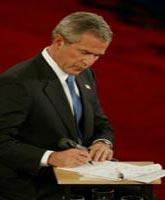
Bush
reiterated the same goal -- to “help us become less dependent on
foreign sources of energy”
|
During
their second presidential debate Friday, October 8, Bush said he also
has an energy plan with the same goal -- to “help us become less
dependent on foreign sources of energy.”
His
plan centers on providing four billion dollars in tax incentives for
conservation and technology exploration. Bush has also proposed to
update the electricity grid and encourage new investment in
transmission.
But
Kerry says the plan will provide tax breaks totaling nearly 15 billion
dollars for Bush's friends in the oil and gas industries. He also
criticized the administration for trying to exempt oil and gas
companies from provisions of the Clean Water Act that limit pollution,
threatening the environment.
While
Bush supports exploration and production of oil in the Arctic National
Wildlife Refuge (ANWR), which contains at least 10 times more oil than
the nation's strategic petroleum reserve can hold when it is
completely filled, Kerry rejects the plan on environmental grounds.
Allies
of both candidates have weighed in on the oil debate in recent weeks.
Late
in September, a group of right wing and pro-Israel neo-conservative
groups issued a letter to the US people called “Set America Free”
urging that the country stop using oil form the Middle East.
The
groups included Analysis of Global Security (IAGS), the Center for
Security Policy, the Foundation for the Defense of Democracies, the
Heritage Foundation, the Hudson Institute, The Washington Institute
for Near East Policy, The Committee on the Present Danger and National
Defense Council Foundation, all staunch advocates of the war in Iraq
and Likudnik policies in Israel.
Ironically,
like Kerry, the groups -- whose meeting in Washington was addressed by
James Woolsey, former director of the Central Intelligence Agency
(CIA) -- say that by promoting improved technology, the United States
can “win the war on terror and shake the yoke of our energy
dependence without compromising our way of life.”
Groups
on the left of the political spectrum also say a new energy policy is
needed. On Monday, the Earth Policy Institute said new technologies
are the answer.
Gas-electric
hybrid engines and advanced-design wind turbines, for example, offer a
way to wean the country from imported oil, argued the Washington
DC-based research centre.
“If
over the next decade we convert the US automobile fleet to
gas-electric hybrids with the efficiency of today's Toyota Prius, we
could cut our gasoline use in half. No change in the number of
vehicles, no change in miles driven -- just doing it more
efficiently,” said Lester R Brown, president of the institute, in a
statement.
But
some analysts doubt the United States can be rid of foreign oil any
time soon. Many estimate that during the next 20 years, US oil
consumption will grow by one-third and electricity demand could
increase by more than 45 percent.
The
United States, a country of 294 million people, is already importing
2.5 million barrels of oil from the Middle East every day.
When
Washington invaded oil-rich Iraq in March 2003 -- for its oil despite
the administration's claim, many people believe -- officials estimated
that oil prices would be as low as 28 dollars a barrel in 2004. Last
week, gas prices hit a record 53 dollars a barrel.
The
benchmark for European imports of Middle Eastern, Russian and African
crude -- Brent crude -- closed at 50.66 dollars a barrel Monday, up 95
cents on the day on London's International Petroleum Exchange. It is
now 20 dollars higher than at the start of the year.
“Energy
independence is a myth,” said H. Sterling Burnett, senior fellow
with the National Center for Policy Analysis (NCPA). “Like
everything else in this age of globalization, energy is bought and
sold on the world market and that is not going to change under any
scenario.”
|