|
Thai Muslims Massacred…What Lies Beneath? (Analysis)
 |
|
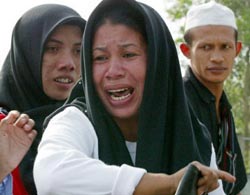
Blood was shed, tears came next
|
By
Mohamed Gamal Arafa, IOL Staff
CAIRO,
October 28 (IslamOnline.net & News Agencies) - The latest
confrontations in southern Thailand that culminated in the brutal
death of over 80 Muslims in police custody have opened a new chapter
of violence in the predominantly-Muslim region.
At
least 78 Muslims died
after being either suffocated or crushed on October 26, in
military custody. They were arrested at a demonstration in the
country’s restive south.
The
official reaction was unnerving to Muslims, who make up 18 per cent of
the country’s overall population.
The
Prime Minister, Thaksin Shinawatra, was quick to praise the security
forces for ending the protests.
“They
have done a great job,” he said. “They [the protesters] really set
out to cause trouble, so we had to take drastic action against
them.”
Muslims
Reactions
Abdulraman
Abdulsamad, chairman of the Islamic Council in Narathiwat, said: “I
believe hell will break out.”
A
local separatist organization, the Pattani United Liberation
Organization (PULO), posted a warning on its website saying Bangkok
would be a target for retaliation.
“Their
capital will be burned down in the same way the Pattani capital has
been burned,” the statement said.
The
tragic incident -- denounced by international rights groups -- was the
worst Muslim loss of life since April, when 108 Muslims were shot dead
in clashes between Muslim youth and security forces.
The
demonstrators wanted nothing less than improving their harsh living
conditions and satisfying their tendency to separatism.
The
south has also seen several bloody clashes when Muslims took to the
streets to push forward their long-cherished demands.
Police
usually respond with unjustified excessive force to end the protests,
according to reports by local and international groups.
On
one occasion, security forces shelled a mosque in which 30 individuals
were hiding. The building was demolished with the bodies inside
smashed beyond recognition.
Separatism
Fears
 |
|
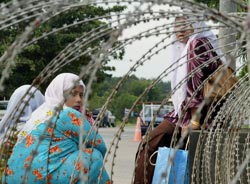
Living under siege in south Thailand (AFP)
|
The
excessive use of force by Thai security forces against Muslims - in
addition to official complacency -- shows how the Buddhist government
greatly fears the growing influence of Muslim groups in the south.
The
five to eight million Muslims have been calling for the formation of a
Muslim state comprising the provinces of Pattani, Narathiwat and Yala
provinces, a demand the government reacts to with excessive violence.
The
government seems to be playing on the current situation worldwide,
exploiting the international enmity towards Muslims to quell any
separatism by what it now calls “terrorist” movements.
Thai
premier is also under pressure to end the violence in the
Muslim-majority provinces that border Malaysia, as he faces elections
in February.
Further,
the government has escalated the tension taking up the chance of the
“war on terrorism” to avoid criticism of international human
rights and win over more supporters for its line of violent reactions
to the protests.
Amnesty
International had urged the Thai government to impartially investigate
the deaths, in the province of Narathiwat.
But
Thaksin reacted with defiance, saying the government had resorted to
“gentle measures” and did not use force.
Feelings
are running high among the Muslim community in the southern provinces
following the imposition of martial law in January.
More
than 350 have since died in clashes with security forces, according to
a BBC count.
Tourism
To
add salt to injury, Muslims in the southern region also complain about
sex trade, rampant in its tourist attractions frequented by many
western vacationers.
The
existence of night clubs and alcohol shops in the region further
infuriate the predominantly Muslim inhabitants.
On
May 7, the PULO has posted a warning on the internet warning Muslims
against going to night clubs or music concerts.
The
government has disregarded these appeals, leading Muslim youths to
protest on a regular basis.
The
violent response of police could be attributed to the government fears
for the collapse of the tourism industry, a key earner of hard
currency and a key boost to the country’s economy.
Several
western governments have warned their nationals against traveling to
Thailand following the recent clashes. Thai officials undermine the
risks, saying the protests are no more than a few of thieves and
bandits.
History
Belies Claims
 |
|
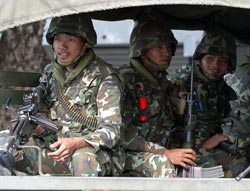
Thai security forces are accused of using excessive power (AFP)
|
Looking
into the historical background of the Muslim kingdom of Pattani,
annexed by Thailand, the picture of the current merciless anti-Muslim
repeated carnages might be clearer.
Most
of Thai Muslims live in the five southern provinces bordering
Malaysia.
Pattani,
Yala and Narathiwat are the only Muslim majority provinces in
Thailand.
Muslims
in these provinces have long complained
of discrimination in jobs and education and business
opportunities.
The
South was a rich Malay kingdom until it was overrun by the Buddhist
kingdom of Siam in the late 16th century when it declared its full
independence from its earlier status of semi-independence under the
rule of the Thai kingdoms of Sukhothai and Ayutthaya.
In
1909, it was annexed by the Kingdom of Siam as part of a treaty
negotiated with the British Empire.
Both
Yala and Narathiwat were originally part of Pattani, but were split
off and became provinces of their own.
There
still exists a separatist movement in Pattani that at times erupts in
violence like in the late 1980’s when the PULO fought against the
Thai forces for a separate Muslim South.
No
Terrorists
“The
search operations in schools and Islamic centers in search of “white
people wearing beards” is furthering tension in the region,” said
Arifin Jehmah, the president of the Yala Islamic Provincial Committee
in an earlier interview with IslamOnline.net.
Several
religious leaders were afraid for their safety and sought shelter in
Malaysia, Muslims in Kelantan, the Malaysian state bordering Thailand,
said in the IOL report
.
Muslim
leaders vehemently denied official claims that terrorists are hiding
in southern areas, saying the government want to get rid of
separatists movements by associating them with terrorism.
“There
are no terrorists in South Thailand, nothing that is close to the
alleged al-Qaeda or the JI, which should not be called the Jemaah
Islamiyah anyway,” said Mansor Saleh, a writer and social worker
from South Thailand.
Saleh
had said that Muslims did not believe the government when it said two
Muslim scholars and a doctor had been arrested for their connections
with the alleged regional “terror network” called the JI.
Thai
Muslim complaints of discrimination in jobs and education, along with
the economic neglect of the south, have provided fodder for separatist
movements in the provinces once part of the Muslim kingdom of Pattani.
|