|
Musharraf’s
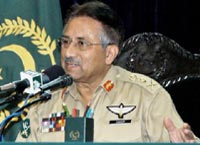
U-turn on Kashmir for Personal Gains : Experts
 |
|
"Musharraf
wants to divert attention from the uniform issue," one
analyst said.
|
Asif
Farooqi, IOL Correspondent
ISLAMABAD,
November 1 (IslamOnline.net) – President Pervez Musharraf’s u-turn
policy on Kashmir, the most significant by a Pakistani leader since
independence in 1947, is mainly for personal political gains, many
analysts and politicians believe.
"Musharraf
wants to divert attention from the uniform issue," Lt Gen Talat
Masood, a foreign policy analyst, told IslamOnline.net.
He
said the new policy shift is part of Musharraf’s tactics to reduce
mounting popular opposition to his controversial
plan to hold
on to his position as the nation's army chief.
In
a major speech to media bigwigs on Monday, October 26, Musharraf
seemingly abandoned Pakistan’s long-standing demand for a plebiscite
in Kashmir and said India and Pakistan should move away from their oft
stated positions for the sake of peace in South Asia.
The
remarks were seen as departure from Pakistan’s firm position on
Kashmir based on a 1948 UN resolution which asked for a plebiscite.
Masood
offered another optimist analysis of Musharraf’s new policy saying
he was trying to publicly pressure India into making concessions.
"He
also wants to change the mindset of the people domestically. To lower
their expectations and aspirations on Kashmir," said the expert.
Playing
American
Imran
Khan, a Cricketer-turned-politician, represents another dominant
viewpoint in Pakistani masses on this issue.
"Gen.
Musharraf is acting at the behest of Washington and New Delhi,"
Khan told IOL over the phone, accusing Musharraf of perusing a US
agenda to strengthen his rule.
"If
any action is taken by the president in this connection, we will
strongly oppose him, and the people of Pakistan will launch a movement
against him," warned Khan, who heads the Justice Movement party.
Risky
Policy
Ikram
Sehgal, another Pakistani analyst and writer, asserted that the new
policy shift carries personal risks for General Musharraf.
"Pakistan’s
major departure of policy, coming from a soldier, is a 180-degree
change of direction in the Army’s thinking," he told IOL.
"What
about the personal risk the President is taking domestically for
having dared to touch a national sacred cow? His enemies have been
provoked to come up with a better alternative to solve this bloody
impasse," Sehgal said.
Qazi
Hussein Ahmad of Jamaat e Islami, the largest Islamic party, said in a
press conference on October 27 that Musharraf would face agitation at
the masses level.
"We
shall bring the people in the streets to wage protest against any
change of policy on Kashmir," he told reporters in Lahore.
Civil
society groups have also stepped in to oppose any change in the
Kashmir policy by what they call "an illegitimate
President."
The
Lahore-based Pakistan Lawyers Forum, one of the several bodies of
lawyers, said lawyers all over the country would hold public
demonstration to protest Musharraf’s position on Kashmir.
"It
saddens me to note that Pakistan is step-by-step backtracking on its
stand on Kashmir. It has always supported a settlement of the issue in
accordance with the wishes of the Kashmiris as well as the relevant UN
Security Council resolutions," said Syed Salahuddin, chief of
Kashmiri Hizbul Mujahideen group.
"But
all of a sudden, a division of Kashmir has been proposed, which has no
relevance to Islamabad's principled stand," he said in a
statement issued on Friday, October 29, from Muzaffarbad, the capital
of Pakistani controlled Kashmir.
"The
people of Kashmir are party to this issue and no final opinion could
be given on these options without involving the representative
leadership of the Kashmiris in the dialogue process," Salauddin
was quoted as saying by the local daily Dawn.
Courageous
Nonetheless,
Musharraf’s new Kashmir policy was supported by many others.
Former
Prime Minister Azad Jammu and Kashmir (AJK), the part of Kahmir under
Pakistan’s control, Sardar Abdul Qayyum Khan described it as a
“courageous” move by President General Pervez Musharraf to
peacefully resolve Kashmir issue.
"As
far as President Musharraf talked about the regions, the proposal was
also discussed in the past but in the present scenario, it is a
courageous and historical step," he told IOL.
"President
Musharraf has extended the proposals truly open heartedly for the
first time in the disputes history," said Qayyum, conceded the
leadership of his Muslim Conference party to his son.
He
added that Musharraf spoke the truth that the issue cannot be resolved
by declaring the Line of Control (LoC) as permanent border nor can it
be resolved on the Indian viewpoint of integral part basis.
He
believed Musharraf’s three proposals, namely, demilitarization of
regions, independence and joint control or UN control will lead to the
solution of issue.
Qayyum’s
views on important national issues, especially with regard to Kashmir,
carry political weight as he still is considered an inspiration for
the largest political party in AJK.
Kashmir
has bitterly divided India and Pakistan since the two counties got
independence from the British rule in 1947.
They
have fought two wars over the region. Both risked nuclear war during a
yearlong military standoff following an attack on the Indian
Parliament on December 13, 2001.
The
Indian side of Kashmir, the only Muslim-majority state of
predominantly Hindu India, is home to a 15-year-old separatist
uprising, which India blames on Pakistan.
But
much to the comfort of the international community, the two nations
warmed to each other this year and have been reciprocating
confidence-building measures.
|