|
Half Mosques Downed, Human Crisis Unfolds in Fallujah
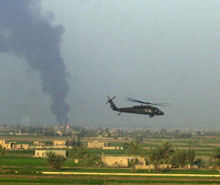 |
|
US
air strikes have reportedly destroyed half of Fallujah’s 120
mosques
|
FALLUJAH,
Iraq, November 10 (IslamOnline.net & News Agencies) – Iraqi
fighters were still putting up fierce resistance in Fallujah
Wednesday, November 10, with US-led troops saying they were in control
of 70% of the resistance hub, and almost half of the city’s mosques
destroyed by US air and tank fire.
Crouching
in mosques, die-hard rebels traded fire with US troops Wednesday in
the heart of Fallujah as the military claimed it controlled 70 percent
of the Iraqi city on the second full day of battle.
As
the punishing beat of ground and air fire tore into pockets of
resistance and fighters who remained vowed to fight to the death, the
Red Crescent painted a grim picture of conditions inside and sent a
small team to evaluate, reported Agence France-Presse (AFP).
An
Iraqi reporter was quoted by Al-Jazeera.net Web Site as saying that
more than half of the city’s 120 mosques have already been reduced
to rubble by
US
air and tank fire.
“Almost
half of the city's mosques have been destroyed after being targeted by
US
air and tank strikes,” Fadil Al-Badrani told
Al-Jazeera.net.
Several
bodies littered the streets as troops advanced cautiously from
house-to-house, or rooftop-to-rooftop, barging through walls to avoid
becoming easy targets out in the open.
Hopelessly
outnumbered, and with their leaders apparently gone, Iraqi fighters
told AFP they would fight to the end for their stronghold, which
became a no-go area for US forces after a battle in April ended in
stalemate and the military withdrew.
One
told AFP that he wanted the shelling to stop so he could confront the
US
soldiers face-to-face, saying that he preferred “a war in the
streets”.
Others
took up positions in central mosques, with
US
marines based outside.
“They
are trading fire in the center of Fallujah. They are firing from
several mosques,” said a
US
marine officer.
Control
 |
|
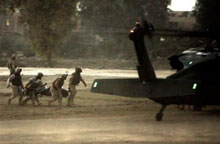
US
forces are faced with stiff resistance, taking casualties
|
Meanwhile,
a senior
US
military officer told AFP “Coalition forces control 70 percent of
the city”.
This
came after US tanks and infantry forged with relative ease through
much of the dusty network of streets, rolling from north to south.
At
this rate, the
US
military said it expected to achieve total control of the resistance
bastion within 48 hours, even as fighters regrouped in the south and
fought from inside central mosques and other buildings.
Al-Badrani
told Al-Jazeera that US forces Wednesday resumed attacks on the
city, targeting Julan in the north-west to Al-Jughaivi in the
north-east.
Machinegun,
mortar and rocket fire shook the city as planes made several bombing
runs over Julan district in the space of 15 minutes,
according to a Reuters reporter.
Smoke
was rising from houses just beyond Fallujah's captured rail station,
where marines and Iraqi forces have a base.
Marines
said their opponents showed no signs of giving up, even though
US
forces penetrated to the center of the city, west of
Baghdad
, after an offensive launched Monday night.
Conflicting
Reports
 |
|
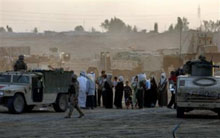
Civilian
losses in Fallujah is a crisis in the making
|
Reports
about fighters inside the city and the extent of their organization,
however, contradicted remarkably.
Despite
the resilience of some fighters, the overall resistance -- expected to
number some 2,000 to 2,500 fighters -- was less effective than
expected, with one marine officer describing it as “unorganized”.
A
tank platoon that moved along Fallujah's main street saw fighters who
had just come under mortar fire climb on to rooftops and fire
rocket-propelled grenades (RPGs) and machineguns.
“There
are lots of them. We took heavy fire,” Gunnery Sergeant Ishmail
Castillo told Reuters. “They opened up on my tank. They don't look
like they are going to cave in.”
Castillo
said his tank had killed six fighters and that two marines were
wounded in fighting. “One of the marines was hit in the head by RPG
shrapnel,” he said.
“They hit us from one area and then another right afterwards. There
is in-depth organization. There were small-arms attacks all night,”
he said.
Heavy
Price
At
least 10,000
US
troops from a pool of 20,000, who have been gathering outside Fallujah
since the middle of October, have fanned out inside the city since
Monday, backed by 2,000 Iraqi soldiers.
But
victory in Fallujah may come at a heavy price, both on the military
and the civilian side, AFP said.
Eleven
US
soldiers and two Iraqi troops have died since the offensive was
launched, along with scores of Iraqi fighters, according to the
military. The casualties could not be independently verified.
There
are no clear figures about how many civilians have been caught in the
crossfire, even though about two-thirds of Fallujah's estimated
300,000-strong population is thought to have fled ahead of the
fighting.
The
Red Crescent said it had serious concerns about medical facilities in
the city after US and Iraqi troops seized the general hospital Monday,
before the full-scale offensive was launched.
Two Red Crescent
officials and a local from Fallujah are headed for the city to
evaluate the humanitarian situation inside, said Firdaws Al-Ibadi, a
spokeswoman for the relief agency.
“We
haven't got the okay for the team to enter the city but something
should be done,” she told AFP.
The
Red Crescent also plans to send a convoy Thursday of five-to-six
trucks laden with food into Fallujah, where a strict curfew has been
imposed and water and electricity supplies cut.
A
central mosque had been converted into a field hospital to treat the
wounded, caught in the street fights, but it only had one medic as all
the others were inside the main hospital, which was seized by US and
Iraqi troops before they launched the full-scale offensive Monday,
Ibadi said.
“Our
first mission is to obtain permission from the multinational forces to
enter the city and start evacuating the wounded, the elderly, the
children and women,” the Red Crescent spokeswoman explained.
“If
we fail to get the green light, we will ask to run the Fallujah
general hospital,” Ibadi said, adding that the Red Crescent had a
team of 10 ambulances, five surgeons and a number of nurses on
stand-by to go.
There
are also concerns over the well-being of the tens of thousands of
people who have set up temporary homes in camps and villages around
Fallujah.
Read
Also…
|