|
Hamas
Changes Resistance Tactics to Adapt
 |
|
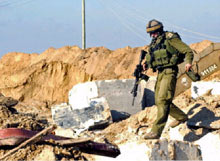
Israeli soldier checks the destroyed tunnel’s rubble in Rafah.
|
By
Yasser Al Banna, IOL Correspondent
GAZA,
December 15
(Islamonline.net) – The
nature of the latest operations by the Palestinian resistance Movement
(Hamas), targeting only Israeli military targets within the
territories occupied in 1967, according to experts, is a change of
tactics, in an attempt to lift pressures and accusations by the west
of being a “terrorist organization”.
In
statements to Islamonline.net, following the Rafah operation that
killed five Israeli soldiers and wounded 9 others Sunday, December 12,
experts said the movement’s current halt to the shelling of Israeli
town of Sedrot using “Qassam missiles”, along with limiting
resistance operations to the West Bank and Gaza Strip, is a clear
evidence of the tactical change.
The
Rafah operation was claimed jointly by Hamas military wing and an
offshoot of Fatah movement, call “Fatah Eagles”.
The
Tactic
Ashraf
Al-Agramy, a Palestinian expert in Israeli Affairs, told IOL Tuesday,
“Tunnel operations represent a dramatic development in resistance
methods, a tactic and qualitative accommodation by the resistance to
adapt to conditions on the ground”.
He
added the change also came in response to Arab and international
pressures to make resistance military operations confined to the
Palestinian territories occupied in 1967, not extended to bombing
operations inside what is now known as Israel.
“The
latest operations centered on Israeli military posts which I consider
more effective on the morale of Israeli soldiers and have larger
implications on the Israeli society at large”, he added.
The
Palestinian expert pointed out that “tunnel operations” send a
message to Israel that tunnels dug under Israeli posts could reach
anywhere and at anytime even after the construction of the separation
wall between the West Bank and Israel, adding the resistance
operations of this kind highlight the ability of the resistance to get
into other places even after the Israeli withdrawal from Gaza.
Political
Adaptation
 |
|
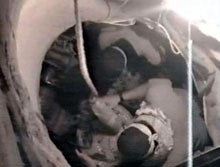
A photo provided by Palestinian resistance for members setting up explosions inside a tunnel.
|
Palestinian
writer and political analyst Dr. Hasan Abu Hashish said that the focus
of Palestinian resistance on tunnel explosions, from time to time, is
due to pressures and takes into consideration the current political
atmosphere.
“Resistance
factions face enormous difficulties, but they always come up with new
tactics so as to keep up the burning torch of resistance. I believe
the military tactics of resistance are used in light of political
conditions and there might be a link between tunnel explosions and the
halt to the shelling of Sedrot settlement by Qassam missiles”, he
said.
“If
Qassam missiles and attacks were halt, they remain means of resistance
and could be used again, in line with the political conditions and
potentialities which are a mater related to the military wings of the
[resistance] factions”, he added.
Abu
Hashish sees tunnel operations, despite technical hardships and high
cost, as proving the resistance wants to send several messages to the
international community to the effect that the Palestinian people are
under occupation and want nothing but to restore their rights.
He
added the message also highlights the fact that resisting occupation
is a legitimate right, guaranteed by all international laws and it can
no longer be considered “terrorism”, as it now targets the army of
occupation.
Hamas
had carried out several resistance operations including “tunnel
explosions”, over the past few months.
The
latest was the tunnel explosion carried out by Qassam Brigades in
June, where a tunnel under an Israeli military post near Gush Katif to
the south of Gaza, was destroyed, leaving at least 5 soldiers killed.
Two
weeks ago, the Israeli officer entrusted with uncovering tunnels in
Rafah was killed as he was searching for a tunnel.
An
Israeli soldier was also killed on December 7 when a Hamas cell
ambushed a special Israeli force to the east of Gaza.
Field
Reasons
Samy
Abu Zahri, Hamas spokesman in Gaza, however, attributed the use of
tunnel explosions in resistance operations to “field reasons
only”, affirming that Hamas has not changed its general policy as to
resistance.
“
All options and means are open in the face of occupation and
aggression including martyrdom [bombing] operations”, Abu Zahri
said, adding that resistance military leaders decide on the nature of
operations, according to field conditions.
Hamas
political leaders usually refuse to directly comment on resistance
tactics, insisting it was the job of the military wing leaders to
select and plan these operations, taking into account the situation on
the ground.
The
European Union and the United states classify Hamas as a
“terrorist” movement under the pretext of targeting Israeli
“civilians”.
Tunnel
Palestinian
had started using tunnels to smuggle weapons, arms and persons through
the border between Gaza sector and Egypt, yet the closures imposed on
the Strip and the difficulties hindering resistance operations inside
Israel forced the resistance to use tunnels to target Israeli military
posts.
A
tunnel is a hole dug on different depths and sizes using different
kinds of tools. It could take months to dig a tunnel, highlighting the
difficulty and cost of the operation.
According
to Palestinian sources, a tunnel length varies according its purpose
and the width of a tunnel entrance ranges between 90 to 150
centimeters. To avoid collapse inside the tunnel during and after
digging, Palestinians use a square wooden frame to avoid any slides.
|