|
Destroyed Fallujah
“Uninhabitable”
 |
|
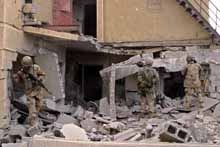
Most of Fallujah homes were flattened by the US air and ground attacks.
|
By
Samir Haddad & Mazen Ghazi, IOL Correspondents
BAGHDAD, December 22 (IslamOnline.net) –
Iraq’s Association of Muslim Scholars (AMS) has ruled out the return of
Fallujah evacuees to their homes during the coming days, dismissing
statements by the interim government, due to wide scale destruction
caused by the US military campaign that rendered the city “uninhabitable”.
A
statement issued Monday, December 20, by the interim Iraqi government,
said that displaced Iraqis will start returning Thursday, December 23,
to Fallujah, which was virtually abandoned by its residents ahead of
last month's massive US assault to regain control of the city from
resistance fighters.
The
statement said that the first batch of citizens would return to the
southwestern neighborhood of Al-Andalus. Fallujah used to have a
population of some 300,000 before the assault.
“The
cabinet today approved the plan for the citizens of Fallujah to start
returning to their city. The return will begin on Thursday December 23
for residents of Andalus district only,” the statement read.
No
Living Conditions
On
the ground, the sufferings of Fallujah displaced and evacuees have
critically escalated seven weeks after being forced to leave their hometown.
The sufferings are manifested in severe shortage of foodstuff, medical
requirements and services as well as the freezing cold, featuring Iraq’s winter.
In
an exclusive statement to IslamOnline.net Tuesday December 21, AMS
secretary general, Sheikh Hareth Suliman Al-Dari said, “Fallujah is
completely destroyed and sabotaged. It has become uninhabitable with
no water, electricity or wastewater facilities.”
“The
rotten smell of the dead is widespread and smokes of internationally
banned weapons [used by the US occupation] cover its sky. So, I don't think they will return to it
even if the occupation forces depart. They will probably be back in
months or even years,” Al-Dari resumed.
Al-Dari
put the blame for the sufferings of Fallujah people on the occupation
troops and the Iraqi government, pointing out to the shortage of
“foodstuff, clothes and shelter.”
Police
Measures
 |
|
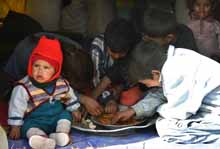
Fallujah evacuees currently suffer greatly, with no clear hope in sight.
|
“Fallujah
is still under occupation and nobody can have access there but the US
troops,” Al-Dari said, pointing out that “resistance still exists in
some neighborhoods.”
On
the rumored negotiations between Fallujah wealthy people and the
officials of the interim government on the return of evacuees, Al-Dari
said, “I have no idea about such negotiations. I do not think any
wise man would ask for the return of Fallujah residents under such
tragic circumstances.”
The
statement by the interim government was strict on banning “the
carrying or licensing of any weapons inside the Fallujah.”
There
was no word, however, on measures declared by the US military recently on conditions set for the return of Fallujah
displaced to their destroyed homes.
The
set of police state measures were reported early December by the
Boston Globe.
The
measures include funneling Fallujans to so-called citizen processing
centers on the outskirts of the city to compile a database of their
identities through DNA testing and scanning, according
to the American paper.
Humanitarian
Catastrophe
To
add salt to injury, Fallujah’s displaced families are currently
suffering difficult and catastrophic humanitarian circumstances.
“Medical
services are very bad. There are several inhabitants in Ameriyat
Fallujah Hospital who suffer from diseases resulting from lack of services,” Dr. Gamal
Nasser, board chairman of Iraqi Red Crescent Society told
IslamOnline.net.
“Some
women suffered abortion and children mortality increased due to the
lack of health care,” he added.
“I
volunteered to transport foodstuff, relief and medical materials
donated by some well-offs to the evacuees,” Abu Mohamed, a driver
who is assigned to transport aids to the hospital that received more
than 3000 displaced families.
“The
US troops and the Iraqi National Guard hinder and may prevent the arrival
of relief materials provided by the parties and relief
organizations,” Abu Mohamed added.
He
pointed out that due to the obstacles imposed by the occupation, a
trip to Baghdad may take three hours, instead of the 50 minutes such a trip usually
takes.
“So,
I have to resort to unpaved roads to reach the Ameriyat Fallujah.”
Schools
Thousands
of evacuees suffer severe difficulties due to the impossibility of
accommodating them in the camps that have been established by some
charities; a matter that led many of them to gather in schools.
Mosleh
Al-Gamily, a secondary school teacher who took refuge in a camp in
Ameriyat Fallujah, said, “I left Fallujah one day before the US
occupation managed to control the town and headed with my nine-member
family to this camp.”
“We
receive aids from philanthropists but feel that the interim government
has done nothing to extend a helping hand. No official visited us, as
if the responsibility of the government towards us has come to an end
by destroying the city,” he added.
|