|
Iraq
Risks Sliding Into Civil War: Interior Minister
 |
|
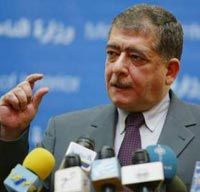
“Failing
to take part in the elections is tantamount to treason and will lead to
a civil war and the division of the country,” Naqib said. (Reuters)
|
BAGHDAD,
January 18 (IslamOnline.net & News Agencies) – Just 13 days
before the controversial general elections in the war-torn country,
Iraqi interior minister warned Tuesday, January 19, the country risked
sliding into civil war if the Iraqi Sunnis boycott the January 30
polls.
The
warning comes as the Iraqi interim authorities declared they decided
to close land borders for three days around voting day to guarantee
security in the country, with insecurity causing more Iraqi blood to
be spilled in a new spree of violence in the war-ravaged country.
“Failing
to take part in the elections is tantamount to treason and will lead
to a civil war and the division of the country,” said Iraq’s
Interior Minister Falah Naqib, who is also a member of the Iraqi Sunni
sect, Agence France Presse (AFP) reported.
“All
Iraqis should take part in the elections as best they can. It is not
crucial that they should vote, the important thing is that everyone
participates,” he said.
Naqib
added that “if Iraqi Arabs, who today make up the best part of the
country's backbone, are divided, the country itself will be torn and
will turn into little fiefdoms and regress by 5,000 years.”
The
Association of Muslim Scholars (AMS), the highest religious authority
in the country, pressed for a boycott of the vote, citing the
impossibility of organizing fair elections held under current
deteriorating conditions.
Also,
the Islamic Party, a major Sunni political player, recently
backtracked on its earlier decision to vie in the elections, dealing a
huge blow to hopes that all Iraq 's communities would turn out in
force for the poll.
The
Iraqi interior minister also admitted that attacks would probably peak
on election day, particularly in the capital Baghdad.
“I
am expecting an escalation of terrorist acts in the coming days,
notably in Baghdad,” Naqib said.
For
the Worst
The
Iraqi interior minister's remarks came only one day after US General
George W. Casey, a top military official, said that the level of
bloodshed and violence would likely to continue unabated in the
war-ravaged country even after the January elections.
Similar
prognosis was also echoed by Iraqi Deputy Prime Minister Barham Saleh
who told AFP that the interim Iraqi government was “prepared for the
worst”.
US
analysts and officials had predicted a week ago the coming
controversial Iraqi polls were likely to lead to more chaos and
instability.
UN
Iraqi envoy Lakhdar Brahimi also warned that holding the elections
would be impossible unless “first and foremost security improves”
with many, including Britain’s daily The Independent,
expecting the vote to be one of the most “secretive” polls in
history.
Iraqi
voters are to choose a 275-member assembly, which will be charged with
writing a permanent constitution.
If
adopted in a referendum later this year, the constitution would form
the legal basis for another general elections to be held by December,
2005.
Border
Closure
 |
|
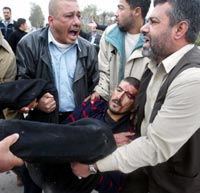
Iraqis rushing an injured man in the attack on the SCIRI headquarters to hospital. (Reuters)
|
The
bleak assessments and lowering down of expectations coincided with the
Iraqi authorities declaring Tuesday to close Iraq's land borders for
three days around the January 30 general elections, according to AFP.
“The
international land borders will be closed between January 29 and
January 31,” said electoral commission spokesman Farid Ayar in a
statement.
He
added that only Iraqi pilgrims returning from Makkah, Saudi Arabia,
after performing Hajj would be allowed into the country.
The
interim Iraqi government of Iyad Allawi announced January 15, a string
of tightened security measures to counter the threat of a surge in
attacks on election day.
Travel
by road will be restricted between the provinces and even inside some
cities.
Polling
station areas will also be sealed off and cars banned from approaching
voting centers.
More
Blood
In
a grim reminder of the deepening insecurity in the chaos-marred
country, three Iraqis were killed Tuesday in an attack on the
headquarters of Abdel Aziz Al-Hakim's Shiite Supreme Council of the
Islamic Revolution in Iraq (SCIRI) in the Iraqi capital Baghdad, AFP
reported.
The
attack occurred when a self-bomber blew himself up at a checkpoint
some 30 meters from the SCIRI headquarters.
“A
suicide bomber tried to drive into the Jadriyah office of SCIRI,”
Haitham Al-Husseini, a SCIRI spokesman told AFP.
A
US military spokesman said “the suicide bomber got out of his car at
a checkpoint near the building, asked to go in but was declined
permission and returned inside his car before blowing himself up”.
Thirteen
people were killed December 27, and dozens others wounded when a
bomber rammed an explosives-laden car into the SCIRI Baghdad
headquarters.
The
attack came less than 24 hours after seven policemen were killed and
15 wounded in a car bombing outside a police station in Baiji, home to
Iraq's largest oil refinery, a senior Iraqi police officer said.
|