|
Israel
Grabs Palestinian Lands, Resumes Wall Building
 |
|
Many
Palestinians lose their lands and properties in the occupied Al-Quds
due to the Israeli separation wall. (Reuters)
|
Additional
Reporting by Samer Khuwayera, IOL Correspondent
NABLUS,
January 25 (IslamOnline.net & News Agencies) – Israel is mulling
a measure to enforce a decades-old law to seize tracts of land owned
by Palestinian citizens in the occupied Al-Quds (eastern Jerusalem)
without compensation.
This
comes as the Israeli government has resumed the construction of its
separation wall in the West Bank, a move seen by the Palestinian
Authority as affecting efforts to reach a ceasefire between the
Palestinian resistance factions and Israel.
A
number of Palestinian landowners in the West Bank city of Bethlehem
were informed by the Israeli authorities that their lands in the
occupied Al-Quds had been seized under the Absentee Property Law even
though they live nearby, Mohammed Dahleh, the lawyer for Palestinian
landowners, told Reuters Monday, January 24.
With
the absentee law reactivated, the Palestinian citizens will lose more
than 1,000 acres (415 hectares) of farmland within Al-Quds municipal
borders, he added.
Under
the 1950 absentee law, Palestinians living in the West Bank and own
property in Al-Quds could be labeled as absentee landowners, allowing
the Israeli government to confiscate their lands without compensation.
The
absentee law was passed in 1950, allowing the Israeli government to
confiscate properties owned by hundreds of thousands of Palestinians
who fled or were forced from their homes during the 1948 war which
resulted in the creation of what is now known as Israel.
Secret
Decision
Israeli
daily Ha’aretz reported recently the Sharon government had
made a decision in June 2004, to enforce the law, but did not make it
public.
However,
a senior Israeli official declined to assert the measure has already
been approved, while not rejecting the intention to pass it.
“There
is an intention to do that. It hasn't been approved yet. That's all.
There are discussions about this law,” he told Reuters, declining
further comment.
The
justice and housing ministries and the Jerusalem municipality also
declined to comment.
“All
the government decisions on this issue are made secretly,” Daniel
Seidemann, an Israeli lawyer representing many of the landowners, was
quoted by the New York Times Tuesday, January 25, as saying.
“It
is treated like a security issue, not a property issue.”
Khalil
Al-Tafakji, map circle director of the Ramallah Arab studies body said
the Israeli law risks the loss by Palestinians of half their
properties in Al-Quds.
“Israel
had used the law in 1948 to seize around 97% of lands of what is now
known Israel,” he noted.
He
added that the law had also been used to seize Palestinian properties
to allow Jewish settlement groups to control whole areas and
neighborhoods.
Land
Seizure
Johnny
Atik, a Palestinian resident in Bethlehem, said that he was told by
the Israeli authorities that eight acres of olive groves now belonged
to the Israeli Custodian of Absentee Properties, a body formed by the
1950 law, according to The Washington Post.
Atik's
land is 100 yards from his home, which sits on the other side of
Israel’s illegal separation wall in the West Bank.
He
added that lands belonging to 40 Palestinian families in his
neighborhood had also been taken.
“This
is state theft, pure and simple,” said Hanna Nasser, the mayor of
neighboring Bethlehem.
The
mayor linked the Israeli decision to the West Bank separation barrier
that Israel is building in the same area.
“When
Israel started building this wall, they stopped letting people use
this land,” he said.
What
Will Remain?
 |
|
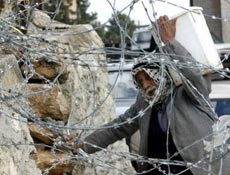
In
addition to daily sufferings, Israel’s separation wall leaves
nothing for Palestinians to finally hope for. (Reuters)
|
The
Israeli move was seen by the Palestinians as a bid to pre-set the
final status negotiations, Reuters said.
“What
will remain for us in final status talks?” Palestinian Negotiations
Minister Saeb Erekat said.
He
added that the Palestinian leader Mahmoud Abbas (Abu Mazen) would
protest to Israel against the absentee law.
Israeli
lawmakers and human rights groups also said the government measure was
a land grab.
Yossi
Beilin, leader of the Israeli Yahad Party, said the Sharon government
has taken unprecedented measures to seize the Palestinian lands in Al-Quds.
He
noted that the Israeli opposition would hold a meeting to annul the
government absentee law.
“It's
just an obvious land grab, and it is absolutely illegal,” said Sarit
Michaeli, spokeswoman for the Israeli rights group B'Tselem.
He
added that “it is so blatantly an attempt to take as much land as
possible with as few Palestinians as possible.”
Construction
Meanwhile,
Israel's attorney-general approved the construction of the 4-km (2.5
mile) segment of its separation wall along a new route near the large
Jewish settlement of Ariel after residents of the adjacent Palestinian
village of Salfit petitioned a court against land expropriation,
Reuters said.
An
Israeli court had ordered construction of the separation barrier
around the Ariel enclave halted last June after the appeal was filed
and then asked the sides to resolve the issue through negotiations.
Changes
were subsequently made to the route although Salfit's mayor denied
Monday reaching any deal with Israeli authorities.
The
Palestinian Authority said the Israeli court decision would undermine
efforts of the Palestinian leader to broker a ceasefire between the
Palestinian resistance factions and Israel.
“How
we are going to convince our people and factions that we are trying to
end Israeli occupation while Israel is imposing facts on the
ground,” Erekat said.
“This
will have a deep and negative impact on our efforts to reach a
ceasefire.”
The
new Palestinian leader has been engaged in talks with resistance
factions’ leaders in Gaza on reaching a common ground to halt
attacks against Israel.
The
separation wall has been deemed illegal by the International Court of
Justice and in July, the
UN General Assembly
adopted a resolution calling on Israel to tear it down.
As
usual, Israel, backed by Washington, defiantly
refused to
abide by the ruling or the resolution.
|