|
After
Mideast Summit, What Lies Ahead: Report
 |
|
“At
no point yesterday did anyone mention occupation. Like sex, it had
to be censored out,” Fisk wrote.
|
CAIRO,
February 9 (IslamOnline.net & News Agencies) – Palestinian
President Mahmoud Abbas was to meet Wednesday, February 9, with
resistance factions to keep them posted on the latest understandings
reached with Israel, listen to reservations and secure a unified
Palestinian front, hoping to give his peace moves a much-needed
momentum.
Palestinian
resistance movements, Hamas and Islamic Jihad, according to Israeli
daily Ha’aretz, are waiting for their meeting with Abbas to
formulate their position after the outcome of the summit Tuesday,
February 8, in the Egyptian Red Sea resort of Sharm El-Shaikh, that
saw both Abbas and Israeli Prime Minister Ariel Sharon declaring –
each in their own way – a ceasefire.
“We
will listen to Abbas, then declare our final position,” a Hamas
spokesman, Sami Abu Zihri, told IOL late Tuesday.
Abu
Zihri saw no actual change in the Israeli attitude, citing the
overlooking of major Palestinian demands in the areas of settlement
activities and the serious commitment on the issue of detainees.
“The
issue of detainees – vital to the success of any real truce – was
left to the Israeli side to decide as it likes. The whole situation
now depends on how Israel acts on the ground, anyway.”
The
same message was echoed by an Islamic Jihad leader, Nafez Azzam, who
said the summit brought about no major breakthroughs.
“We
did not have high expectations (out of the summit) and that is exactly
what happened.”
Azzam
further criticized Sharon for failing to explain exactly what he is
committing himself to.
“We
have mentioned several times before that calm cannot come from one
side, and cannot come for free. We will wait for the return of Mr.
Abbas, and then we will see.”
On
arriving with Abbas in Amman after the summit, Palestinian Prime
Minister Ahmed Qorei sounded sure of the possibility to reach
understandings with the resistance factions.
“There
are good understandings between all the Palestinian groups and
factions and leaders,” Qorei said. “We'll discuss with them now,
immediately, the results [of the summit].”
Fragile
Truce?
 |
|
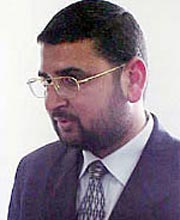
“We
will listen to Abbas, then declare our final position,” Abu
Zihri said.
|
The
summit, meanwhile, received large media coverage worldwide, with some
going as far as describing it as an important step on the way to
peace, and others downplaying its significance as a mere “fragile
ceasefire” that does not have bigger chances of success than
previous short-lived ones.
According
to Indo-Asian News Service (IANS) Web site, analysts were not sure if
the summit would usher in real progress on the Middle East peace
process after more than four years of bloodshed.
“There
are many who are not fully convinced of peace hope and history seems
to hold against optimism as numerous agreements fell through in the
past,” the Web site said, reminding of a similar event in June 2003,
when US President George W. Bush, flanked by Sharon and Abbas (then
Palestinian Prime Minister) in Jordan, launched the roadmap.
The
then dubbed “peace summit” fell apart only a couple of months
later when Israel assassinated a
top Hamas political leader,
Ismael Abu Shanab.
“It
is just a meeting and it is just a beginning,” IANS quoted Saber
Rabie, a political professor at Cairo University, as saying, on the
Sharm El-Shaikh summit.
“Those
who try to depict a rosy picture should bear in mind that a ceasefire
is only one of many tough issues the two sides should deal with,
actually the least difficult one.”
Following
the summit, political analysts, observers and Palestinian resistance
factions warned Sharon’s ceasefire pledge was not clear enough,
leaving the door open to problems that may lead to a fresh flare up in
confrontations.
“The
main issues of concern to Palestinians were not even mentioned. There
was no clear pledges on (releasing) all Palestinian detainees in
Israeli jails, no word on (Israeli) withdrawal, stopping of
settlements or dismantling the separation wall,” Palestinian MP and
former negotiator Hanan Ashrawy, told Al-Jazeera Tuesday.
Palestinian
negotiator, Saeb Erekat, himself acknowledged the two sides had
different opinions on several major issues that would surely pop up in
any negotiations for a comprehensive peace deal, including the status
of East Jerusalem, the border issue, settlements and the refugees.
“We've
got a really tough road ahead. We can't pin too much hope on the
summit.”
Analysts
told IANS that with a ceasefire declared, both sides have a lot of
concrete work to do to shore up the agreement.
Media
Reactions
Famous
British writer, Robert Fisk, was more blunt in touching on what really
happened in Sharm El-Shaikh though.
Under
the title, “There will be no Middle East Peace without Justice”,
he touched on a core issue that no one at the summit seemed to pay
attention to. “At no point yesterday did anyone mention occupation.
Like sex, it had to be censored out,” Fisk wrote in the
Independent.
Another
article, also in the Independent, touched on what Sharon should do to
help turn “the fragile truce” into a real push for more concrete
steps along the thorny path for peace.
“Abbas,
facing internal political challenges, needs more than that (Appointing
a US security coordinator). First, he needs the “confidence building
measures” that Sharon spoke of to have an impact on the lives of
Palestinians. That may mean Israel relenting on its determination not
to release some long-serving prisoners "with blood on their
hands", according to the daily.
“It
will certainly mean the dismantling of checkpoints and closures, which
bring economic and social misery. But equally it will mean the
maintenance of political momentum. And here there was little
encouragement for Mr Abbas this week.
“Based
on its inclusion in phase one of the road map, the Palestinians see
the issue of "dismantling the terrorist infrastructure" and
disarming the factions as linked to, and facilitated by, a political
process. The more the Palestinian state begins to take shape on the
horizon, the easier it will be to fulfill that obligation. The subtext
of Mr Sharon's approach is that it is a precondition of the road-map
process starting.
“The
contradiction in the US position appears to be this: Ms Rice and
President Bush genuinely want Mr Abbas, and the road map, to succeed.
Whether in a Freudian slip or not, Ms Rice seemed to contrast the
positions of Sharon and Abbas when she said on Monday "we
know" that the Palestinians accept the road map and that Mr
Sharon "has said" that he does so.
“But
at the same time the US also shows little sign of wanting to undermine
the belief of many around Mr Sharon that "final status"
issues can be put off perhaps for years. That could deprive Mr
Abbas of the very momentum he needs.”
Read
Also…
|