RIYADH,
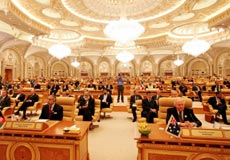
February 9 (IslamOnline.net & News Agencies) – An anti-terror
conference hosted by Saudi Arabia wrapped up its proceedings, with
support for a Saudi proposal to set up an international center to
combat terror.
The
conference, however, asserted that the United Nations is the major
forum to promote international cooperation against terrorism, in a
clear counter to the unilateral US terror-combat policies.
“A
task force has been established to further elaborate this proposal,”
read the closing “Riyadh Declaration”, according to Agence France
Presse (AFP) Tuesday, February 8.
On
Saturday, February 5, Saudi Crown Prince Abdullah bin Abdul Aziz
opened the conference with a call for establishing a global center to
combat and preempt terrorism.
The
center, due to be hosted by Switzerland, aims at promoting exchange of
intelligence and security information on terror-combat.
Saudi
Interior Minister Prince Nayef bin Abdul Aziz said the center could be
an institute for research, training and sharing of expertise.
“There
are various ways. It could be more of a think-tank, doing research
papers, or more of an operational real-time thing,” US State
Department official William Pope told Reuters Tuesday.
US
and British delegates, however, said the proposed center could not
replace bilateral exchange of intelligence and security cooperation.
A
recent report by the Washington-based Center for Strategic and
International Studies said Saudi Arabia's counter-terrorism efforts
were being hampered by the weakness of its main foreign intelligence
service.
The
four-day event was attended by representatives from some 50 countries
and international organizations.
Important
Message
The
conference was hailed by western delegates as an important wider
message that Saudi Arabia was serious about fighting terrorism at home
and enhancing international cooperation, Reuters said.
“The
main thing is that Saudi Arabia, which was considered since 9/11 as
perhaps the home country of a certain kind of terrorism, is not only
taking measures inside the country but playing an important role
internationally to fight it,” a European official said.
The
same message was echoed by US, European and Russian officials who said
that Saudi Arabia was serious about measures like stopping the abuse
of Islamic charities for international “terrorist” funding.
“One
mustn’t be naive, you can’t cut that off at a stroke,” said
Anatoly Safonov, special representative on terrorism for Russian
President Vladimir Putin.
“But
we see there is understanding, there is the political will to fight
this, and there's no doubt there are already initial results.”
Cooperation
The
final communiqué stressed the UN should be the major forum to enhance
international cooperation on combating terror, urging all countries to
comply with relevant UN resolutions and implement the 12 major
conventions on terror-combat.
“Any
international effort will not be sufficient to effectively combat the
terrorism phenomenon if not conducted within the framework of joint
actions and an all-inclusive strategic vision,” the declaration
said.
It
also called for promoting inter-agency cooperation and coordination on
national, bilateral and regional levels to combat terrorism, money
laundering, weapons and explosives trafficking and drug smuggling.
The
communiqué further stressed the fact that terrorism has no specific
religion, ethnic origin, nationality, or geographic location.
“In
this respect, it is of paramount importance to stress that any attempt
to associate terrorism with any given faith will in actual fact serve
the interests of terrorists; it should be rejected wholeheartedly.”
The
participants further encouraged individual efforts to expand political
participation, achieve sustainable development, and promote the role
of civil institutions to help address the conditions that spawn
violence and extremist thinking.
Since
May 2003, Saudi Arabia has been battling a wave of militant attacks by
presumed Al-Qaeda militants who have killed more than 100 people and
wounded hundreds in a spate of bombings and shootings.
Security
forces have killed or arrested most of the network’s top leaders,
but analysts say the movement will remain a threat in the world’s
biggest oil exporter for years.
Seized
Assets
The
conference also called for developing the UN mechanisms to help the
non-profit charities enhance their relief role and prevent using their
funds in illegal activities.
It
also urged to draw up the best means to use the money seized from
“terrorists”.
“Countries
were encouraged to set up domestic bodies” to deal with seized
terrorists’ money, said the communiqué.
Saudi
Arabia has proposed setting up an international fund from seized
assets to help victims of “terrorist attacks” but the proposal was
dropped by the conference, according to Arab news.
“That
did not go through,” a delegate participating in the conference said
on condition of anonymity.
Saudi
Arabia has tightened financial regulations to stem the flow of money
from wealthy Saudis to militants -- although Western officials say
more could still be done.
However,
Saudi charities suffered the brunt of the new measures.