|
Two Attacks in Cairo Target Tourists
 |
|
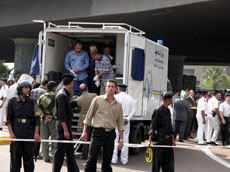
Egyptian
police seen in the scene of the first bomb near the Egyptian
Museum.
|
Additional
Reporting by Hamdy Al-Husseini, IOL Staff
CAIRO,
April 30, 2005 (IslamOnline.net & News Agencies) – Cairo
Saturday, April 30, was the scene of a bombing attack and a shootout
apparently targeting tourists, killing three persons and wounding
seven others, including four foreigners.
The
first bombing took place near the Egyptian Museum in central Cairo at
Gen. Abdul Munem Riyadh Square, killing one man and injuring seven
others including four tourists.
Health
Minister Dr. Mohammad Awad Taggudin told state-run Nile News channel
that the injured are three Egyptians, two Israelis, a Swede and an
Italian.
He
added injured Egyptians were rushed to Al-Munira public hospital,
where the foreigners were taken to Kasr El-Eini hospital. Three
foreigners were slightly wounded and the fourth was in serious
condition.
On
the kind of bomb used in the attack, the minister said that the
Interior Ministry will issue later in the day a statement on the
grisly incident.
Two
Versions
Security
sources initially said that someone may have thrown a bomb from a
nearby bridge, directly hitting a bystander and other tourists.
They
later said that a man called Ibrahim Yousri blew himself up at the
back of the museum, Reuters said.
The
dead man’s body was lying on the pavement near a bridge across the
Nile and his head was in pieces, panicked witnesses told IOL.
IOL
correspondent on the scene said that a powerful explosion was heard in
Abdul Munem Riyadh Square and ambulances rushed to the scene of the
blast.
He
added the place has not been crowded as usual but regularly frequented
by tourists, noting that a police cordon was thrown up around the site
and traffic movement has come to a standstill.
The
Egyptian Museum has the world’s largest collection of Egyptian
antiquities from the time of the Pharaohs and is a popular tourist
destination. But the bomb exploded at the back of the museum, some
distance from the entrance.
Second
Attack
In
the district of Al-Saida Eisha in Old Cairo, Egyptian police further
said that they killed two women after they opened fire on a tourist
bus.
Earlier
police reports said two people had died in what was thought to be an
explosion near the bus, reported Agence France-Presse (AFP).
There
were no immediate reports on the identities of the women.
Al-Jazeera
television previously reported that two explosives-laden young women
attempted to get on a tourist bus and blew themselves up when they
were unable to.
On
April 7, a man killed himself and three tourists when the bomb he was
carrying exploded among a group of tourists in the historical Al-Azhar
district downtown Cairo, killing two French citizens, a US national
and the bomber.
Egyptian
authorities have arrested at least nine people in connection with the
attack on the Khan El-Khalili market.
That
bombing was the first against foreign targets in Cairo in more than
seven years. Afterwards, authorities beefed up security around the
country's main tourists attractions and embassies urged their citizens
to keep a low profile.
Last
October, at least 34 people, including several Israeli tourists, were
killed in triple bomb attacks on the Hilton hotel Taba and two nearby
resorts in the Sinai Peninsula. More than 10 were wounded.
Revenge
Sources
told Al-Jazeera that the museum’s incident may have come to avenge
the death in an Egyptian custody of the cousin of an Egyptian wanted
in connection with Khan El-Khalili bombing.
Mohammad
Suleiman Youssef, 40, was the cousin of Ashraf Said Youssef,
identified by the Interior Ministry as the fugitive who recruited the
bomber who blew himself up in the Islamic district.
A
police source, who asked not to be named, told Reuters that police
sent the man’s body back to his village north of Cairo for burial.
The
man was a primary school teacher in the northern Cairo suburb of
Shubra El-Khaima, where the bomber also lived.
Friends
of the man went to the village to pay condolences to his family but
found no one at home, one friend told Reuters.
Two
of the dead man’s brothers are also in custody, he added.
The
circumstances of Youssef’s death were unclear and a spokesman at the
Interior Ministry told Reuters he had no information about the case.
The
government-financed Supreme Council for Human Rights said in its first
annual report this month that at least nine Egyptians died in
detention during 2004 and that torture was commonplace in Egyptian
detention facilities.
|