|
Iraqis Suffer “Tragic” Conditions: UN Report
 |
|
“The survey, in a nutshell, depicts a rather tragic situation of the quality of life in Iraq,” said Saleh.
|
BAGHDAD,
May 12, 2005 (IslamOnline.net & News Agencies) - The Iraqi people
are suffering from a desperate lack of jobs, housing, health care and
electricity, according to a report prepared by the Iraqi authorities
and the UN and released on Thursday, May 12.
“The
survey, in a nutshell, depicts a rather tragic situation of the
quality of life in Iraq,” Planning Minister Barham Saleh during a
ceremony in Baghdad attended by UN Secretary General Kofi Annan's
deputy representative in Iraq Staffan de Mistura, reported Agence
France-Presse (AFP).
The
370-page report, entitled “Iraq Living Conditions Survey 2004”,
was conducted over the past year on a representative sample of 22,000
families representing a total of 150,000 inhabitants in all of Iraq's
18 provinces.
Eighty-five
percent of Iraqi households lacked stable electricity when the survey
was carried out. Only 54 percent had access to clean water and 37
percent to sewage.
“If
you compare this to the situation in the 1980s, you will see a major
deterioration of the situation,” said Saleh, pointing out that 75
percent of households had clean water two decades ago.
The
survey put the unemployment figure at 18.4 percent, but the minister
explained that “under-employment” topped 50 percent.
He
stressed that the survey “shows a contrast between the potential of
Iraq, with all the human and natural resources that we have, and the
unfortunate lack of development and lack of quality of life we are
suffering from”.
Bleak
Picture
 |
|
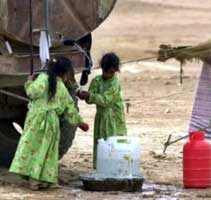
The report said only 54 percent of Iraqis had access to clean water.
|
The
report also stressed that Iraq is lagging behind on two of the United
Nations' millennium goals, which are to eradicate poverty and hunger
and to reduce child mortality.
The
survey said that 23 percent of Iraqi children suffer from chronic
malnutrition.
A
recent study by Iraq's health ministry in tandem with Norway's
Institute for Applied International Studies and the UN Development
Program (UNDP) said children are paying the silent
cost of the US-led occupation with malnutrition rates
exceeding by far those in the world’s poorest and disease-plagued
countries.
Acute
malnutrition among Iraqi children has nearly doubled since the US
invaded the country 20 months ago, added the report.
The
new report stressed that despite a relative abundance of skilled
doctors and nurses, health is another area of concern.
It
cited antiquated equipment, a shortage of medicine and a health system
suffering from the wider infrastructure problems.
The
British medical charity, Medact, reported last year that the US-led
war on Iraq has caused a public health disaster that has left the
country's medical system in
tatters and increased the risk of disease and death.
It
added that cases of vaccine-preventable diseases were rising and
relief and reconstruction work had been mismanaged.
The
new report further regretted that the Iraqi education system is no
longer among the best in the region.
It
stressed that “wars, sanctions, and harsh economic conditions have
taken a toll on the educational system”.
Unsafe
In
another development, the International Monetary Fund said Iraq is too
dangerous a place to open an office.
IMF
spokesman Thomas Dawson told reporters “the security situation has
made it impossible in terms of visiting and reestablishing a funds
presence in Iraq.”
But
he added that the IMF “remains in contact with the transitional
government and various technical counterparts to review the 2004
record as well as prospects for 2005.”
The
IMF is also making preparations to carry out the first regular annual
review of the Iraqi economy for 25 years, Dawson added.
“And
if all goes well we are looking into starting negotiations on a stand
by (loan) in the late summer with the possibility to having the
arrangement towards the end of this year.”
|