|
Iran Says May Delay Nuclear Activities
 |
|
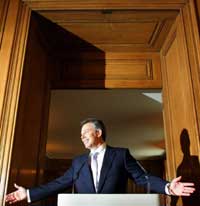
Blair said the consequences would entail supporting “referral to the UN Security Council”. (Reuters)
|
TEHRAN,
May 13 (IslamOnline.net & News Agencies) – Iran said Friday, May
13, that it could delay the resumption of some of its nuclear
activities after Europe threatened to join Washington in seeking UN
Security Council action if Tehran makes good on its threats to resume
atomic work.
However,
Iranian officials insisted that Iran would never abandon its nuclear
program.
“It
is possible that this resumption is delayed for a while,” Gholam
Reza Aghazadeh, a vice president and head of Iran’s Atomic Energy
Organization, was quoted by Agence France-Presse (AFP) as saying.
Aghazadeh
nevertheless said that a resumption of certain nuclear activities tied
to the conversion of uranium ore was “certain”, but did not give
any date.
Contacted
by telephone, Iranian nuclear negotiator Cyrus Nasseri told AFP
negotiations at the Vienna headquarters of the International Atomic
Energy Agency (IAEA) were continuing.
A
spokesman for Iran’s Supreme National Security Council, the body
charged with handling nuclear diplomacy, said Iran still wished to
officially inform the IAEA that it was backing away from its freeze of
uranium enrichment-related activities.
“Iran
is determined to submit to the IAEA a letter that concerns a
resumption of a part of our suspended activities,” the spokesman,
Ali Agha Mohammadi, was quoted as saying.
Mohammadi
also said Iran was giving Britain, France and Germany -- with whom the
suspension was agreed in November 2004 -- until the end of the day to
“change their position”, demanding Iran abandon fuel cycle work
altogether.
“Iran’s
rights cannot be trampled on... because of the threats of three
countries and a big power,” he said, referring to the EU-3 and the
United States.
European
Pressure
 |
|
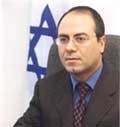
Shalom claimed that Iran will have the technological know-how within six to nine months to build a nuclear bomb.
|
Iran
warned Thursday that it could “momentarily” resume conversion work
at Isfahan.
But
in a letter to Tehran Thursday, Britain, France and Germany warned
that any violation of their accord under which Iran froze its
sensitive fuel cycle work -- the focus of suspicions of a nuclear
weapons drive -- would have “consequences” for the country.
Britain’s
Prime Minister Tony Blair said that would entail supporting
“referral to the UN Security Council if Iran breaches its
undertakings and obligations”.
The
contents of the letter reflected a tougher strategy by the Europeans,
who are moving closer to the Bush administration’s position,
according to the Washington Post Friday.
US
officials told the daily they welcomed the letter, while avoiding
language that could inflame tensions.
“The
Security Council always remains an option should the Iranians not live
up to their obligations, but we are still hopeful that they will
recognize where they are,” Secretary of State Condoleezza Rice said
in congressional testimony Thursday.
Away
from cameras, US officials began mapping scenarios for a possible
emergency session of the International Atomic Energy Agency next week,
according to the US daily.
A
US official involved in the policymaking, speaking to the Post
on condition of anonymity, said the administration wants to have a
strategy in place when British Foreign Secretary Jack Straw arrives in
Washington for talks Tuesday, May 17.
The
IAEA meeting will take place if Iran officially informs the agency
that it plans to restart a uranium-conversion facility in the town of
Isfahan.
The
situation was enflamed after Israeli Foreign Minister Silvan Shalom
said Friday that Iran will have the technological know-how within six
to nine months to build a nuclear bomb.
Shalom
said a nuclear Iran would pose “an existential threat” to Israel
–- a close ally of the United States.
Israel,
which is widely believed to have some 200 atomic bombs, had earlier
threatened to launch a strike on a nuclear Iran.
|