|
Palestinian Parliamentary Vote Set to Be Delayed
|
|
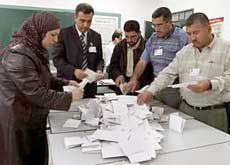
Analysts said that an election delay could give Fatah more time to prepare effectively. (Reuters)
|
By Youssef Al-Shaib, IOL
Correspondent
RAMALLAH, May 25, 2005 (IslamOnline.net)
– The Palestinian parliamentary election, set for July 17, is very
much likely to be put off over a row on a new election law, enacted
last week by parliament, between President Mahmmoud Abbas and
lawmakers, sources close to the mainstream Fatah movement told
IslamOnline.net Wednesday, May 25.
An overwhelming majority of lawmakers
rejected Abbas’s call for amending the law to allow proportional
representation so that more deputies are elected from party lists, or
semi-proportional system, a mix between the proportional and
single-seat election.
The new law is a mix between the two
electoral systems but with two-thirds for the single-vote and
one-third for the proportional representation.
The Fatah sources said that the
dispute means that Abbas, who reiterated he is determined to hold the
election on time, could send the new law back to parliament, which
indicates pushing back the election.
A further parliamentary debate on the
law and Abbas’s amendments need more time, making it impossible to
open the door for announcing candidacy on June 5 and consequently
delaying the election.
Deputy Prime Minister Nabil Shaath
Wednesday said that the election will have to be postponed because of
the legal dispute, according to Reuters.
On Monday, May 23, the independent
Election Commission, signaled an election delay as it said that it
needed at least two months from the time the new legislation is
ratified by Abbas to lay the groundwork for voting.
Serving Fatah
 |
|
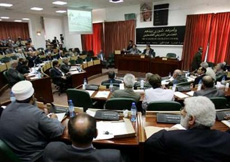
Will the coming Palestinian parliament witness Hamas MPs? (Reuters)
|
Commenting on the likely delay,
Palestinian political analyst Hani Al-Masri said the move would give
Fatah more time to prepare effectively for a cut-throat competition
with popular Hamas, which announced for the first time it would take
part in the parliamentary election.
“As far as law is concerned, there
should be a three-month period between the enactment of an election
law and the elections,” he told IOL.
He added the strong show of Hamas in
the municipal elections gave Fatah a cause for concern.
“It makes no difference for Fatah,
if it is not ready for the race, whether the election is held on time
or would be delayed for September or October, given Hamas’s
performance in the recent elections,” he said.
“Add to that, the sharp division
that surfaced after the death of president Yasser Arafat, which left
the movement chaotic and badly affected its unity,” Masri added.
“This means that Fatah could work
on delaying the election till after its sixth congress slated for
August 4.”
No Delay
Hamas, for its part, rejected any
election delay, saying it does not serve the common good.
It called in a statement for holding
the parliamentary election on time as agreed upon last February in
Cairo between the Palestinian Authority and the resistance factions.
“The election is a milestone in
Palestinian history as it would help uproot corruption and piece
together the political jigsaw,” it said.
Hamas made a very strong showing
making use of the corruption allegations marring Abbas's Fatah party
in recent municipal elections and the resistance group has demanded
the vote be held on time and would likely complain bitterly about any
delay.
Tens of thousands of Hamas supporters
demonstrated in the Gaza Strip Monday, May 23, against a court ruling
that overturned some of Hamas's crucial victories there in the second
phase of the municipal elections.
The ruling prompted the resistance
movement to mull boycotting the run-off the election and rethink its
decision to join the Palestinian political mainstream in general.
In the first phase of the municipal
elections in January, Hamas secured a landslide victory. Of the 118
seats on 10 councils, Hamas candidates won over 77 seats or 65 percent
against nearly 22 seats or 26 percent for Fatah.
But on the second phase held May 5,
Fatah captured about 50 of 84 councils in Gaza and the West Bank while
Hamas won around 30, including the Gaza border city of Rafah and the
West Bank town of Qalqilya.
|