|
Economy Tops Iranian President’s Agenda: Expert
 |
|
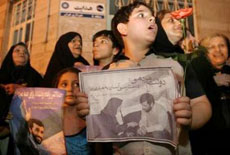
Ahmadinejad
appeared closer to the Iranian people as one of them who feels
their problems, said the expert. (Reuters)
|
By
Khaled Mamdouh, IOL Staff
CAIRO,
June 27, 2005 (IslamOnline.net) – Economy will top the priorities of
Iranian President-elect Mahmoud Ahmadinejad, who will be pragmatic in
dealing with Iranian-US relations and will seek to refute
misconceptions, especially in the western media, about his
"extremist" leanings, said an expert in Iranian affairs.
"I
expect the economic file to be the first interest of Ahmadinejad’s
government, where he will seek to push the wheel of national economy
through reforming the administrative apparatus to battle
corruption," Mohammad Al-Said Abdul Moamin, professor of Iranian
studies at Egypt's Ain Shams University, told IslamOnline.net's
visitors in a live dialogue Sunday, June 26.
He
cited Ahmadinejad’s career as mayor of Tehran and the dramatic
changes and new look he gave the capital, which earned him the love
and respect of the locals.
In
the run-up to Iran’s fiercest presidential battle ever,
Ahmadinejad's camp played on the frustration expressed by the vast
majority of poor and underprivileged Iranians and their needs.
"I
vote for Ahmadinejad because he wants to cut the hands of those who
are stealing the national wealth and he wants to fight poverty,"
Rahmatollah Izadpanah, 41, said on elections day.
On
Sunday, Ahmadinejad told his first news conference since winning the
Friday's presidential elections that his government will be one of
"justice and fairness, in the service of the people... whatever
views they have".
Ahmadinejad
has trounced former president Akbar Hashemi Rafsanjani in Friday's
run-off with 61.69 percent of the vote.
The
election has been seen as the most critical since the 1979 Islamic
revolution and he will become the first non-cleric president of the
Islamic republic.
Moderate
Politician
 |
|
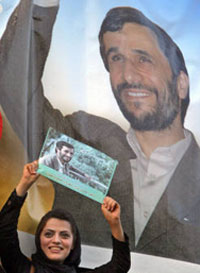
An
Iranian young woman holds up a campaign poster for Ahmadinejad.
(Reuters)
|
On
thorny political issues, especially Iran-US relations and the nuclear
file, Abdul Moamin believes Ahmadinejad was completely sold wrong in
the media.
"As
regards politics in general, the man is the exact opposite of what the
media said about him. He is neither extremist nor narrow-minded."
The
Egyptian expert maintains that the 49-year-old president-elect
"is most likely to take a moderate approach in his relations with
neighbors, to enhance ties with Muslim countries, especially Arab
ones."
He
cited Ahmadinejad campaign to rename a Tehran street named after the
assassin of late Egyptian president Anwar Sadat.
He
championed naming the street "Intifada", in solidarity with
the Palestinian people's struggle against the Israeli occupation.
"That
was done while he was Tehran’s mayor as a friendly gesture to
Egypt."
The
controversial street issue is one of the stumbling blocks to
normalized ties between the two heavyweight Muslim countries.
Abdul
Moamin further expected Ahmadinejad to adopt a policy of enforcing
relations with Arab states, citing his belief that Iran’s strength
is reinforced by good relations with the Muslim world.
Domestic
Agenda
On
the role played by the media, in general, and western media in
particular, in adversely helping to bring someone branded as
“hardliner” to the helm of power in Iran, the Egyptian expert said
pressures from the US and Europe may have helped Ahmadinejad, but his
success is mainly attributed to internal reasons.
"The
western media was not objective in covering the elections. They
actually took a stand provocative to the Iranian which pushed the
Iranians closer to Ahmadinejad and away from so-called reformists –
portrayed as seeking relations with the west at any cost."
Ahmadinejad,
on the other hand, appeared closer to the Iranian people as one of
them who feels and understands their problems, Abdul Moamin said.
"The
media focused on simple issues like women playing football or not or
sex segregation in public, trying to complete the image of a
hardliner. He, on the other hand, focused on the problems of the
people, promising revolutionary solutions to such problems."
Ahmadinejad
promised the Iranian people Sunday a government of "peace and
moderation".
He
stressed that "no extremism will be acceptable in popular
government".
US
& Nukes
On
Iran-US relations, Abdul Moamin did not expect Ahmadinejad to be a
stumbling block before such relations, provided that dialogue respects
the will of the Iranian public.
"It’s
not expected for him to block the Iranian-US dialogue. But apparently
he has set up conditions acceptable to the Iranian people, for such
process to succeed. Achieving Iran’s interests, not just those of
Washington, comes first and foremost. This means establishing balanced
relations, based on equality."
Ahmadinejad
told reporters Sunday that Iran "is on a path of progress and
elevation, and does not really need the United States on this
path".
But
he added: "We can work with any country in the world that does
not show animosity to Iran."
Moumin
also did not expect dramatic changes to the thorny issue of Iran’s
nuclear program.
"The
nuclear file and foreign policy in Iran largely fall within the
authority of the supreme leader of the Islamic republic and its
national security council," he said.
The
new president-elect reiterated Sunday his country's right to nuclear
technology for peaceful purposes.
"Today
we can say that nuclear technology is our right, to be used for
peaceful purposes," he said.
"We
need this technology for energy and medical purposes. We shall carry
on with it."
Ahmadinejad
also underlined that it was in the country's interest to continue
talks with the European Union over its nuclear program.
|